Key takeaways
- Google AI has developed a new learning algorithm that combines evolution strategy and representation learning.
- The algorithm addresses the challenges of high-dimensional sensory inputs in robotic control.
- PI-ARS can effectively train vision-based locomotion controllers for legged robots in complex environments.
- The innovation leverages predictive information to enhance the robot's understanding of its surroundings.
Evolution strategy (ES) is an optimisation technique that has been applied to multiple challenging decision-making problems, such as power system control and legged locomotion.
However, one of the major weaknesses of ES-based algorithms lies in the complexity in scaling to issues that require high-dimensional sensory inputs for encoding dynamics, such as training of robots with complex vision inputs.
To combat this challenge, researchers at Google AI have proposed a learning algorithm that combines ES and representation learning to solve high dimensional problems effectively.
The paper, ‘PI-ARS: Accelerating Evolution-Learned Visual-Locomotion with Predictive Information Representations’, says that the primary idea is to leverage predictive information in order to obtain a representation of the high-dimensional environment dynamics.
The same innovation would be applied on Augmented Random Search (ARS) – a well-known ES algorithm – transforming the learned compact representation into robot actions.
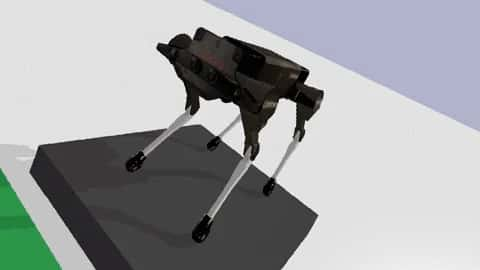
Initially, the team tested PI-ARS on the challenging issue of visual-locomotion for legged robots. The algorithm enables fast training of performant vision-based locomotion controllers and can traverse a variety of difficult environments.
Source: Overview of PI-ARS Data Flow, Google AI
The researchers then combined PI (Predictive information) with Augmented Random Search (ARS), an algorithm with excellent optimization capabilities for challenging decision-making tasks. The blog read, “At each iteration of ARS, it samples a population of perturbed controller parameters, evaluates their performance in the testing environment, and then computes a gradient that moves the controller towards the ones that performed better.”
Read the whole blog here.
Spotted an error? Tell our editors. Read our editorial standards and corrections.