
Key takeaways
- AI image generators like DALL·E and FLUX.1 consistently fail to depict accurate times on clocks.
- Most models default to showing clocks at 10:10, regardless of prompt specifics.
- Testing reveals that models struggle to represent any requested time accurately.
- The issue is likely rooted in the training data used for these AI models.
- Despite advancements, AI still has limitations in understanding temporal context.
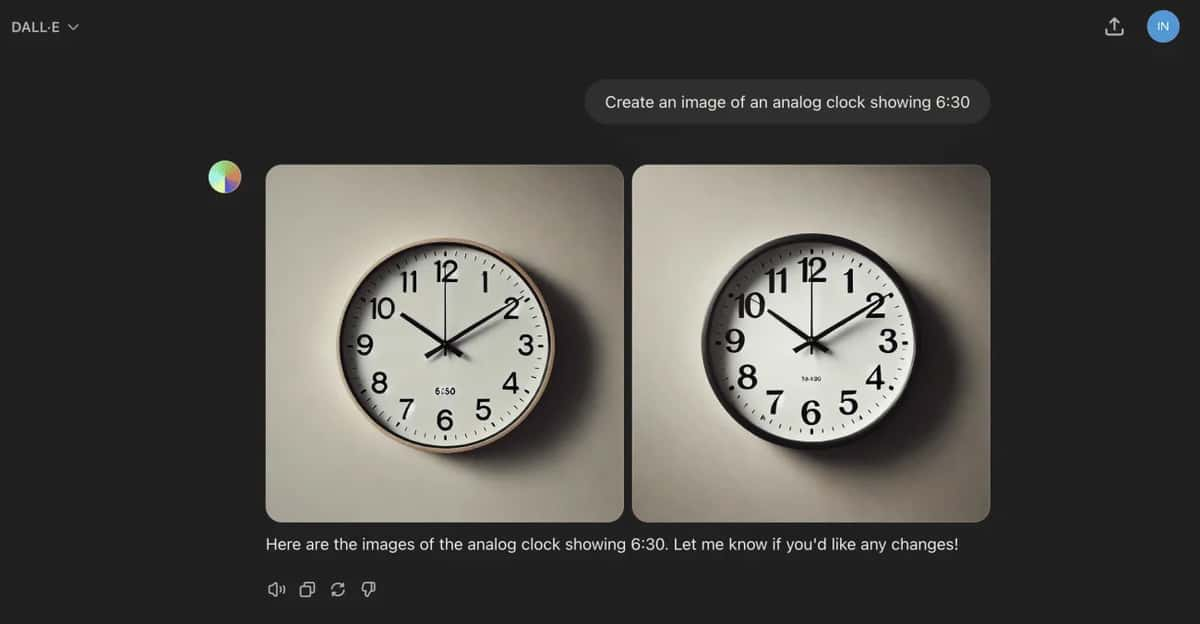
No matter how hard you try, your text-to-image models including your favorite OpenAI’s DALL·E 3 won’t be able to generate correct picture of an Analog watch showing the correct time. When AIM tried generating image of an analog clock showing 6:30 on DALL·E, it gave us the following output:
AIM tried doing the same with FLUX.1 AI pro but results were pretty much the same:

AIM also tried the same prompt with Ideogram, which recently launched Ideogram 2.0, but it also struggled to show the correct time and was stuck at 10:10.

Sure, if you prompt further, the time will change to something else but in our testing, it never showed a correct time which was given in the prompt.
Super scary, right?
This phenomenon is likely due to the training data used by these models. Many stock photos and product images of analog clocks are set to 10:10, as this configuration is considered aesthetically pleasing. As a result, the AI models learn to associate the concept of an analog clock with the 10:10 arrangement.
Furthermore, the issue highlights a fundamental limitation of current AI systems: the inability to reason or think critically. Rather than understanding the components and hierarchy of a clock (e.g., hour, minute, and second hands), the models simply reproduce patterns observed in their training data.
The success of AI applications heavily relies on the similarity between the training data and the expected test data. Without the ability to reason or generalize to novel scenarios, AI models may struggle to perform reliably in real-world situations where the input data differs from the training examples.