
Microsoft Research has announced the release of AutoGen v0.4, a redesigned library for agentic AI and multi-agent applications. This update introduces an asynchronous, event-driven architecture to address user feedback and enhance functionality, the company stated in its blog.
The new version includes features such as asynchronous messaging, modular components, improved debugging tools, and cross-language support. AutoGen v0.4 comprises three layers – core, agent chat, and first-party extensions.
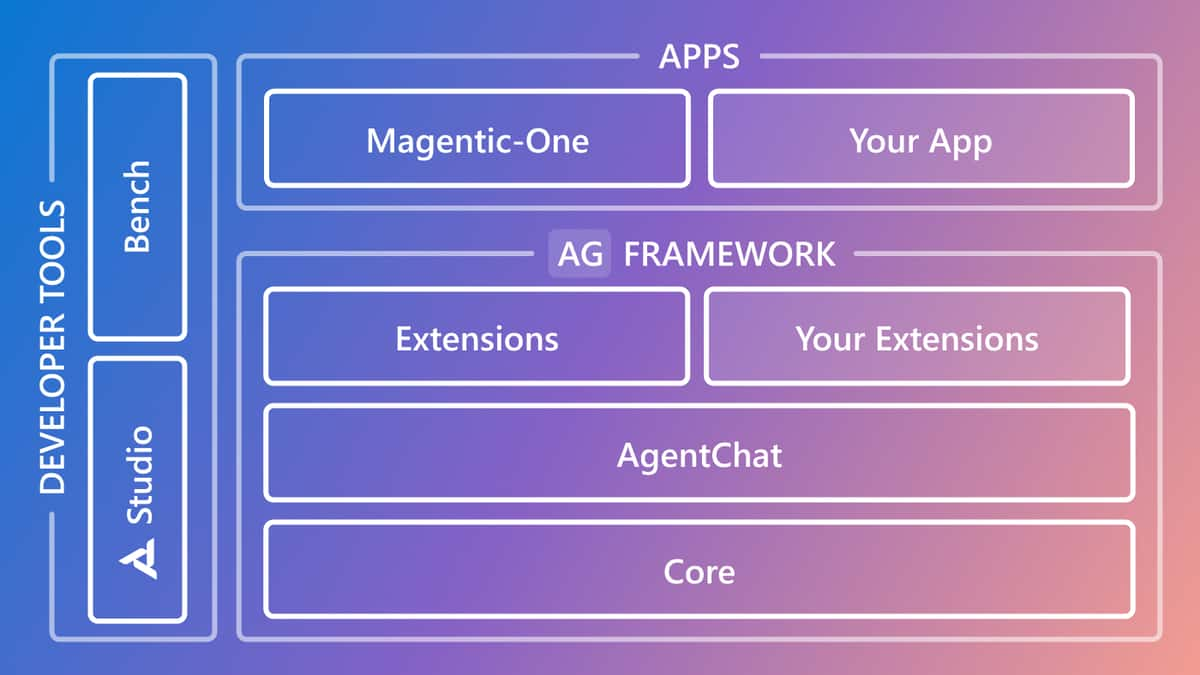
The framework introduces upgraded developer tools, including AutoGen Bench for benchmarking agents and AutoGen Studio for rapid prototyping. AutoGen Studio offers capabilities like real-time agent updates, mid-execution control, and interactive feedback.
“This low-code interface enables rapid prototyping of AI agents,” the blog explained while talking about AutoGen Studio. To facilitate migration from previous versions, the AgentChat API maintains a similar level of abstraction as v0.2. Microsoft provides a migration guide for detailed assistance.
The new architecture addresses issues identified in earlier versions, including architectural constraints and limited debugging functionality. The asynchronous approach enables flexible multi-agent collaboration patterns and improved reusability of components.
AutoGen v0.4’s modular design allows users to customise systems with pluggable components, including custom agents, tools, memory, and models. The framework also supports the creation of proactive and long-running agents using event-driven patterns.
The update highlighted improved observability and control over agent interactions and workflows. Built-in metric tracking, message tracing, and debugging tools provide monitoring capabilities, along with support for OpenTelemetry for industry-standard observability.
Cross-language support is a notable addition, which enables interoperability between agents built in different programming languages. Currently, AutoGen v0.4 supports Python and .NET, with plans to expand to additional languages in the future.
Microsoft’s roadmap for AutoGen includes releasing .NET support and introducing built-in applications for challenging domains. The company encourages user engagement through AutoGen’s Discord server and GitHub repository.
“We remain committed to the responsible development of AutoGen and its evolving capabilities,” the blog post added. The release also introduced Magentic-One, described as “a new generalist multi-agent application to solve open-ended web and file-based tasks across various domains”.
- Bihar Partners with IT Cos to Train Government School Teachers In AI
- Meta Wants $95 Billion Through Stock Sales to Fund AI Infrastructure
- Pronto Founder Enters Physical AI Space With Provision Labs
- HCLTech Taps NVIDIA Simulation Tools to Automate Software-Defined Vehicle Testing
- Tata Communications Plans $450 Mn Investment to Build 10,000 Km AI Network
- Telangana Unveils AI-Powered Digital Twin of IT Minister at DevFest 2026