Key takeaways
- NVIDIA developed HOVER, a 1.5 million parameter neural network for humanoid robot control.
- HOVER enables complex movements using minimal programming by mimicking human subconscious processes.
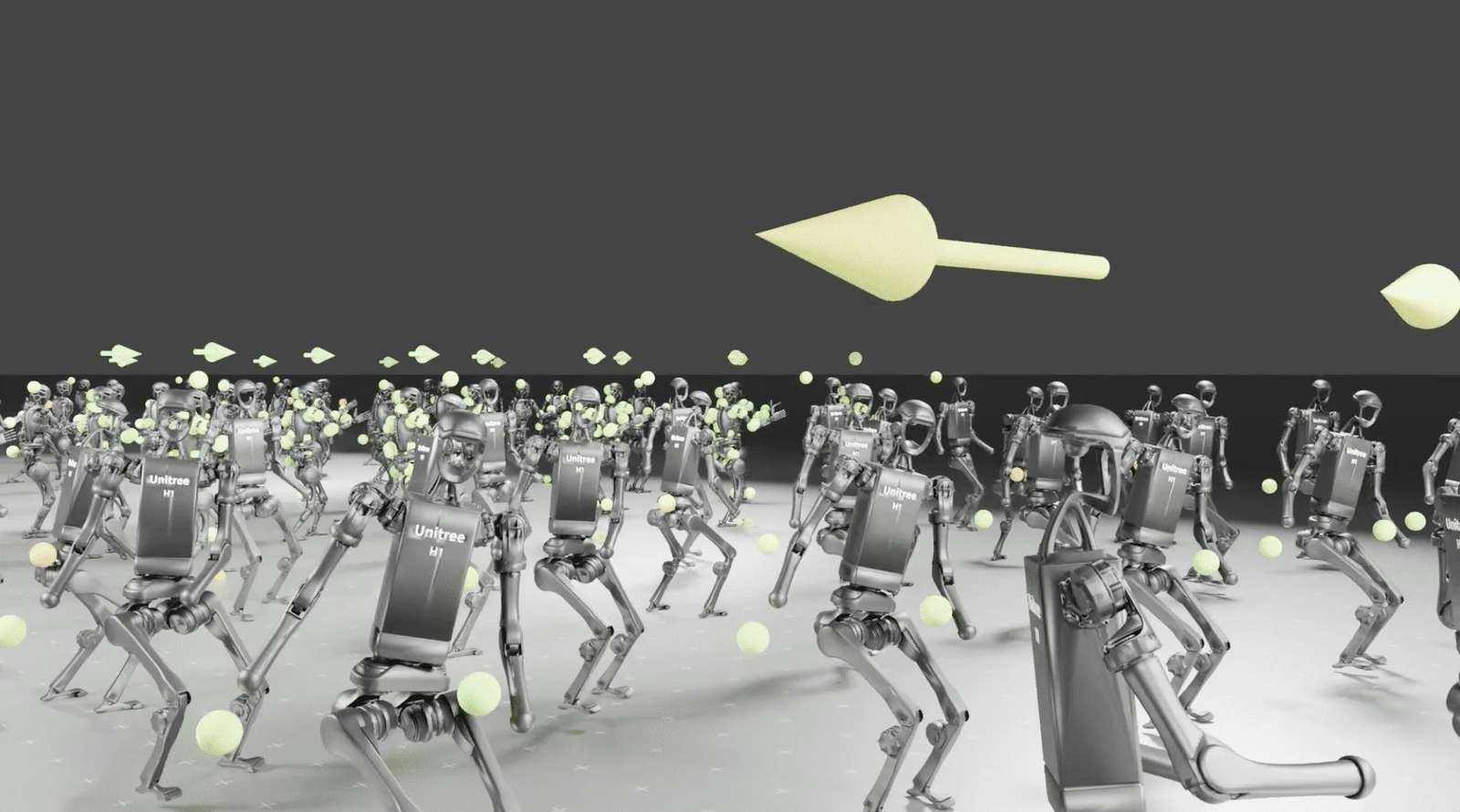
- Trained in NVIDIA Isaac, HOVER accelerates physics simulations by 10,000 times real time.
- The research team includes experts from top universities and NVIDIA's GEAR Lab.
Researchers at NVIDIA have developed HOVER (humanoid versatile controller), a 1.5 million parameter neural network designed to coordinate the motors of humanoid robots for locomotion and manipulation.
“Not every foundation model needs to be gigantic. We trained a 1.5M-parameter neural network to control the body of a humanoid robot,” said Jim Fan, senior research manager and lead of embodied AI (GEAR Lab) at NVIDIA.
Alongside the GEAR Lab, the diverse team of researchers who developed HOVER includes experts from NVIDIA, Carnegie Mellon University, University of California, Berkeley, The University of Texas at Austin, and UC San Diego.
Fan added that this model captures the subconscious processes involved in human movement, allowing robots to execute complex tasks without extensive programming. “It takes a lot of subconscious processing for us humans to walk, maintain balance, and maneuver our arms and legs into desired positions,” he explained.
HOVER was trained in NVIDIA Isaac, a GPU-powered simulation suite that accelerates physics simulations by 10,000 times faster than real time. Fan said the model underwent a year of virtual training in a simulated environment, taking only about 50 minutes of real-world time on a single GPU. He explained that this efficiency allows the neural network to transfer seamlessly to real-world applications without requiring fine-tuning.
HOVER can respond to various high-level motion instructions, including commands for head and hand poses using XR devices like the Apple Vision Pro, whole-body poses from motion capture or RGB cameras, joint angles from exoskeletons, and root velocity commands from joysticks, according to Fan
Moreover, the model provides a unified interface for controlling robots with different input devices, facilitating the collection of teleoperation data for training purposes.
It also integrates with an upstream Vision-Language-Action model to convert motion instructions into low-level motor signals at high frequency. Compatible with any humanoid that can be simulated in Isaac, HOVER enables users to easily bring their robots to life.
Earlier this year, NVIDIA also announced Project GR00T, a general-purpose foundation model for humanoid robots.
Robots powered by GR00T, short for Generalist Robot 00 Technology, are engineered to understand natural language and mimic human movements by observing actions. This allows them to quickly learn coordination, dexterity, and other skills required to navigate, adapt, and interact effectively in the real world.
Spotted an error? Tell our editors. Read our editorial standards and corrections.