
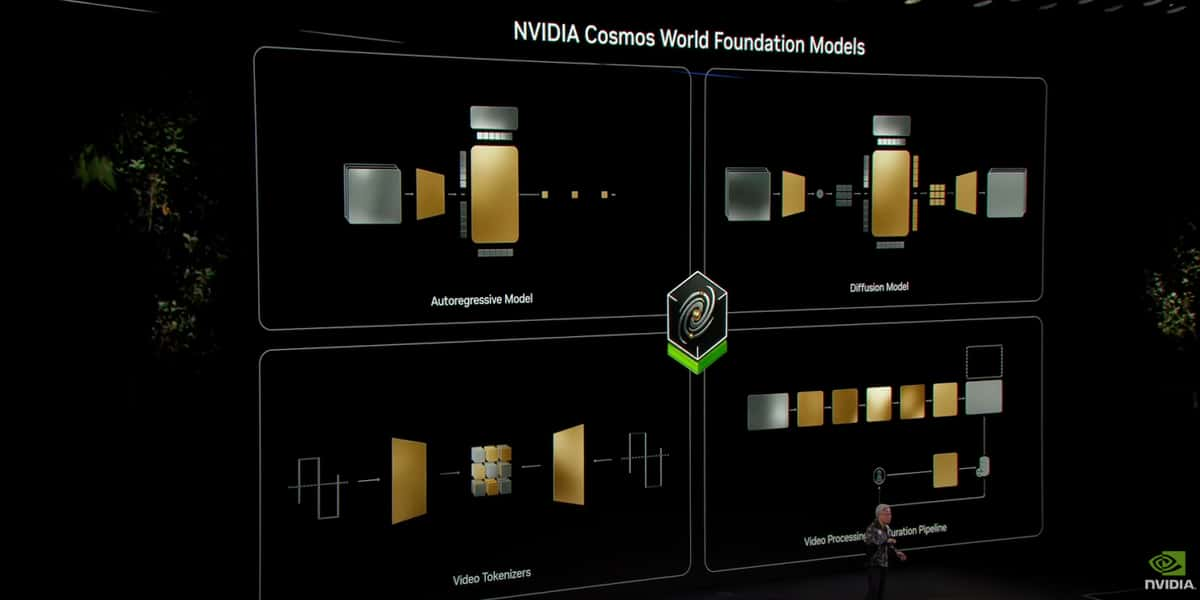
At CES 2025, NVIDIA unveiled Cosmos, a platform built to speed up the development of physical AI systems, including autonomous vehicles and robots. The platform includes generative world foundation models (WFMs), video tokenisers, guardrails, and an accelerated data processing pipeline to help developers create and refine AI models with reduced reliance on real-world data.
Cosmos is available under an open model license on Hugging Face and the NVIDIA NGC catalogue. Fully optimised NVIDIA NIM microservices will follow, with enterprise support provided through the NVIDIA AI Enterprise software platform.
Speaking at CES, NVIDIA CEO Jensen Huang said, “The ChatGPT moment for robotics is coming. Like large language models, world foundation models are fundamental to advancing robot and AV development, yet not all developers have the expertise and resources to train their own. We created Cosmos to democratise physical AI and put general robotics in reach of every developer.”
The Cosmos models can generate physics-based videos using inputs such as text, images, and sensor data, enabling their use in applications like video search, synthetic data generation, and reinforcement learning.
Developers can customise the models to simulate industrial environments, driving scenarios, and other specific use cases. NVIDIA also introduced NeMo Curator, an accelerated video processing pipeline that can process 20 million hours of video in 14 days, and Cosmos Tokeniser, a visual data compression tool.
“Data scarcity and variability are key challenges to successful learning in robot environments,” said Pras Velagapudi, chief technology officer at Agility Robotics. “Cosmos’ text-, image-, and video-to-world capabilities allow us to generate and augment scenarios for a variety of tasks that we can use to train models without needing as much expensive, real-world data capture.”
Major robotics and transportation companies, including Agile Robots, XPENG, Waabi, and Uber, have begun adopting Cosmos for their AI development.
Uber CEO Dara Khosrowshahi said, “Generative AI will power the future of mobility, requiring both rich data and very powerful compute. By working with NVIDIA, we are confident that we can help supercharge the timeline for safe and scalable autonomous driving solutions for the industry.”
In addition to Cosmos, NVIDIA introduced the Llama Nemotron large language models and Cosmos Nemotron vision language models, developed for enterprise use in sectors including healthcare, finance, and manufacturing.
- AI Productivity to Add $28 Billion to $84 Billion to India's GDP: Cognizant Study
- OpenAI's Codex Helps in Aerodynamic Engineering for Mazda
- Bengaluru Accounts for 34% of India's FDE Talent: Report
- 84% See AI Productivity Gains, but Only 10% Allow Agent Autonomy: TCS Study
- Snowflake Introduces Business Ontology, Cortex AI Gateway to Bring AI Agents Into Enterprise Workflows
- Three Members Behind Claude Code Leave Anthropic Within 10 Days