
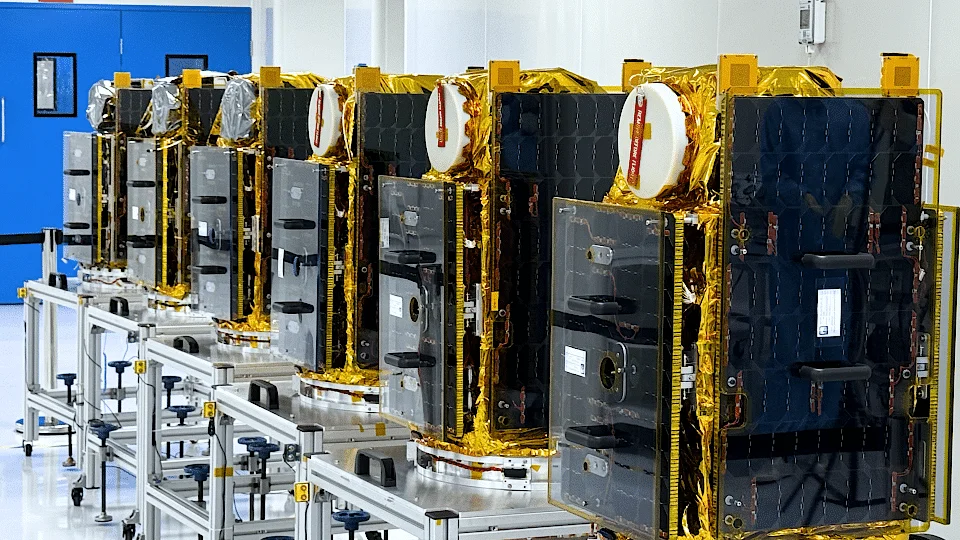
Pixxel has launched three additional Firefly satellites aboard SpaceX’s NAOS Mission on Falcon 9, expanding its commercial constellation to six. The six satellites now provide daily high-detail hyperspectral images of Earth, making it the most advanced commercial hyperspectral imaging constellation to date.
The Fireflies can capture more than 135 spectral bands at 5-metre resolution across a 40-kilometre swath. This enables the detection of environmental changes such as vegetation stress, water contamination, and mineral mapping.
“Expanding to six Fireflies will transform hyperspectral imaging from isolated snapshots into a continuous planetary memory,” said Awais Ahmed, founder and CEO of Pixxel.
Expansion Towards Planetary Monitoring
Pixxel said the Firefly expansion lays the groundwork for its upcoming Honeybee satellites, which will extend into short-wave infrared bands. Together, the two fleets are expected to deliver faster revisit times and broader spectrum coverage.
“The upcoming Honeybees are special because they will take us further into the electro-magnetic spectrum, enhancing hyperspectral capabilities and increasing the number of use cases,” said Kshitij Khandelwal, founder and CTO of Pixxel.
Pixxel’s Aurora Earth Observation platform already integrates hyperspectral data into user workflows, aiming to shift Earth observation from a reactive tool to a predictive one. By combining satellite data with AI-powered analytics, Pixxel says it can support industries, governments, and scientists in anticipating change and acting with greater foresight.
This month, the Indian National Space Promotion and Authorisation Centre (IN-SPACe) selected four homegrown startups to develop and operate India’s first fully indigenous commercial Earth Observation (EO) satellite constellation.
The consortium, led by Pixxel, which includes Piersight Space, Satsure, and Dhruva Space, will design, build, and manage the constellation of 12 EO satellites.

Your reaction
Discussion
What's your take on this story?
No comments yet — be the first to share your view.