
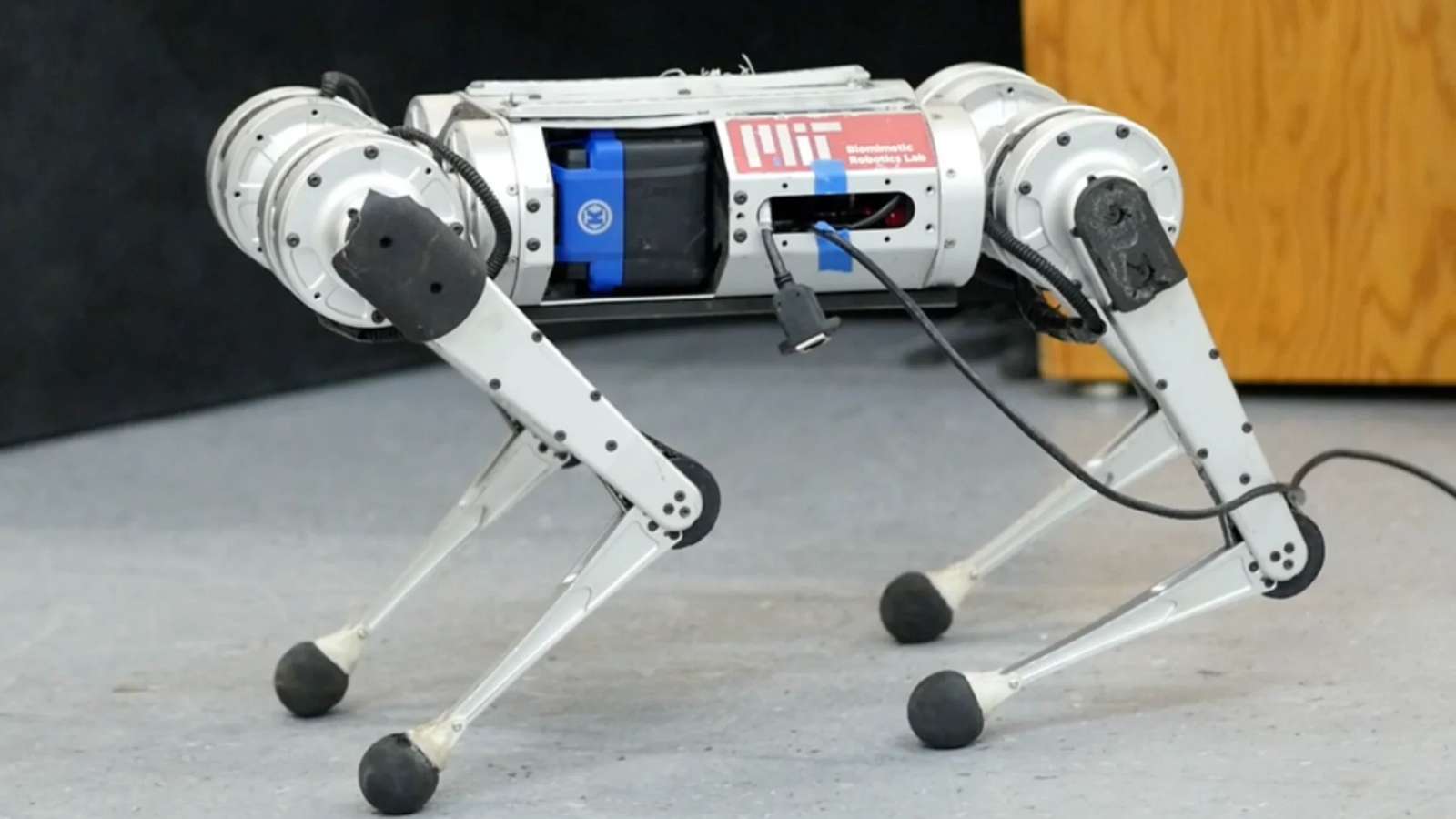
Researchers from MIT’s Improbable AI Lab (part of MIT’s CSAIL), under the aegis of MIT Assistant Professor Pulkit Agrawal, and Institute of AI and Fundamental Interactions (IAIFI) have developed a model-free reinforcement learning system while working on fast-paced strides for a robotic Mini Cheetah The cheetah has now broken the record for the fastest run recorded.
Mini Cheetah achieved a top speed of 3.9 m/s–quicker than the average human. Under the hood, the controller is fully end-to-end, converting joint encoder and IMU data directly to joint commands with no additional state estimation or control subsystems. The architecture is remarkably simple yet displays rich, diverse behaviour relative to prior works in agile locomotion.
Leveraging the simulation tools, the robot can accrue 100 days’ worth of experience on a wide range of terrains in just three hours. The robot’s behaviour improves from simulated experience. The robot has picked up skills from exposure to different terrains and the model has learned from trial and error and can be applied in a set of real-world scenarios. The adaptability comes from the self-learning model. The work was supported by DARPA Machine Common Sense Program, Naver Labs, MIT Biomimetic Robotics Lab, and the NSF AI Institute of AI and Fundamental Interactions.
- Amazon Warns Engineers Against AI Productivity Traps in Latest Memo
- Gnani AI Launches Prisma v3.0 Speech Recognition Model for 10 Languages
- Venttup Raises $3 Million To Expand Precision Manufacturing
- Articul8 Launches Bivia To Help Enterprise AI Agents Make Decisions
- NVIDIA Launches Open-Weight Transcription Model for 40 Languages
- Sarvam AI Rolls Out Indus Cowork to 2,500 Maharashtra Govt Officials