
A PhD student at the University of Strasbourg, Wassim Tenachi, has recently developed a new framework called Φ-SO that uses deep learning to uncover physical laws from data.
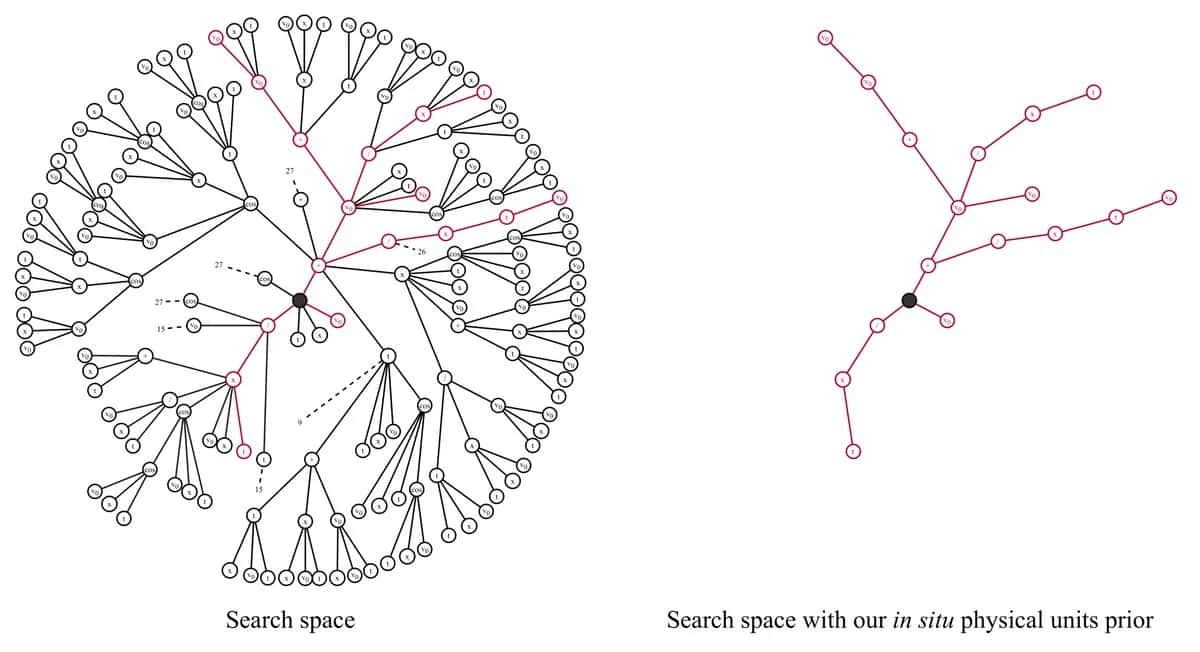
This new breakthrough offers a chance to break open the "black box" of neural networks and recover underlying equations. Unlike previous approaches, Φ-SO focuses on physics, leveraging the constraints imposed by physical units to generate vastly improved solutions.
Similar to Brenden Petersen and Mikel Landajuela’s DSR work, the system uses deep learning techniques to propose physically sound solutions that are consistent with the units associated with data. This approach leads to physically possible solutions and improves performance. The algorithm is able to fit both noiseless and noisy data, making it useful for deriving analytical properties of physical models.
The heart of the algorithm is an embedding that generates a sequence of mathematical symbols while cumulatively keeping track of their physical units. The algorithm has been applied to several test cases from astrophysics, including a search for the energy of a particle in Special Relativity, the Hubble diagram of supernovae of type Ia, and a function in galactic dynamics. In each case, the algorithm was able to generate physically sound equations that fit the data better than existing methods. For galactic dynamics, no algorithm other than Φ-SO was able to recover this equation.

This new approach has the potential to revolutionize physicists’ understanding of physical systems by discovering previously unknown physical relationships from surveys. The goal is to develop a method for connecting observational data to theory.
Future contributions to this research will allow for differential and integral operators, potentially enabling the solution of ordinary and partial differential equations with physical units constraints. Overall, Φ-SO is a powerful tool for discovering physical laws from data.
- Coforge Revenue Rises 54% as AI Engineering and Deal Bookings Gain Momentum
- Tech Mahindra Partners With SpaceXSI to Bring AI Into Software Engineering
- Infosys AI Revenue Rises 29% in Q2, FY27 Growth Guidance Cut
- LTM Launches BlueVerse Industrial AI Lab in Chennai
- Chariot Launches Speech Recognition Model for 10 Indian Languages
- Meta Expects Up To $145 Billion In Capex As AI Investments Expand