
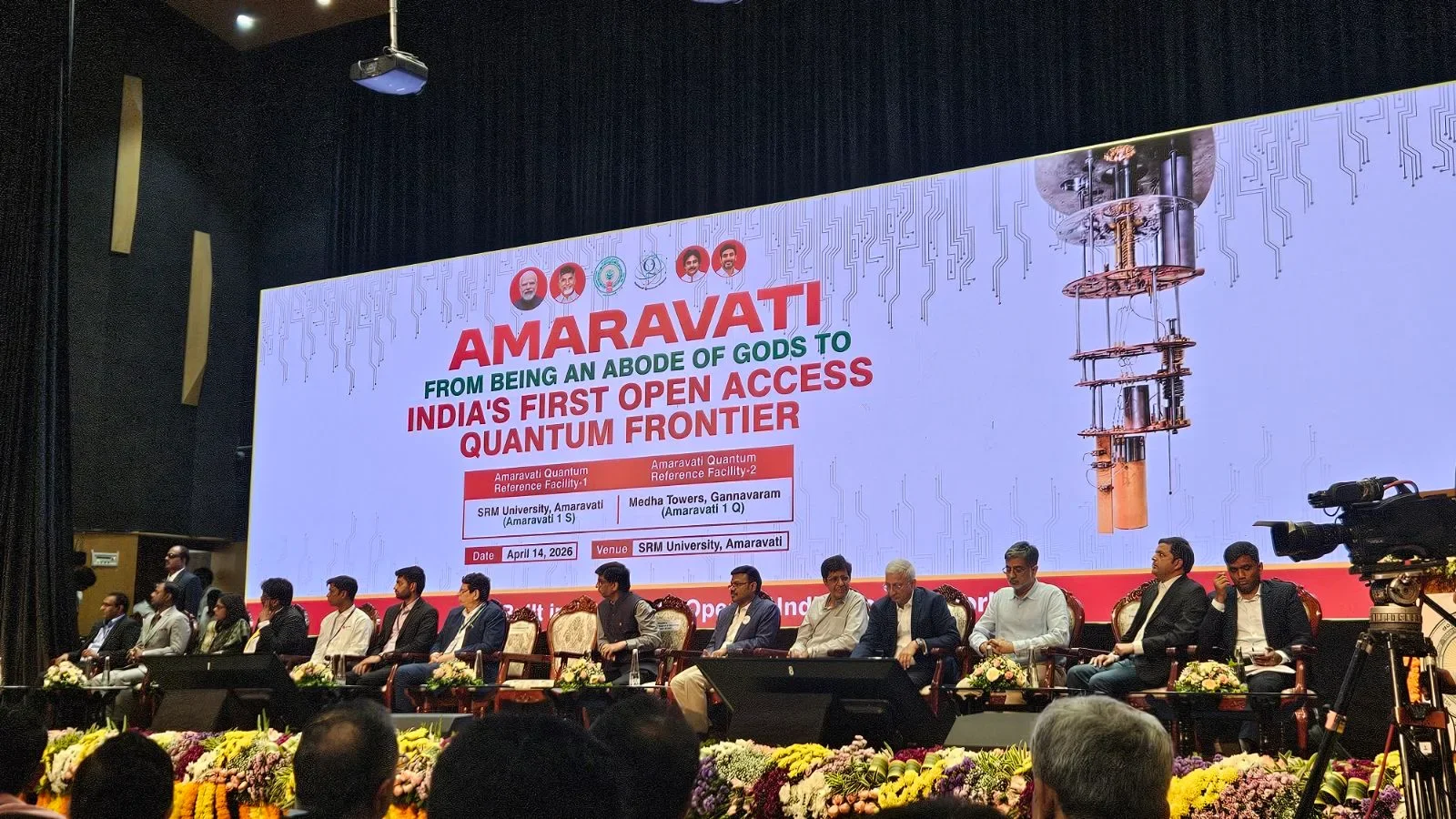
Andhra Pradesh has unveiled its most indigenous quantum computer in Amaravati, built by Qbit Force. L Venkata Subramaniam, the former India Quantum Leader for IBM, incubated Qbit Force for this mission and achieved this moat within 14 months.
Alongside this, Qubitech, another recently incubated quantum startup, has inaugurated India’s first open-access quantum characterisation (referencing) facility, QU-414.
The company announced the launch on World Quantum Day to mark not only state efforts but also the country’s efforts to build quantum hardware capabilities. The facility will support researchers, academics, government labs, and industry partners working on quantum technologies.
https://youtu.be/Br-YZ-8W_S8?si=a5m_OCH2V1PpVJbj
Qubitech owns and operates the facility, while QBit Force designed and built it. The lab offers infrastructure for superconducting qubit hardware, cryogenic electronics, material characterisation, and dilution refrigeration.
It aims to provide shared access to systems that were earlier limited to a few global labs.
QU-414 operates from room temperature to 10 millikelvin (-273°C) using dilution refrigeration. It enables prototyping and testing of quantum processors, Josephson junctions, quantum amplifiers, microwave resonators, cryogenic wiring, and high-density interconnects.
The computer takes 30 hours to cool down to room temperature after opening.
The computer's processors and amplifiers are supplied by TIFR and IISc Bengaluru. Its precision power supply is provided by IIT Delhi, while QUTE Electronics, a deep-tech startup spun off from the Inter-University Accelerator Centre (IUAC) in New Delhi, offers the precision voltage. Flex wires are manufactured at IIT Bombay, and the entire setup holds CSIR certifications.
The facility provides “end-to-end capabilities” across quantum hardware development and validation, according to a statement.
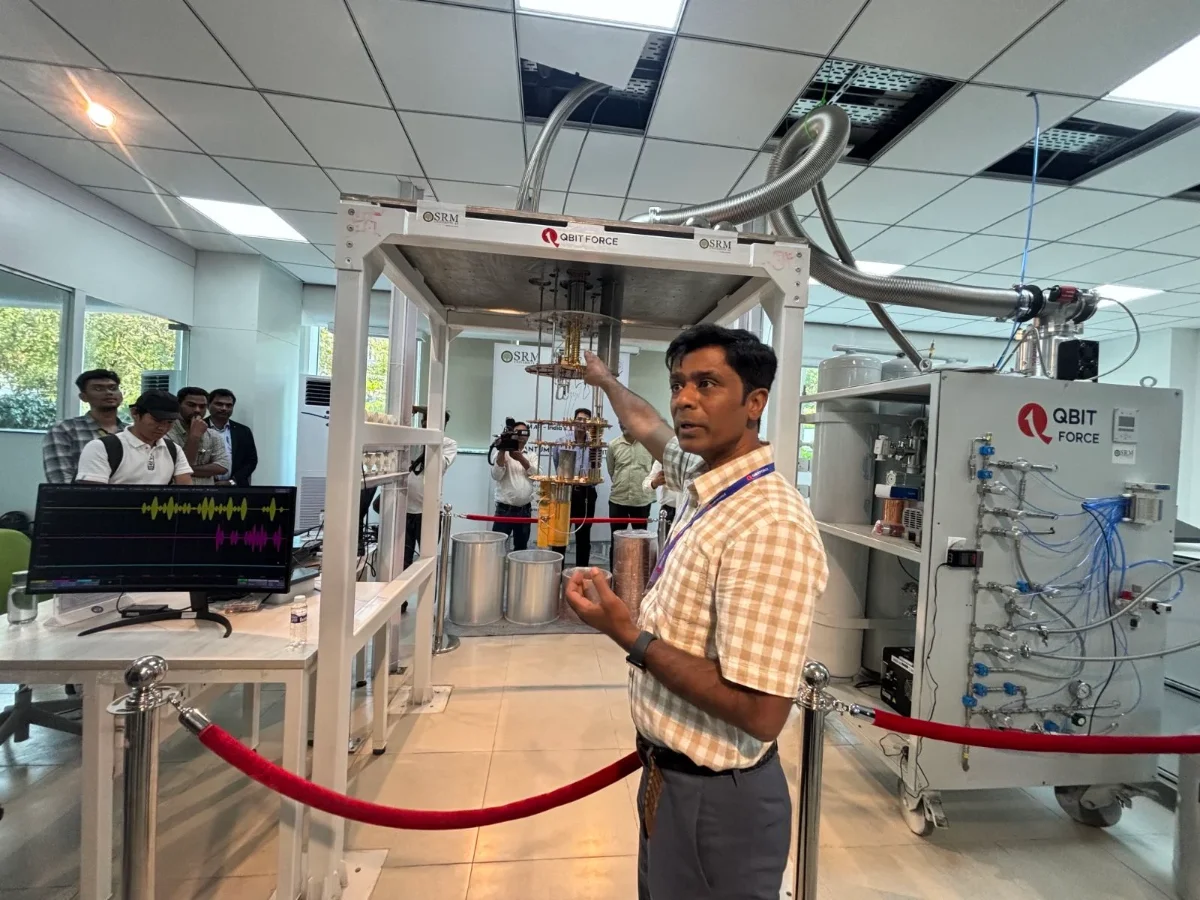
It also covers research on semiconductors, superconductors, and advanced substrates like indium phosphide and silicon germanium. Engineers can test CMOS devices, quantum sensors, and new materials such as graphene and MoS₂.
Qubitech says the facility integrates cryogenic platforms with wiring, filtering, and readout systems in low-noise conditions. It also runs a warm electronics research programme focused on FPGA-based qubit control and signal-chain engineering.
The programme aims to lower costs and simplify access to quantum research tools.
The facility will also function as a training hub. The quantum startup partnered with the Washington Institute for STEM, Entrepreneurship and Research and Amaravati Quantum Valley for this effort. The lab will offer hands-on training in cryogenic measurements, qubit characterisation, and control electronics.
“QU-414 is designed to serve as a shared national resource,” the company says. It will provide access to infrastructure that was earlier available “only at a handful of facilities worldwide.
The startup aims to support students, researchers, and industry engineers via courses and workshops. It plans to promote research, development, and education through its facility, and its mission is to create “the nation’s first indigenous quantum computer on an open-access hardware platform”.

Your reaction
Discussion
What's your take on this story?
No comments yet — be the first to share your view.