
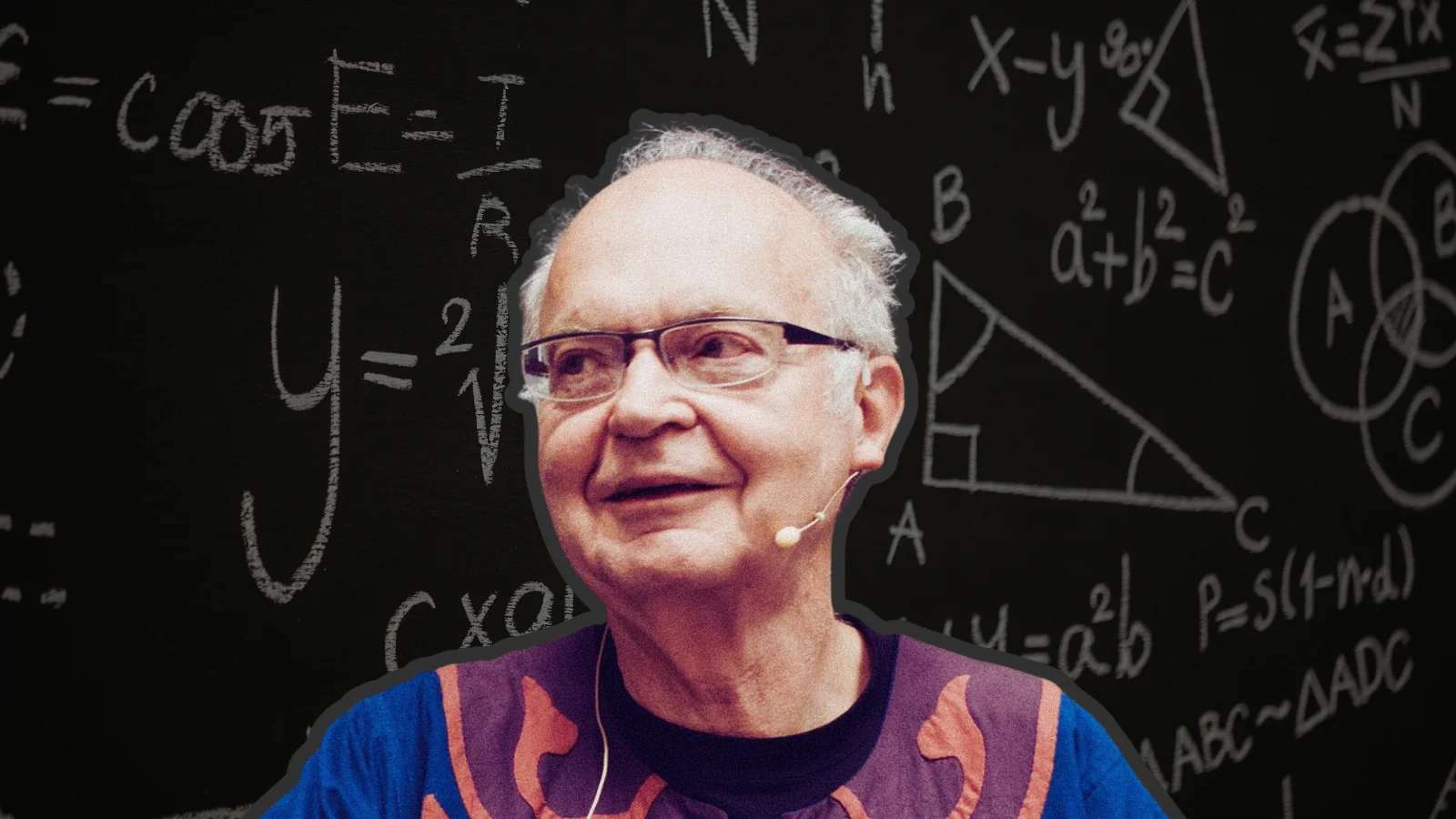
Computer scientist Donald Knuth, often regarded as the father of algorithm analysis, said in a recent note that Anthropic’s Claude Opus 4.6 has solved a mathematical problem he had been working on for several weeks.
“Shock! Shock! I learned yesterday that an open problem I’d been working on for several weeks had just been solved by Claude Opus 4.6,” Knuth wrote.
He added that the result made him reconsider his scepticism toward generative AI. “It seems that I’ll have to revise my opinions about ‘generative AI’ one of these days,” he said.
“What a joy it is to learn not only that my conjecture has a nice solution but also to celebrate this dramatic advance in automatic deduction and creative problem solving.”
The problem emerged while Knuth was preparing material for a future volume of his landmark series, The Art of Computer Programming.
In simple terms, it asked whether a certain type of mathematical network could always be split into three loops, each of which passes through every point exactly once.
Knuth had solved the smallest case, while mathematician Filip Stappers had discovered working examples for several larger ones through experimentation.
However, no general rule explaining why the pattern worked had been found.
Stappers then submitted the problem to Claude Opus 4.6 and asked the model to document its progress as it explored different approaches.
According to Knuth’s note, the model carried out dozens of experiments—writing and running small programmes, testing ideas, and gradually refining its strategy.
Eventually, Claude discovered a rule-based method that generates the required cycles. Tests showed the approach works for all odd values of the parameter tested, including cases up to 101. Knuth later verified the construction and produced a mathematical proof confirming the result.
The problem remains open for even-numbered cases. While the model reportedly found solutions for a few specific instances, it did not identify a general pattern.
Knuth described the episode as an impressive demonstration of how modern AI systems may assist in exploratory mathematics by combining coding, experimentation, and pattern discovery.
Knuth, a professor emeritus at Stanford University, received the Turing Award in 1974—often described as the Nobel Prize of computing—for his foundational contributions to algorithm analysis and for shaping the discipline through his writing.
The Art of Computer Programming series, first published in 1968, systematically catalogues algorithms, data structures, and mathematical techniques underlying modern software, and is widely considered one of the defining texts of computer science.
- AI Productivity to Add $28 Billion to $84 Billion to India's GDP: Cognizant Study
- OpenAI's Codex Helps in Aerodynamic Engineering for Mazda
- Bengaluru Accounts for 34% of India's FDE Talent: Report
- 84% See AI Productivity Gains, but Only 10% Allow Agent Autonomy: TCS Study
- Snowflake Introduces Business Ontology, Cortex AI Gateway to Bring AI Agents Into Enterprise Workflows
- Three Members Behind Claude Code Leave Anthropic Within 10 Days