
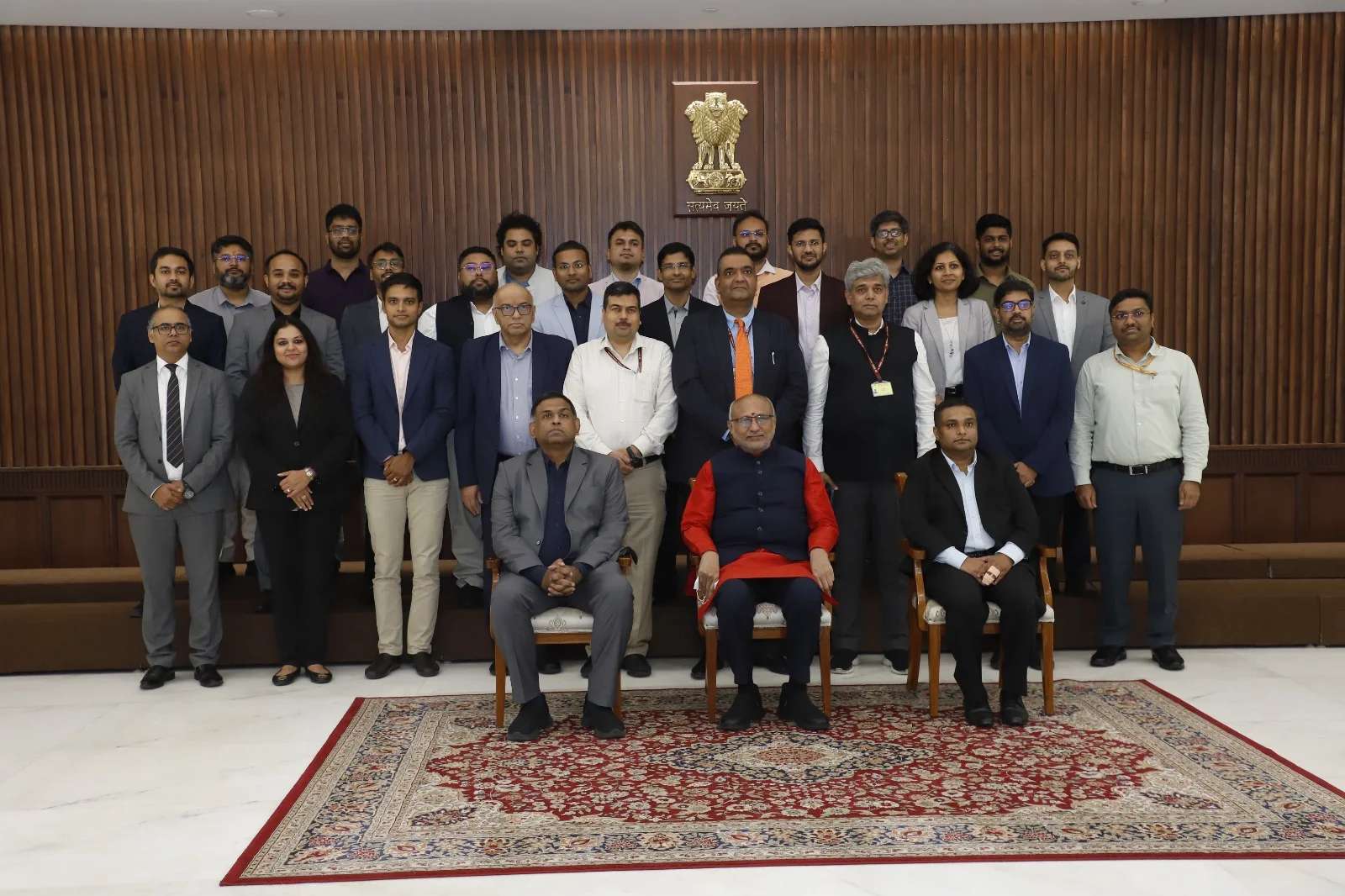
Voice AI Startup Gnani AI has launched Gnani Artha, an end-to-end sovereign AI stack for Indian enterprises and public institutions, combining its Evon v3.3 language model with its Plexus agentic AI platform.
Vice-President of India CP Radhakrishnan unveiled the stack in New Delhi on August 28.
Evon v3.3 is a 30-billion-parameter open-weights model trained across 11 Indian languages, while Plexus is designed to deploy AI agents across enterprise and government workflows.
Gnani AI said Plexus will be available to enterprise customers, while Evon v3.3 weights will be made available by request on Hugging Face under an Apache 2.0 licence.
“Bharat is making significant strides in AI. India’s approach focuses on making AI open, affordable, and accessible, ensuring that innovation uplifts society as a whole,” Radhakrishnan said.
“This initiative shows that our engineers have the capability not only to use frontier technologies, but also to build them,” he added.
Evon v3.3 uses a mixture-of-experts architecture, with 30 billion total parameters and around 3.5 billion parameters active for each token.
According to Gnani AI, the model outperforms Sarvam’s 105-billion-parameter Indic model on 10 of 11 languages on MILU, an Indian-language benchmark covering 11 languages and a range of academic and professional subjects.
It also outperforms Sarvam’s 30-billion-parameter model across all 11 languages and reaches parity with GPT-5.4 Nano.
The company has also rebuilt Evon’s tokeniser for Indian scripts. Gnani AI claims that Evon v3.3 requires around 20% fewer tokens per Indian-language word than the tokeniser used by the GPT-5 family, and less than half the tokens required by byte-level tokenisers used by models such as DeepSeek, Llama and Qwen.
The lower token usage is intended to reduce compute requirements, improve response times and allow more usable context within each query.
The model is available as open weights and can run on a single node, allowing institutions to deploy it within their own data centres or virtual private clouds. Gnani AI said this can help organisations keep customer data within their own infrastructure while meeting data residency requirements.
The second component of Gnani Artha, Plexus, is an agentic AI platform that allows organisations to build workflows using individual AI agents.
The platform is designed around agents that have their own identity and can be combined into workflows for specific outcomes. Its use cases include grievance resolution in government and reconciliation processes in banking.
For government grievance handling, for instance, a multilingual agent can capture a citizen's complaint, while another reasoning agent identifies patterns across complaints, such as a rise in cases from a particular district. The system can then consolidate the issue, route it to the relevant department and update the citizen after resolution.
In banking, Plexus agents can compare millions of entries across bank statements, core-banking ledgers and payment-switch logs. The system can clear matching entries, prepare explanations for exceptions and route unresolved cases to the appropriate team.
Plexus includes orchestration, human-in-the-loop controls, guardrails, observability and audit logging. It can integrate with enterprise and public digital infrastructure, use tools and work with different underlying models, including Evon v3.3.
“Sovereign AI is not about keeping the world out. It is about India having the capability to build for itself - and then for every country that shares its problems,” said Ganesh Gopalan, CEO of Gnani AI.
Founded in 2016, Gnani AI is headquartered in Bengaluru. The company develops foundation models and agentic AI systems for enterprises and government.
Gnani AI said it works with more than 200 enterprises across sectors including BFSI, insurance, telecom, healthcare, education and the public sector. It is also among the organisations participating in the Government of India's IndiaAI Mission to build sovereign AI models.
- AI Productivity to Add $28 Billion to $84 Billion to India's GDP: Cognizant Study
- OpenAI's Codex Helps in Aerodynamic Engineering for Mazda
- Bengaluru Accounts for 34% of India's FDE Talent: Report
- 84% See AI Productivity Gains, but Only 10% Allow Agent Autonomy: TCS Study
- Snowflake Introduces Business Ontology, Cortex AI Gateway to Bring AI Agents Into Enterprise Workflows
- Three Members Behind Claude Code Leave Anthropic Within 10 Days