
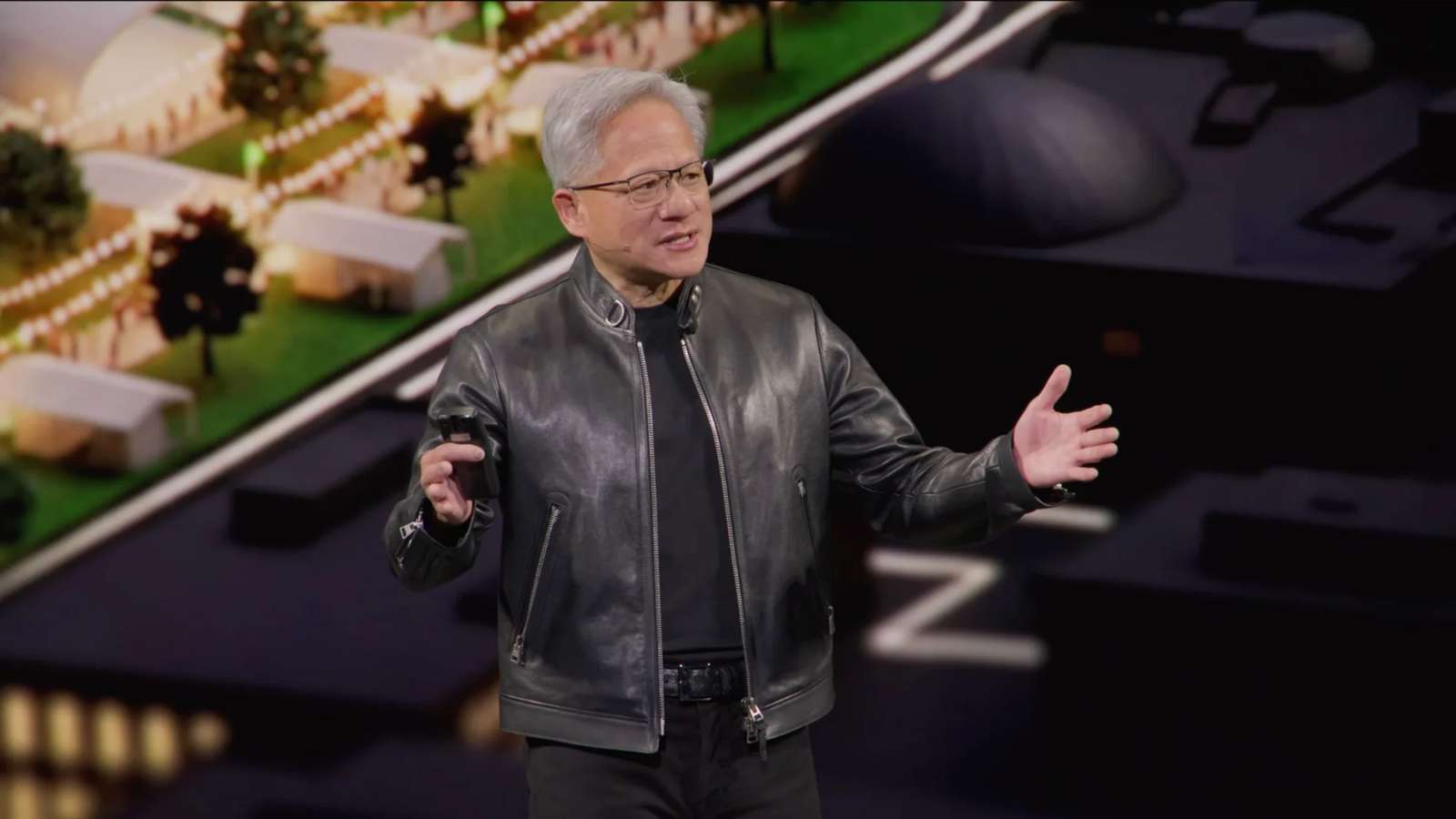
NVIDIA CEO Jensen Huang has questioned the motives of AI industry leaders warning about artificial intelligence risks, saying people making claims that AI could bring about the end of the world may have "ulterior reasons" for doing so.
In a CBS News interview, Huang rejected predictions that AI could bring about humanity's end by 2030 and said existing regulations should be applied rather than adding new ones.
Huang was responding to warnings, including those from former Anthropic researcher Jacob Coxon, who has raised concerns about the possibility of AI posing a threat to humanity within the decade. The comments come as AI companies and researchers debate how quickly frontier systems should be developed and what safeguards should accompany them.
When asked whether people could be "gone in a decade" because of AI, Huang rejected the prediction and said the narrative was overly dramatic.
"It is not grounded on facts. It's not grounded on science," Huang said. He added that the underlying concern about AI safety was not wrong, distinguishing that concern from predictions about AI causing catastrophic consequences.
"They must be doing it for ulterior reasons," he said, suggesting the reasons could be political, attention-driven or something else.
Huang said AI development should continue quickly while companies ensure that safety is not compromised.
"We should go as fast as we can, but not faster than we should," Huang said. He added that companies releasing unsafe products that put people in harm's way could face existing laws.
Huang went further, arguing that AI leaders' calls for regulation were not what they appeared to be. "They're actually not asking for more laws. They're asking to be relieved of the laws we do have," he claimed.
He also addressed AI regulation directly, saying, "We don't need more regulations. We need to apply the current regulations we have."
Huang's position differs from that of Anthropic CEO Dario Amodei, who has called for a slower pace of frontier AI development. In his essay, "We Must Pace the Frontier," Amodei argued that companies should slow the pace of AI so that safety work can keep pace with development.
Amodei proposed measures including embedded third-party evaluators, coordination among frontier AI companies, and broader international coordination.
Anthropic has since partnered with Accenture for what it describes as independent evaluation of its frontier AI models. Accenture's specialist AI business, Faculty, will lead the work, including model evaluation, red-teaming, alignment assessments and safeguard testing. Anthropic and Accenture each expect to invest at least $1 billion over five years to build capacity for the work.
Huang, meanwhile, has argued that AI development should continue rapidly while companies maintain appropriate safety measures. He has also called for countries developing AI to share safety practices and consider global standards for AI products and services.
- Apple Posts Record Revenue in India for Q4 FY26
- Dispatch Network Raises ₹5 Cr Pre-Seed Led by Antler India to Build AI-Powered Delivery Network
- Coforge Launches BridgeCX With Pega, Mastercard for Customer Personalisation
- HCLTech Launches AI Agents to Support Mainframe Operations
- MIT Researchers Show LLMs Can Read and Edit Neural Network Weights Without Retraining
- Anthropic Posts $17 Bn in Q3 Revenue, Swings to Operating Loss