Riding the AI Wave, Indian IT to Hit $315 Bn in FY26: Nasscom
By C P Balasubramanyam ·
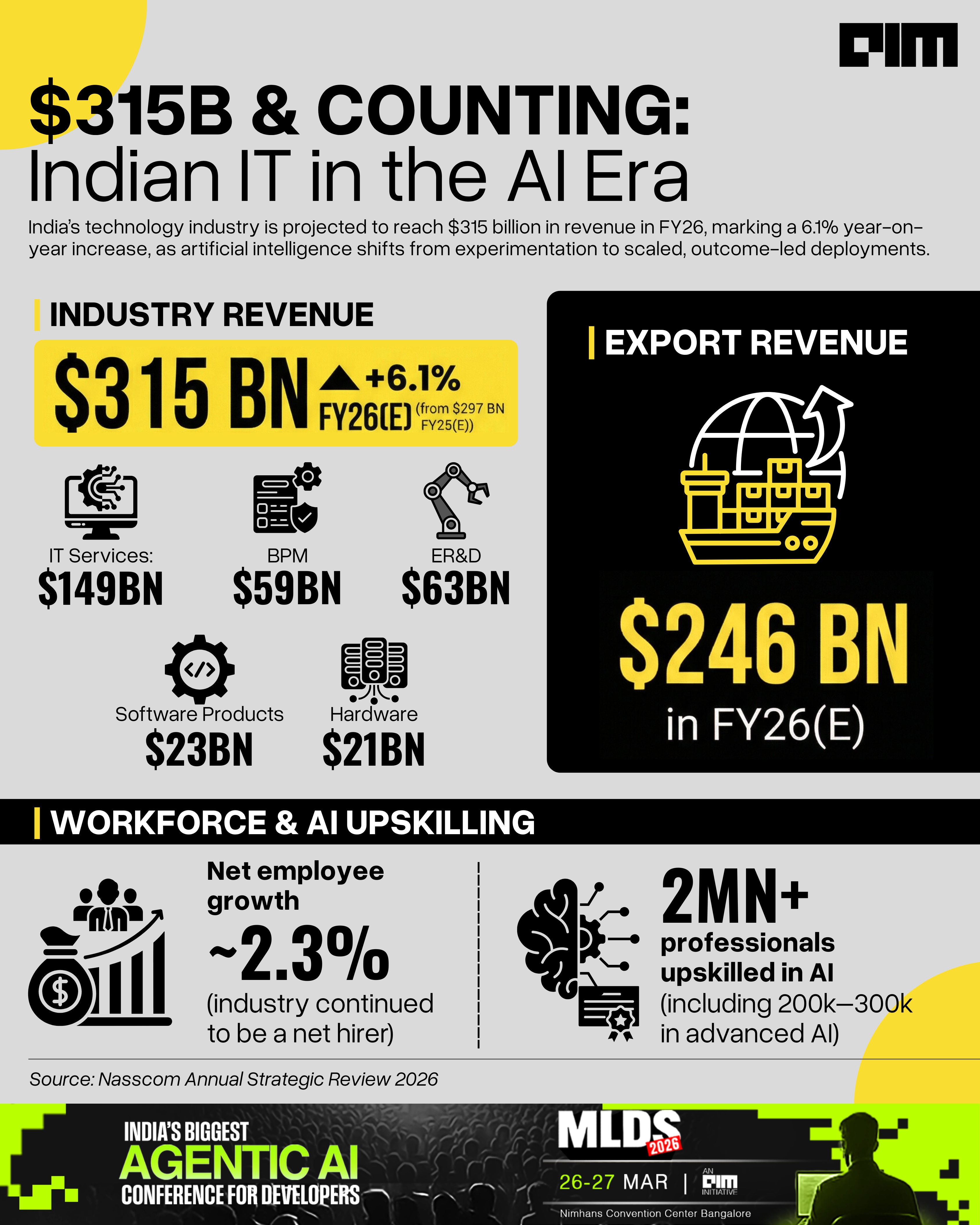
India’s technology industry is projected to reach $315 billion in revenue in FY26, marking a 6.1% year-on-year increase, as artificial intelligence shifts from experimentation to scaled, outcome-led deployments, according to the Nasscom Annual Strategic Review 2026.
The report described the past year as a decisive inflection point for the sector, with AI moving into function-specific use cases that are reshaping operating models and accelerating productivity.
AI revenue is estimated at upwards of $10–12 billion in FY26, reflecting a transition toward measurable return on investment and scaled adoption.
Despite global uncertainty and a broader economic reset, technology demand remained resilient, though spending priorities shifted toward efficiency and outcome-driven transformation, the report noted.
Hiring and Skilling
The industry remained a net hirer, with headcount rising 2.3% in FY26, supported by large-scale skilling initiatives. Over 2 million professionals were upskilled in AI during the year, including 200,000–300,000 in advanced AI capabilities.
Sindhu Gangadharan, Chairperson, Nasscom, said in a statement, “AI is accelerating productivity and changing the nature of work, but it is also expanding the opportunity frontier.”
As AI gets embedded across functions, she said, we will see roles redesigned around outcomes, deeper specialisation, and significantly higher AI fluency.
“The industry’s focus is on building ‘Human + AI’ teams, investing in continuous skilling, and converting efficiency gains into growth, creating new jobs and new career pathways even as delivery becomes more agile and more resilient.”
The review highlighted how ‘Human + AI’ teams are becoming the dominant delivery construct, enabling companies to redesign roles around outcomes and specialisation. Industry leaders are also rethinking offerings in an AI-first era, moving from discrete service delivery to platformised, productised solutions that embed intellectual property.
GCC, ERD Driving Growth
Global capability centres (GCCs) and engineering research and development (ER&D) remained key growth engines with significant headroom, while segments such as cybersecurity, data analytics, cloud and GCC-as-a-service gained deeper traction across industries. GCCs are shifting from scale-led operations to strategic ownership of critical functions, BPM (business process management) firms are combining AI and data to move beyond robotic process automation toward decision support, and ER&D providers are increasingly taking lifecycle ownership of products and systems.
Export demand remained steady, with APAC and the Middle East leading growth, while the domestic market expanded steadily. The vertical mix evolved gradually, with emerging sectors such as healthcare and travel and transportation seeing gains, largely driven by GCC expansion.
Rajesh Nambiar, President, Nasscom, said, “The past year has been a reset for the global environment, but technology demand has remained resilient; shifting decisively toward productivity, measurable ROI and scaled AI deployments.”
He said that the country’s AI advantage is widening, making organisations more agile and outcome led. At the same time, growth engines like GCCs and ER&D are moving up the value chain, from scale to strategic ownership, reinforcing India’s role as a trusted partner built on cyber resilience and responsible AI.”
Demand is Stable
Findings from the Nasscom Global End User CXO Survey reinforce this shift. The survey showed that 86% of CXOs expect business demand to remain stable or increase in CY26, including 56% who anticipate growth over CY25.
Further, 90% indicate increasing AI allocation within digital budgets in CY26, signalling that AI is moving from discretionary experimentation to scaled, budget-backed deployments aligned to measurable outcomes.
As the industry enters its next phase, Nasscom said it is evolving beyond execution to becoming a co-creation partner in defining, deploying and governing digital solutions end-to-end—underpinned by orchestration-led models, IP-driven innovation, lifecycle ownership, and a continued focus on cyber resilience and responsible AI by design.