
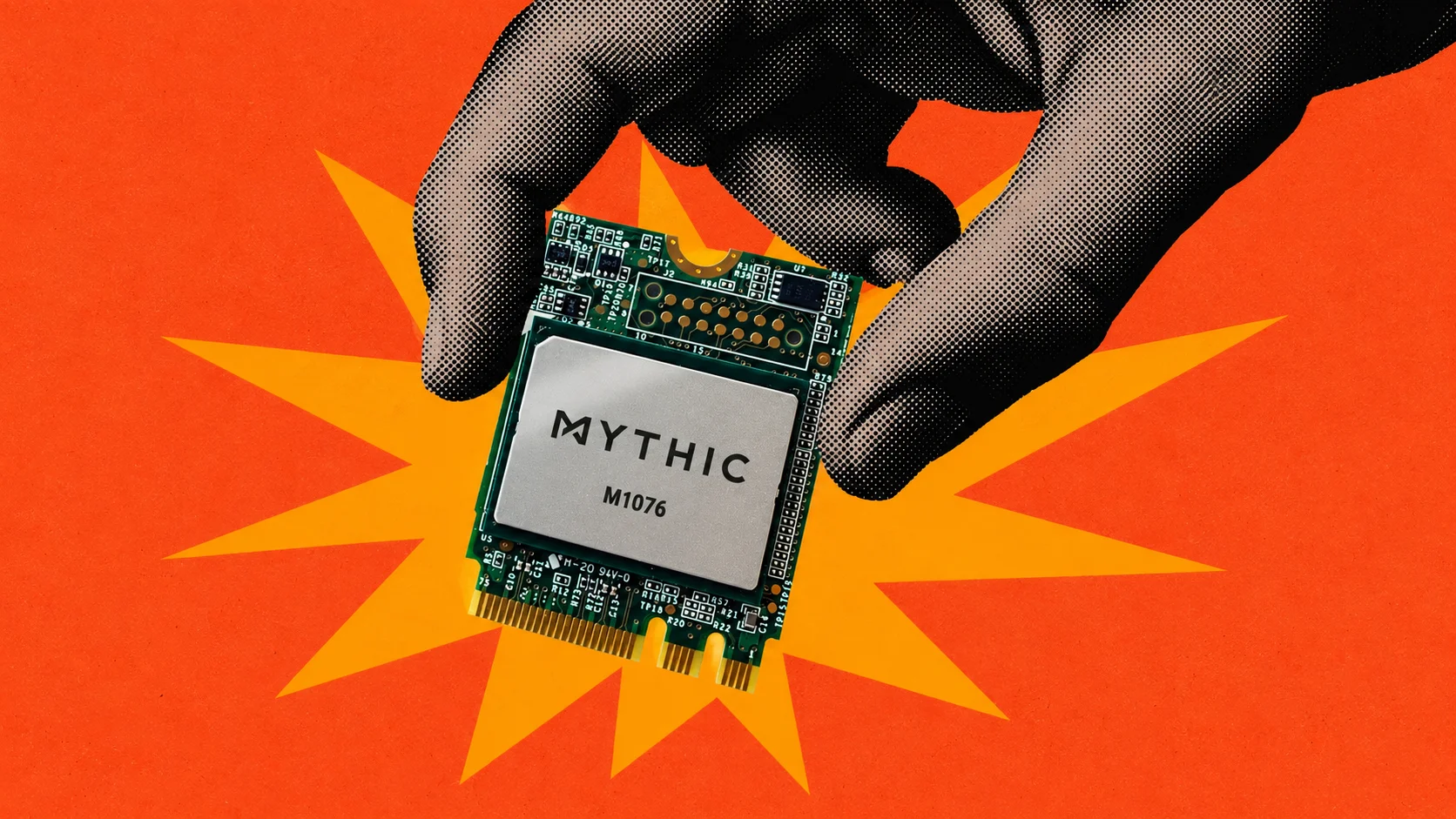
Mythic AI, the chip startup that raised $125 million last December, has now opened a centre of excellence in Bengaluru, where it plans to build out its semiconductor engineering capabilities.
The city is home to R&D centres of chip giants such as AMD, NVIDIA, Qualcomm, Arm, and others.
The new centre will serve as a key product development and innovation hub, with plans to build a premier AI chip development team spanning VLSI design, physical design, design-for-test, systems and applications engineering.
The company says that this expansion is a part of its goal to 4x its team size by Q1 2027.
AIM sat down with Taner Ozcelik, CEO of Mythic AI, to understand the company’s technology and the quite wild performance claims it has made.
Why Mythic AI?
The startup is betting on analogue compute.
Its chips—the M1, Vanguard, and Mead—are built around analogue in-memory computing, which performs matrix operations inside memory rather than moving model weights back and forth between memory and a separate processor.
The approach is designed to reduce the power and latency associated with AI inference, particularly at the edge.
“By going back and forth between the memory and the processor a thousand times more than you should—you’re consuming a lot of energy,” says Ozcelik. “We can collapse all of that into memory, and then do analogue computing.”
Essentially, unlike GPUs, Mythic aims to eliminate the data movement between memory and compute that makes AI inference energy-intensive.
Instead, Mythic stores the weights directly in the memory and performs matrix multiplication there, using analogue signals to carry out the computation.
This saves energy by reducing the need to move data between memory and compute. “We’re building chips that will hopefully change the world—without changing the planet,” Ozcelic adds.
25x Lower Power? Up to 675x Faster Token Speeds?
The company’s chips—the M1, Vanguard and Mead—represent different stages of Mythic’s attempt to commercialise analogue compute.
These analogue chips can be combined in different configurations depending on the workload—from a single low-power chiplet for edge devices to hundreds or more chiplets for larger AI workloads such as LLM inference.
The M1 is available today, delivering up to 25 TOPS of inference while storing up to 80 million model parameters directly on-chip.
Mythic says the M1 can run at 3–4W, with lighter workloads reaching 1–2W. It is available both as a standalone chip for integration directly into a device’s circuit board and as a compact M.2 accelerator card for applications including industrial machine vision, surveillance, drones and edge servers.
Mythic says the chip is already in customers’ hands and has been validated across automotive, robotics, defence and edge AI applications, although the company has not disclosed detailed revenue or deployment figures.
Vanguard, slated for 2027, is the company’s next-generation APU. Unlike the M1, it combines a 28nm analogue compute die with a 5nm digital die: the analogue side handles dense matrix multiplication, while the digital side handles control, programmability and other high-performance workloads.
Mythic says Vanguard is designed to scale its architecture beyond edge inference to LLMs, computer vision and enterprise AI.
The Bengaluru centre will initially contribute to the development of Vanguard.
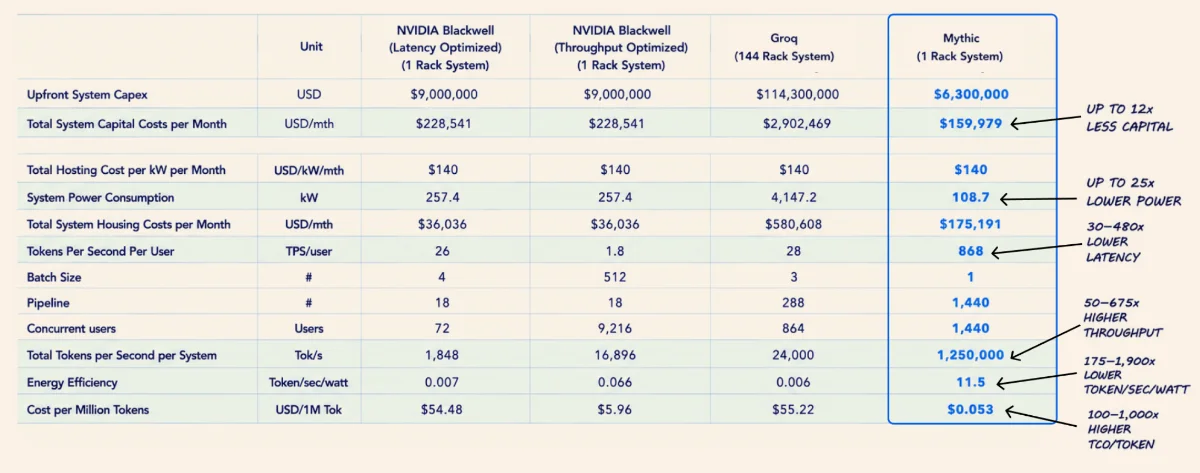
The company claims that, in a rack-scale solution, it can offer up to 12x less capital, 25x lower power, and 50–675x higher throughput than NVIDIA GPU racks, among other wild numbers.
Mead is further out and still in development, offering an improved architecture that enables much greater memory density.
Across its current APU architecture, Mythic claims up to 120 trillion operations per second (TOPS) per watt, which it says is roughly 100x the performance-per-watt of comparable GPUs when memory movement is included.
For Vanguard, the company claims 75–1,900 tokens per second per watt for LLM inference, depending on the configuration.
‘Jensen Will Crush You If You’re Not Materially Better’
Lockheed Martin Ventures is both an investor and defence partner. In February, Honda and Mythic signed a joint development agreement to develop an automotive AI SoC for Honda’s next-generation software-defined vehicles.
The companies are targeting more than 1,00,000 TOPS within a low-power envelope, with applications ranging from vision transformers and autonomous-driving systems to vehicle control and cloud-free in-car LLMs. Prototype chips are expected to be tested in vehicles in the late 2020s or early 2030s.
In May, Mythic acquired German processor-IP company Videantis, whose technology is already deployed in roughly 30 million production vehicles, giving Mythic an established automotive platform alongside its new Honda programme.
Alongside the APU roadmap, Mythic is also developing Starlight, a sub-1W sensing platform that embeds its analogue compute technology into sensors for applications such as defence, robotics and automotive vision.
Ozcelik says Mythic’s software stack takes models built in familiar frameworks such as PyTorch and TensorFlow, or exported in ONNX, and optimises and compiles them for the company’s analogue compute architecture.
Ozcelic says the software is the biggest differentiator, and that is also why NVIDIA has won. “You have to make it super easy for people to adopt it,” he says.
“About half our team is now in software,” he added, as the company now aims to get its analogue technology out in the world at scale. “If the software works, if the chip is as good as we think it is going to be—I’m pretty sure we’re winning,” he says.
He adds that to compete with NVIDIA and earn a meaningful market, newer AI chips must offer a significant improvement over existing solutions.
“You cannot say—I’m 60% better. Jensen [Huang, NVIDIA CEO] will crush you in a quarter. So there needs to be a material difference.”
‘Scars are the Assets of the Company’
However, Mythic is far from being a new startup.
Founded in 2012 by Mike Henry and Dave Fick, the company spent years trying to turn analogue compute-in-memory into a commercially viable AI processor.
It raised more than $165 million under its original incarnation, according to Co-Founder Henry, but the path to a working product was considerably more difficult—and expensive—than the founders initially expected.
By the end of 2022, Mythic had run out of money.
However, investors subsequently put in $13 million in March 2023 to keep the company alive.
Ozcelik, who joined as CEO in mid-2024, describes the period before his arrival as a long, expensive engineering exercise.
According to him, the company had spent roughly $200 million on development, much of it learning how to make analogue computing work reliably at scale. “We learned how to do analogue computing” over roughly seven years, he says, during which Mythic went through three chip revisions.
The problems were not necessarily with the underlying thesis, but with the engineering required to make it practical.
Ozcelik describes them as “rookie mistakes”, as analogue-to-digital converters lacked sufficient accuracy, some components were used far more heavily than anticipated, the network-on-chip architecture ran into problems, and the software stack was not developed early enough.
The result was a company that had spent heavily but had not yet reached a sustainable commercial position.
Ozcelik argues that those failures nevertheless created an important technical advantage for the current Mythic.
The company spent years developing its analogue memory cell, analogue circuitry, calibration techniques, and software stack, then later acquired additional digital-processing expertise.
“The scars are the assets of the company,” he says. “But we have cleaned up a lot of those mistakes. And this is a completely new company right now.”
The Challenge for Commercial Success
Rather than moving through the market one segment at a time, Ozcelik says Mythic is building the same architecture to work across them.
The company plans to use the same hardware and software stack from a single low-power chiplet in an edge device to systems with hundreds of chiplets for data-centre workloads, he explains, akin to NVIDIA’s use of a common GPU architecture across its products.
Ozcelik says the company currently has 16 M1 APUs running in servers in its colocation facility, where it is testing the SDK and system-level performance. The company has also recently started running small language models on the M1.
But the challenge now for Mythic AI is commercial success.
NVIDIA dominates, with a massive software ecosystem that makes deployment easy.
Mythic’s headline performance and efficiency claims, however, have yet to be independently demonstrated at the scale of deployment the company is targeting.
Its most aggressive comparisons with GPU systems remain company-reported figures.
At scale, Mythic will also have to contend with temperature, device variability, noise, calibration and conversion overheads—all the challenges that come with analogue computing—while ensuring that addressing them does not erode the efficiency gains at the heart of its analogue approach.
That said, custom AI accelerators have found markets of their own. Google’s TPUs have become a core part of its infrastructure, while startups such as Cerebras and Groq have moved beyond silicon demonstrations into commercial AI infrastructure.
But these examples remain exceptions in a crowded field of startups chasing NVIDIA. And not all of them have translated that capital into commercial viability.
Graphcore, once valued at $2.8 billion, was acquired by SoftBank in 2024 after struggling to secure the investment needed to keep pace with the market.
Untether AI, which had raised more than $150 million, shut down its product business in 2025 after AMD acquired its engineering team.
Yet, investors continue to fund the category because building a new processor is a long-term bet.
Recently, Etched raised another $700 million at a $21 billion valuation, while SiMa.ai, which has raised $355 million to date, secured a strategic investment from Micron in April as it works to scale its low-power physical AI platform.
Positron raised $875 million in September at a $5 billion valuation, while MatX raised $500 million in February to develop chips for large-scale AI workloads.
The development cycle is expensive and can take years, but all carry the hope that a successful architecture can become infrastructure.

Your reaction
Discussion
What's your take on this story?
No comments yet — be the first to share your view.