
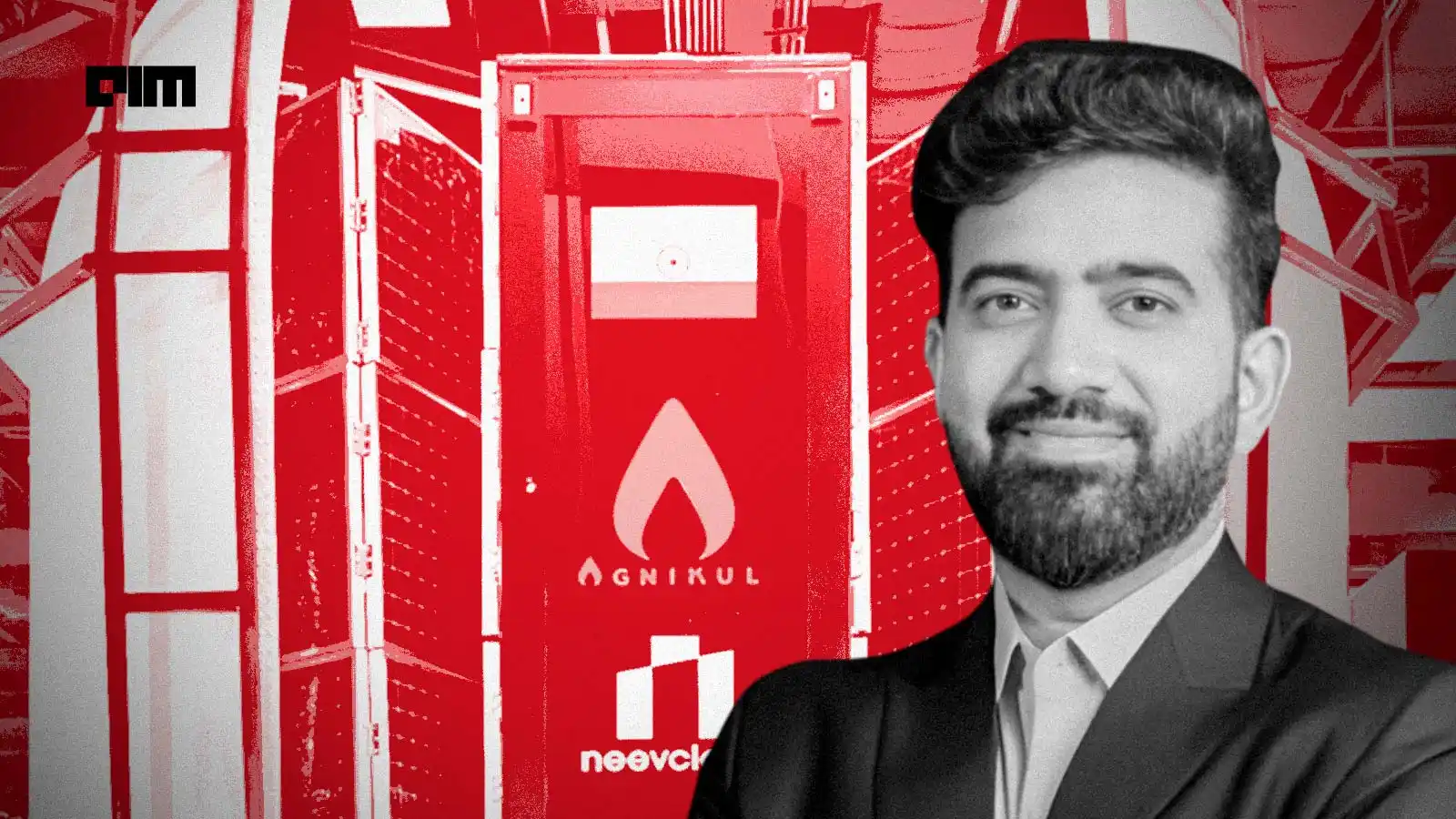
Bengaluru-based cloud provider NeevCloud is looking beyond Earth. After building data centres in Raipur and Indore, it now plans to move AI inference into space.
The company recently signed a commercial agreement with homegrown space tech company Agnikul Cosmos to deploy a space-based AI data centre in low Earth orbit (LEO) by the end of 2026.
Under the mission, NeevCloud will build a module to host real-time AI inference workloads in orbit. It will be launched atop Agnikul’s extendable upper-stage platform, with plans to repurpose it to host compute capabilities. The project targets customers needing low-latency AI services in regions with limited ground infrastructure. The companies plan to scale the network to more than 600 orbital edge data centres by 2030.
In an exclusive interview with AIM, Narendra Sen, Founder and CEO of NeevCloud, clarifies that the primary purpose of the orbital data centre is inference, not model training. The use cases include border security, unmanned vehicles, drones, maritime zones, and remote industrial environments where connectivity and compute are constrained.
Notably, US-based Starcloud last year became the first company to perform AI inference in space, running Andrej Karpathy’s Nano-GPT as well as Google Gemma on an NVIDIA H100 GPU.
Sen argues that building edge data centres everywhere is not practical. While it is technically possible to deploy smaller GPU clusters at factories, malls, or remote facilities, managing distributed infrastructure at scale becomes complex.
“Managing 10 GPUs or 100 GPUs or one GPU requires the same efforts,” he says, explaining that operational overhead remains high regardless of size. The goal is to reduce latency for critical workloads.
Back to Earth
NeevCloud currently operates two data centres, with one live in Raipur and another in Indore. “We have committed around 1,000 GPUs, which are the NVIDIA B300, and then we will scale based on demand,” Sen says.
“We are not buying GPUs speculatively, which would strain our capital. We are phasing purchases, so we haven’t made large upfront acquisitions,” he adds.
The company provides private AI cloud environments for enterprises, startups, and mid-sized customers that want control over workloads. It also wants to deepen its focus on India.
“If you are not in the IndiaAI system, then you are not able to compete, because they are getting pricing almost half,” Sen says.
Founded in 2023, NeevCloud recently moved its headquarters from Indore to Bengaluru and has a team of 140 employees. The company is planning to raise funds to support expansion. “Fund is very much required,” he remarks.
Why Indore and Raipur?
For NeevCloud, the decision to build in Indore and Raipur was driven by power, not proximity to financial hubs.
“Earlier, decisions were based on fibre. Now all the decisions are based on energy supplies,” the founder explains.
He points out that both Madhya Pradesh and Chhattisgarh are power-surplus states and strategically located in central India. From a latency perspective, the region has its merits.
“If your use cases are around India, you usually get similar latency whether you are coming from Delhi to central India, from the South to central India, or from the East or West. From a latency perspective, it’s very strategic,” he says. Sen also cites seismic safety and state policy support as contributing factors.
Cost plays an equally important role. Land prices in Mumbai, he notes, can go up to ₹60 crore per acre. In contrast, sites in Indore and Raipur are available for under ₹30 lakh per acre. “Here, we can scale from 100 megawatt to gigawatt,” Sen says.
Last year, NeevCloud secured six acres in Indore for an 18 MW data centre and 13 acres in Raipur for a 100 MW facility.
It has also reworked how it builds facilities. Traditional data centres can take 18–24 months to construct. NeevCloud claims it can complete builds in six to eight months using horizontal, pre-engineered designs. “We are a technology company, not a real estate company,” Sen says. “We started solving the supply chain issue and building it fast.”
He compares the shift to trends in the US data centre market. “Everybody was in Virginia—80–90% of data traffic flowed from there. Now people are moving to Dallas and wherever power is available,” he said. “If Mumbai is Virginia, then Indore and Raipur are the Texas of India.”
NeevCloud serves a mix of enterprises, startups, mid-sized firms, global AI companies entering India, and universities. A prominent client is manufacturing company Shakti Pumps, which runs its AI workloads on NeevCloud’s infrastructure.
Some customers deploy their own GPUs within NeevCloud’s facilities. The company does not currently serve hyperscalers. Instead, it is positioning itself differently. In an AI infrastructure market dominated by hyperscalers and coastal hubs, NeevCloud is building around a power-first strategy in central India and pushing inference to the edge, even beyond Earth.

Your reaction
Discussion
What's your take on this story?
No comments yet — be the first to share your view.