

Google Colaboratory is a cloud service that can be used for free of cost, provided by Google. It supports free GPU and is based on Google Jupyter Notebooks environment. It provides a platform for anyone to develop deep learning applications using commonly used libraries such as PyTorch, TensorFlow and Keras. It provides a way for your machine to not carry the load of heavy workout of your ML operations. It is one of the very popular platforms of the kind. But there are some others which form as efficient alternatives of Colab. These are the best alternatives available out there for Google colab.
1. Microsoft Azure Notebooks

Azure notebooks by Microsoft is very similar to Colab in terms of functionality. Both platforms have a cloud sharing functionality available for free. Azure Notebooks wins in terms of speed and is much better than Colab in this regard. It has a memory of 4 gigabytes. Azure Notebooks creates a collection of related notebooks called Libraries. These libraries are the size of each data file as less than 100 megabytes. Azure Notebooks supports programming languages of Python, R and F#. It has a native Jupyter UI. Azure Notebooks is more suitable for simple applications.
2. Kaggle
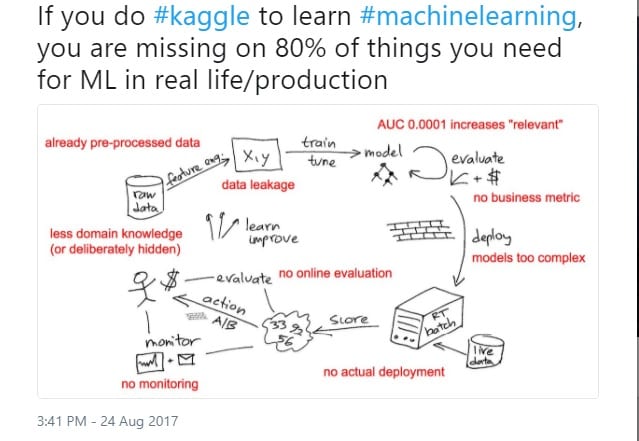
Kaggle is an excellent platform for deep learning applications in the cloud. Kaggle and Colab have a number of similarities, both being products of Google. Just like Colab, it lets the user use the GPU in the cloud for free. It provides Jupyter Notebooks in the browser . A majority of Jupyter Notebook keyboard shortcuts are exactly the same as Kaggle. It has many datasets that can be imported. Kaggle Kernels often seem to experience a little lag but is faster than Colab. Kaggle has a large community to support, learn and validate data science skills.
3. Amazon Sagemaker

Amazon SageMaker notebook runs on the Jupyter Notebook App. It is responsible to create and manage Jupyter notebooks that can further be used to process data and further train and deploy ML models. For the training and deployment of the models, it provides APIs. Amazon SageMaker provides a console that lets the user use the console UI to start model training or deploy a model. It allows for easy integration of ML models in applications.
4. IBM DataPlatform Notebooks

IBM introduced Watson Data Platform and Data Science Experience (DSX) back in 2016 with support for open-source options. These options included Apache Spark, R, Python, Scala and Jupyter notebooks. It eventually started its platform for multi-cloud freedom of choice for data science work. This was done with the help of containerization of the product by way of Kubernetes. As a result, it can be deployed in Docker or CloudFoundry containers wherever the data resides. IBM DataPlatform Notebooks, unlike Google Colab, have containerization for multi-cloud deployment or a hybrid deployment. Colab needs data science to be fone on its own public cloud.
IBM supports containerization because it encourages customers to be able to analyze data and build, deploy and run models anywhere, including rival public clouds. DSX is both a part of and, optionally, independent from Watson Data Platform as DSX Local. It provides permission-controlled, collaborative access to projects, data, data science tools, services, and community space. DataPlatform Notebooks supports languages of R, Python and Scala and supports Jupyter and Apache Zeppelin notebooks. DSX users can use open source libraries including Spark MLlib, TensorFlow, Caffe, Keras and MXNet.
5. Jupyter Notebook:

Jupyter Notebook is an open source web application whose purpose is to create and share documents that contain live code, equations, visualizations and text. Jupyter Notebook is maintained by the people at Project Jupyter. They are an incidental project which originated from the IPython project. It supports languages of Python, R and Julia. Their main use is in computational physics and data analysis. It provides a variety of visualisations which is rendered directly in the notebook. There are two modes that it has called insert and escape. Just like Colab, Jupyter notebooks are more focused on making work reproducible and easier to understand.

Your reaction
Discussion
What's your take on this story?
No comments yet — be the first to share your view.