Key takeaways
- SQL is essential for data management and commonly required for data analyst roles.
- A relational database organises data in tables with defined relationships, using keys for identification and linking.
- Key concepts in SQL include tables, records, primary keys, attributes, and foreign keys.
Structured Query Language (SQL) plays an important part in the data management system in an organisation. While applying for a data analyst job, most organisations ask for hands-on experience with SQL. SQL is a simple yet powerful language that is used widely as a business intelligence tool. In this article, we list down 5 important steps one must know to master SQL for data science.
1| Basic of Relational Database And SQL
A database is a set of structured data which can be easily accessible. A relational database is a collection of data that contains the pre-defined relationship between them in the form of tables with rows and columns. Some of the key terms which are used thoroughly in the relational database are tables, records, primary keys, attributes, and foreign keys. The tables are sometimes called a relation which contains one or more than one category of data, the attributes are also known as columns, a record is also known as a tuple or a row. The primary key is contained in each table. It is unique and used to identify the information in a table. The foreign keys are used to link the primary keys of another table.
Structured Query Language (SQL) is a powerful database tool that is used to perform operations such as create, maintain and retrieve data stored in the relational database. It is basically a standard language for data manipulation in a Database Management System (DBMS).
2| Understanding the SQL Commands
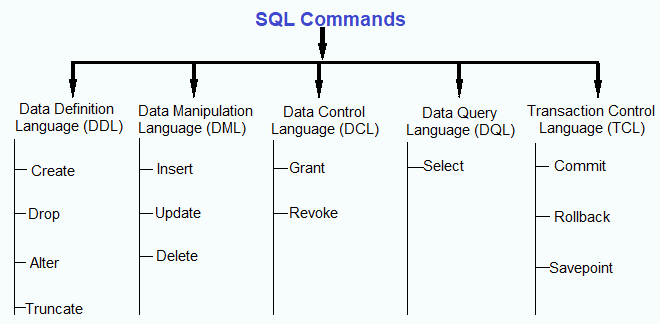
Data Definition Language (DDL): The DDL commands such as create, drop, alter and truncate is used for creating, dropping, altering and modifying the structure of database objects.
Data Manipulation Language (DML): The DML commands such as insert, update and delete are used for inserting, updating and deleting the structure of database objects.
Data Control Language (DCL): The DCL commands such as grant and revoke are used for providing security to database objects.
Data Query Language (DQL): The DQL command such as select is used for retrieving data from the database.
Transaction Control Language (TCL): TCL commands such as commit, rollback and savepoint is used for managing transactions in the database.
3| Knowledge of Joins
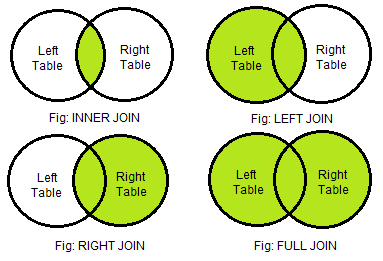
The SQL Joins are basically used for combining records from two or more tables in a database. The different types of Joins are
- INNER Join: This join selects all the records with matching values in both the tables.
- FULL Join: This join selects all the records either from the right table or left.
- LEFT Join: This join selects records left-most table along with the matching records from the right table.
- RIGHT Join: This join selects records from the right-most table along with the matching records from the left table.
4| Interface SQL With Python Or R
If a programmer knows statistical language such as Python or R, s/he can easily run the packages of both the languages to build machine learning models on a large dataset in a SQL server. Knowledge of these statistical languages along with the understanding of SQL will surely help a programmer move up the career ladder. With Python or R in SQL Server, one can perform data analysis, prepare datasets, create interactive visualisations of data, etc.
5| Advanced SQL
Once you gain insights on the basics of SQL and understand them clearly, it is time to learn a deeper concept which is Advanced SQL. In this part, you will learn about various other keywords and concepts such as UNION, UNION ALL, INTERSECT, MINUS, LIMIT, TOP, CASE, DECODE, AUTO-INCREMENT, IDENTITY, etc. in order to create advanced reports and perform complex pattern matching.