
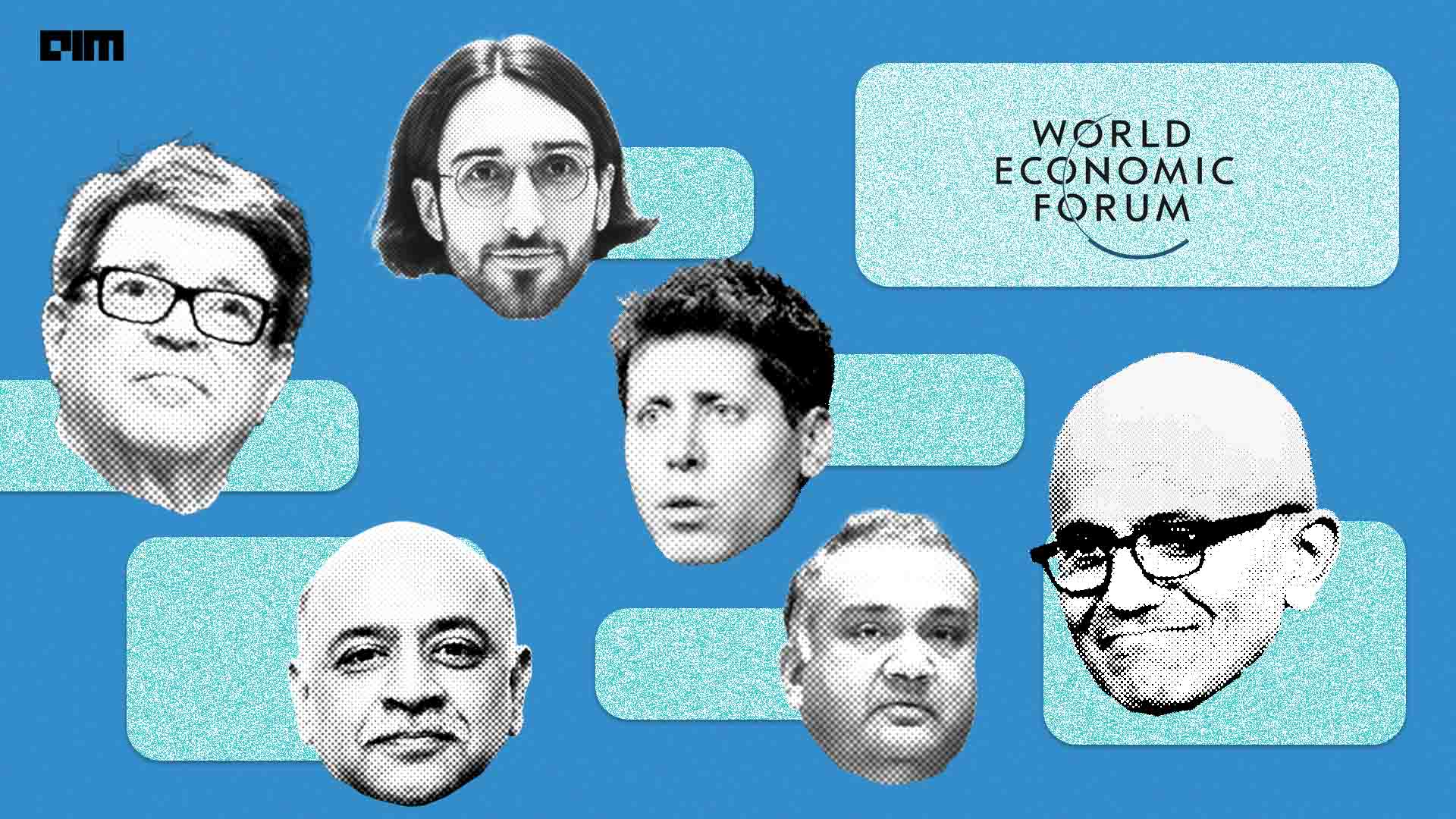
AI conversations took centre stage at the World Economic Forum for the first time with eminent leaders and industry experts discussing AI policies, regulations, impact on the job market, economy and more. At the event, over 30 talks and sessions revolved around AI, besides discussions on climate change (50), jobs (58), and security and cooperation (64).
Here’s a glimpse of the top conversions that took place at the 54th edition of the World Economic Forum (WEF) held between January 15 and 19, in Davos, Switzerland.
A Conversation with Satya Nadella
Microsoft CEO Satya Nadella captured the attention of many when he spoke about how AI is bringing accelerated change in the world for the better. In conversation with WEF chairperson Klaus Schwab, Nadella elaborated on his vision of generative AI impacting industries and jobs. He also shared insights on how he believes AI will transform the way we approach scientific exploration.
He also touched upon AI improving healthcare, education and products and services sectors. Nadella suggests that AI is capable of turning things around even in case of zero or negative economic growth.
Nadella feels there is a need for global coordination on AI, with an agreement on a set of standards and appropriate guardrails for the technology. “I think a global regulatory approach to AI is very desirable because we're now at a point where these are global challenges that require global norms and standards,” Nadella said.
The Expanding Universe of Generative Models
Another interesting discussion was the panel on ‘The Expanding Universe of Generative Models’, featuring AI pioneers including Yann LeCun, Nicholas Thompson, Kai-Fu Lee, Daphne Koller, Andrew Ng, and Aidan Gomez discussing the growth of GenAI, future trends, opportunities, and engaging in candid conversations about open-sourcing and equality in AI.
During the roundtable discussion, LeCun advocated for open-source foundational models. “OpenAI does not have a monopoly on good ideas. They’re not going to get to AGI by themselves, in-fact they’re using PyTorch and Transformers, which was published by many of us. They’re profiting from the open research landscape,” said LeCun.
Further, he added, “All of our digital diet will be mediated by AI systems, you do not want this to be under the control of a small number of private companies. So, the basic foundation models will have to be open source. He also laid emphasis on the models built for particular cultures, languages, and values and what role they can play in the ecosystem.
LLM scaling was extensively discussed during the session. Andrew Ng shared his perspective, noting that while scaling gets progressively more challenging, the pace of innovation will continue to feel like it's accelerating.
“This year we’ll see the image processing revolution, autonomous agents going off and doing the work for us, edge AI on our own devices — all these vectors of innovation,” he said. Aiden Gomez, CEO of Cohere, echoed this sentiment, saying, "We're not done with scaling LLMs, we still need to push up."
Generative AI: Steam Engine of the Fourth Industrial Revolution?
According to the WEF, generative AI is considered the fourth industrial revolution. In this session, speakers from government and business discussed the implications of generative AI following its rapid emergence in 2023 and how they can manage the risks.
The panel consisted of Senator Mike Rounds from South Dakota, Minister Sultan Alama from the UAE, Julie Sweet (Accenture chief), Arvind Krishna (chief and chairman of IBM), and Cristiano Amon (president and CEO of Qualcomm).
"Artificial intelligence, in today's form, is projected to generate $4 trillion of annual productivity before the end of the decade,” said Krishna. Moreover, he believes that generative AI will enhance employee productivity. “We can anticipate a 20-40% increase in productivity for a programmer who embraces AI, as opposed to one who doesn't," he added.
On the other hand, Amon specifically focused on how Qualcomm is working to introduce generative AI capabilities within the car. He explained recent advancements in AI at CES 2024, such as the ability to have a conversation with your car.
Mike Rounds spoke about how AI will be transformational in healthcare, expressing optimism that the US public will appreciate AI after witnessing the improvements in quality of life.
Technology in a Turbulent World
In a key and highly anticipated Davos session, OpenAI CEO Sam Altman joined Marc Benioff, chair and CEO of Salesforce, Julie Sweet, chair and CEO of Accenture, Jeremy Hunt, UK chancellor of the exchequer and Albert Bourla, CEO of Pfizer, to discuss safety, trust, and human interaction as AI becomes increasingly important in our daily lives.
In this session, Altman addressed the recent case of The New York Times suing OpenAI, presenting his stance and thoughts on the matter.
“We wanted to pay The New York Times a lot of money to display their content. We were as surprised as anybody else to read that they were suing us. That was sort of a strange thing,” said Altman.
Gen AI: Boon or Bane for Creativity?
The session extensively focused on the topics of copyright, intellectual property (IP), and the exploration of whether prompts should be copyrighted, along with discussions on distinguishing human-made content from machine-generated content.
The panel featured Neal Mohan, CEO YouTube, Daren Tang, director-general of the World Intellectual Property Organisation (WIPO), Almar Latour, CEO and publisher of The Wall Street Journal at Dow Jones & Company and contemporary artist Krista Kim.
Latour shared his opinion on the ongoing NYT case and said that WSJ has 138 years of reporting which is high quality data and when that gets scraped and used in a different context, there needs to be compensation for it. “There are very classic models for that, licensing is an age-old business. Applying that forward into the AI era is where our focus is” he said.
“I would prefer to have a commercial solution rather than just going through the courts," he added.

Your reaction
Discussion
What's your take on this story?
No comments yet — be the first to share your view.