
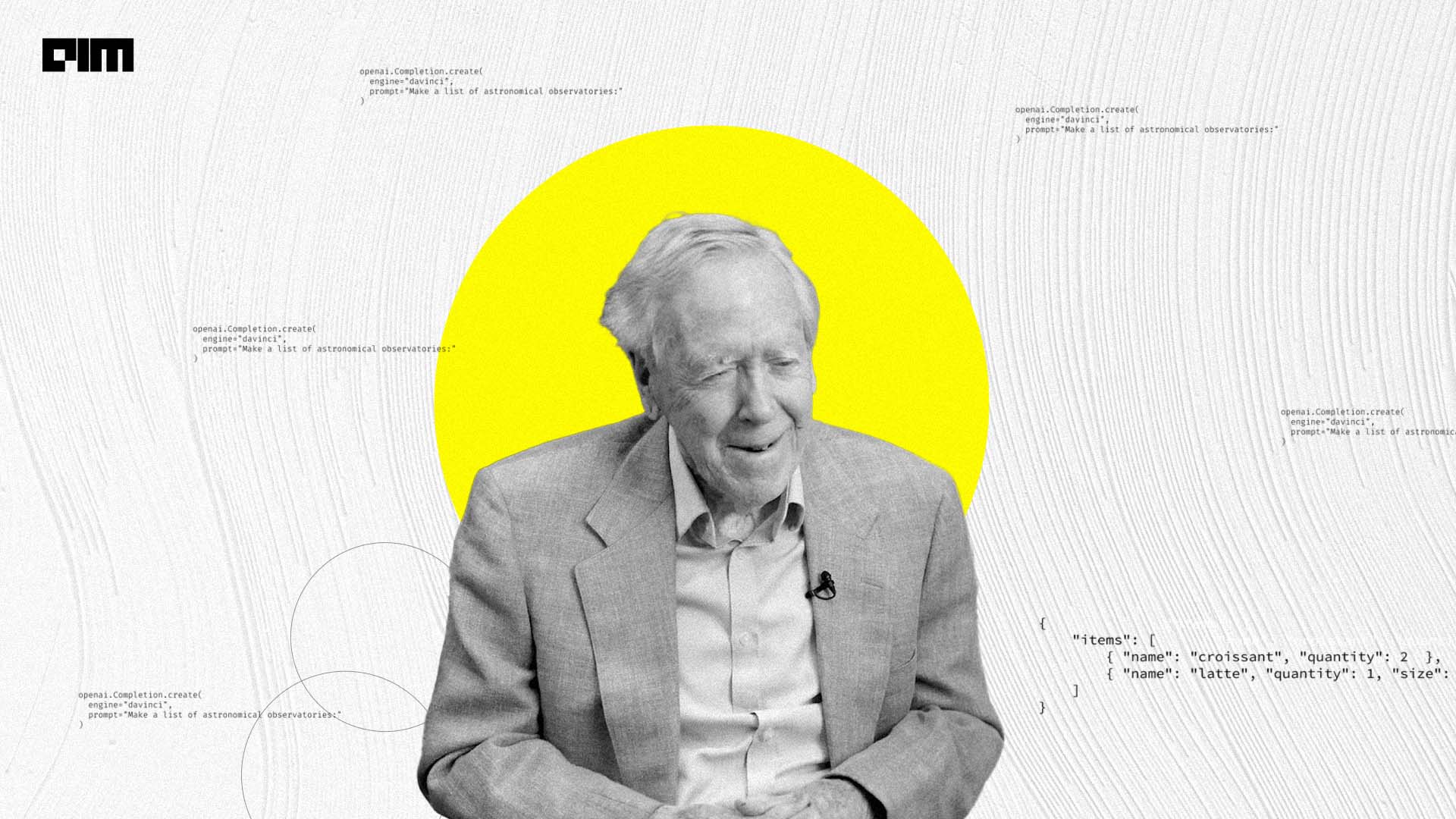
Every maths lover on the internet has once in their lifetime come across the name Professor Gilbert Strang. The YouTube star, even before it was a thing, devoted his entire life to the MIT maths department.
In the early 2000s, MIT decided to create OpenCourseWare and instead of trying to sell courses, made them open to everyone. Then they recorded Strang’s ‘linear algebra course maths 18.06’. “In fact, I think India has more people who know that, of course, than any other country in the world,” Strang shared in an exclusive interview with AIM.
Read more: Inside The Mind of Gilbert Strang
Strang’s teaching methods remain irreplaceable even today as he “structures the class so that ideas seem to flow from the students into proofs", said a former student, Jesse Michel. “Every class includes a cool maths trick or joke that keeps the class laughing,” he added.
The icon continues to stay relevant even after his retirement through his online courses and teaching methods. We have picked out his 6 most viewed and loved topics at MIT.
Linear Algebra 18.06
This lecture by Strang has achieved an impressive milestone, surpassing 10 million views on OpenCourseWare (OCW). This remarkable feat tells us why he is considered one of the most renowned mathematicians globally. At 88, Professor Strang delivered this lecture as his last, and received a standing ovation for his lifelong commitment to the field of mathematics.
Here’s the link to the course.
Mathematical Methods For Engineers (2)
Regarded as a graduate-level course, this lecture stands out as one of the finest discussions on numerical analysis available. Delivered during the Fall of 2000, the lecture delves profoundly into the difference methods for ordinary differential equations.
Here’s the link to the course.
Matrix Methods in Data Analysis, Signal Processing, and Machine Learning
A comprehensive understanding of linear algebra is key to mastering and developing machine learning algorithms, particularly in deep learning and neural networks. This course offers a thorough review of linear algebra, its practical applications in probability, statistics, and optimisation. Moreover, it presents an in-depth and clear explanation of the field of deep learning.
https://www.youtube.com/watch?v=t36jZG07MYc&t=1s
Here’s the link to the course.
Computational Science and Engineering (1)
Crafted in the Fall of 2008, this course is acclaimed for being a practical and valuable mathematics course. Students often express that it stands as one of the most useful maths courses they have ever encountered. The primary objectives of the course are to see the underlying patterns in numerous significant applications and to equip learners with methods to compute solutions.
Here’s the link to the course.
Highlights of Calculus
In this course, Strang presented a concise series, providing a foundational introduction to the fundamental concepts of calculus, shedding light on its mechanics and significance. With an inclusive target audience, this series is resourceful for beginners as well as for educators pursuing self-learning.
Here’s the link to the course.
Wavelength, Filter Banks and Applications
The course written in Spring 2003 was co-instructed by Prof Kevin Amaratunga. The professors aim for the right balance of theory and “applications”. The course has no specific prerequisites, although a basic knowledge of Fourier transforms is recommended. The introduction begins with time-invariant filters and basic wavelets and further covers the analysis of filter banks and wavelets, design methods and so on.

Your reaction
Discussion
What's your take on this story?
No comments yet — be the first to share your view.