Key takeaways
- Deepfake technology uses artificial intelligence to create videos that can mislead viewers by showing real people in fictional scenarios.
- There is a growing concern within the deep learning community regarding the implications of malicious deepfake content.
- Industry experts are collaborating to raise awareness and develop strategies to combat the deepfake phenomenon.
- Google, in partnership with Jigsaw, has created a dataset comprising both real and deepfake videos to aid in detection efforts.
- Machine learning practitioners have access to various resources and datasets to help counter the deepfake epidemic.
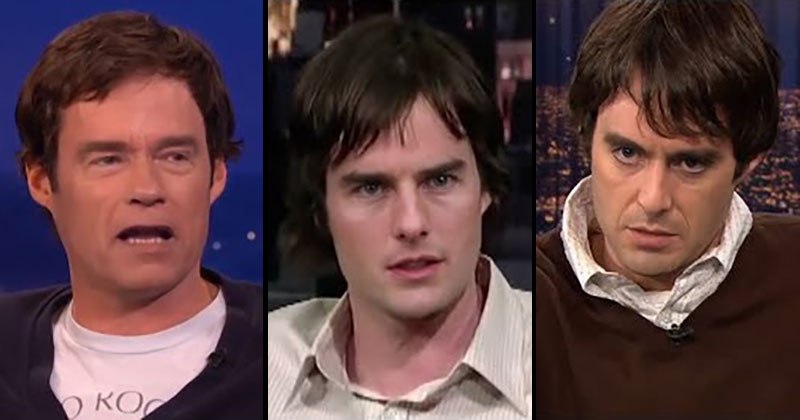
Video DeepFake Detection With Google’s DeepFake Dataset
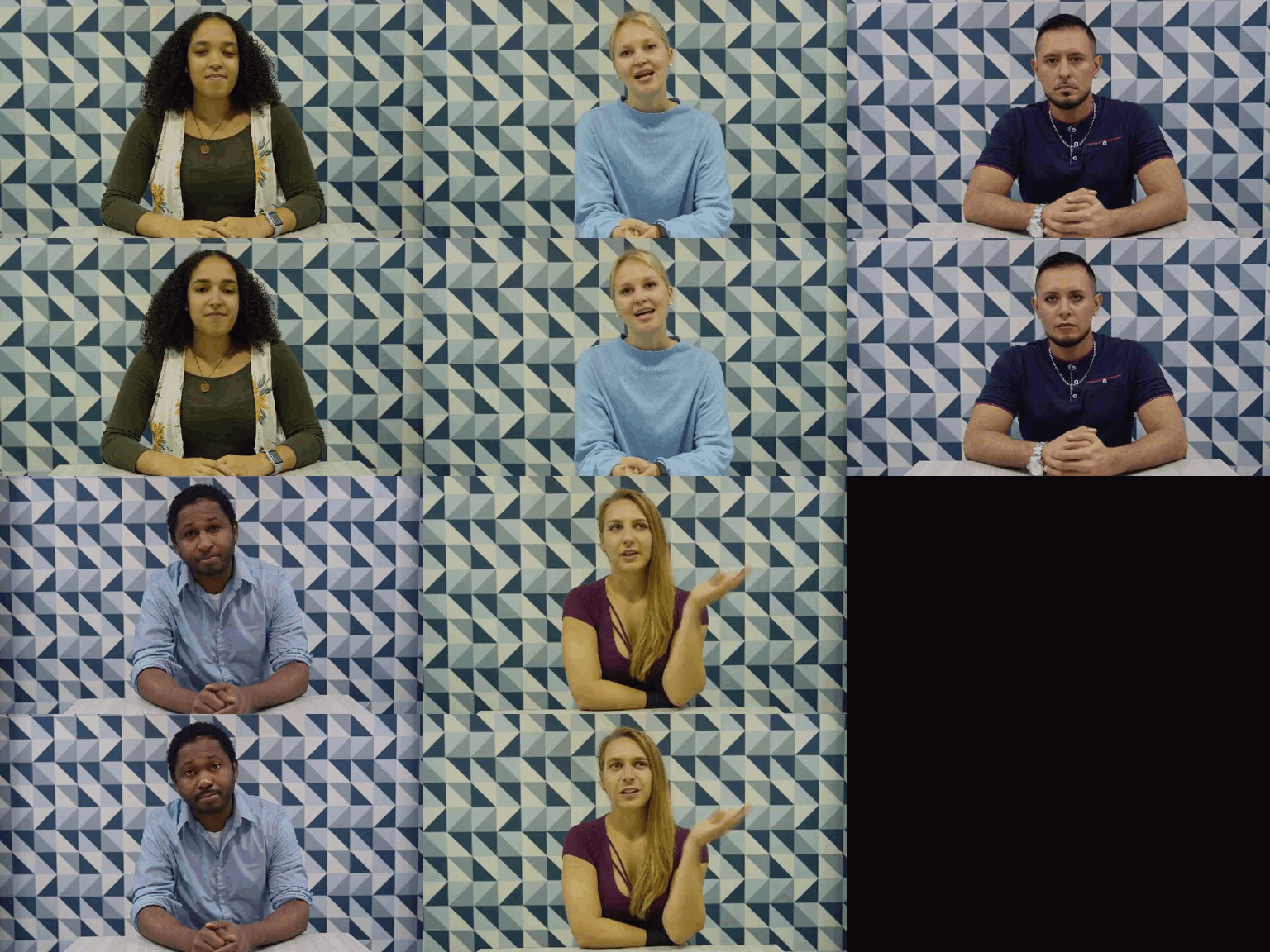 Last week, Google in collaboration with Jigsaw released a dataset of deepfakes. The researchers worked with consenting actors to record hundreds of videos in the process of preparation of the dataset. Using publicly available deepfake generation methods, many deepfakes were created from these videos. The resulting videos, real and fake, comprise our contribution, which was created to directly support deepfake detection efforts. This dataset is now available, free to the research community, for use in developing synthetic video detection methods.
Crunching Facial Datasets
There are a bunch of datasets that have been generated manually over the years for various image recognition tasks. Now with the rise of deepfakes, datasets containing faces of famous people who are usually prone to attacks can be of great use. Here are few:- Microsoft’s 1 million dataset: The 1 million celebrities are obtained from Freebase based on their occurrence frequencies (popularities) on the web. Grounding the face recognition task to a knowledge base has many advantages. First, each people entity on Freebase is unique and clearly defined without disambiguation, making it possible to define such a large scale face recognition task. Second, each entity naturally has multiple properties (e.g. gender, date of birth, occupation), providing rich and valuable information for data collecting, cleaning, and multiple task learning.
- The 'Celebrity Together' dataset: The 'Celebrity Together' dataset has 194,000 images containing 546k faces in total, covering 2622 labeled celebrities (same identities as VGGFace Dataset). 59% faces correspond to these 2622 celebrities, and the rest faces are considered as 'unknown' people. The images in this dataset were obtained using Google Image Search and verified by human annotation.
- The IMDB-WIKI dataset: Contains list of the most popular 100,000 actors as listed on the IMDb website and from their profiles date of birth, name, gender and all images related to that person.
Forgery Localisation using LSTMs
This approach involves the use of a high-confidence manipulation localisation architecture that utilises resampling features, long short-term memory (LSTM) cells, and an encoder-decoder network to segment out manipulated regions from non-manipulated ones. Resampling features are used to capture artifacts, such as JPEG quality loss, upsampling, downsampling, rotation, and shearing. This network exploits larger receptive fields (spatial maps) and frequency-domain correlation to analyse the discriminative characteristics between the manipulated and non-manipulated regions by incorporating the encoder and LSTM network.Using Adobe Forensics
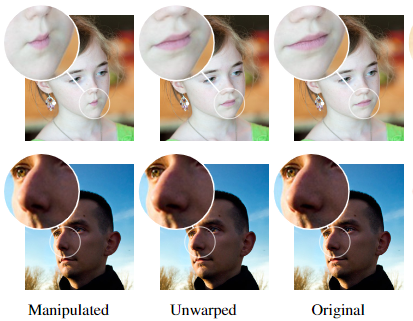 To keep the malicious actors at bay, Adobe Research team in collaboration with UC Berkeley developed a system to detect photoshopped faces. Face-Aware Liquify tool in Photoshop is scripted directly, which abstracts facial manipulations into a high level, such as “increase nose width” and “decrease eye distance”.