
5 min
The history of music is more than just creativity, it’s about technological innovation as well. From the invention of musical instruments to augmenting it with electric in the 1950s, to the advent of synthesizers and electronic music – with each innovation, the style and pallet that music offered also expanded. AI is one such big innovation coming music’s way.
AI generated music, though a relatively newer tech, has gained enough prominence. Surprisingly, the music generated by computers is also getting pretty good and remember that we are in the early days of this innovation.
Here are 7 online tools available for anyone to play with AI generated music.
 AIVA is an AI-powered online tool that lets you create soundtrack and theme music. There’s a decent number of features provided to the users and the output is actually very decent. Their preset algorithms allow composing music in pre-defined styles like Cinematic, pop, rock, etc. There’s a free version of the tool that actually lets you create unlimited tracks and have some fun out of it, though restricted to just 3 downloads per month.
Here’s what their website says about AIVA, “She has been learning the art of music composition by reading through a large collection of music partitions, written by the greatest Composers (Mozart, Beethoven, Bach, ...) to create a mathematical model representation of what music is. This model is then used by Aiva to write completely unique music.”
https://www.youtube.com/watch?v=6k-7yxNF3UM
 Another hi profile project by Elon Musk’s AI research organization OpenAI, Musenet is an interesting online tool that lets you combine different styles of music. For eg, combine Chopin with the style of lady gaga. According to the website, “MuseNet was not explicitly programmed with our understanding of music, but instead discovered patterns of harmony, rhythm, and style by learning to predict the next token in hundreds of thousands of MIDI files.”
https://www.youtube.com/watch?v=fY5omEwxWa8
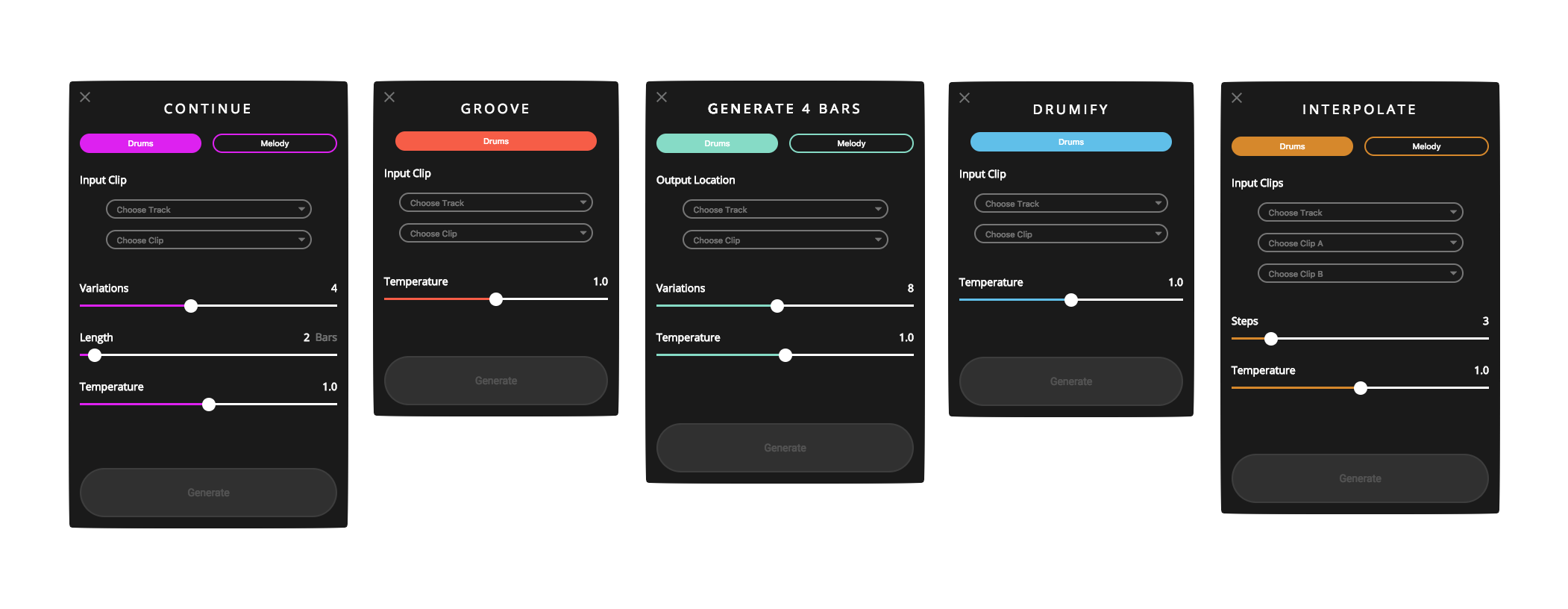 Magenta is an open source, Tensorflow based project by Google that lets you train a model on music and images and finally generate new model out of it. What makes this great is that besides being open source, it also provides for pre-trained models. So for eg: Magenta Studio is a plugin to the popular DAW for musicians called Ableton Live. The music creators that import this tool and let AI do some of its magic.
The plugin consists of 5 tools, each with its own utility: Continue, Groove, Generate, Drumify, and Interpolate. What’s more, the tools are also available standalone for download. We tested the tools ourselves on Ableton Live and have decent feedback on it (more on it in next one).
 Humtap is a mobile app that lets anyone create music on runtime on the phone. You can just hum or tap to create a melody or beat in runtime and in different styles and instruments.
 This one is a little different. Rather than create music, this tool master the tracks to sound like a pro and uses AI/ machine learning for exactly that. So, the tool would look at the production elements of the composer, match it with a large number of album grade music it is fed and then create output filters that are musically pro.
AIVA
AIVA is an AI-powered online tool that lets you create soundtrack and theme music. There’s a decent number of features provided to the users and the output is actually very decent. Their preset algorithms allow composing music in pre-defined styles like Cinematic, pop, rock, etc. There’s a free version of the tool that actually lets you create unlimited tracks and have some fun out of it, though restricted to just 3 downloads per month.
Here’s what their website says about AIVA, “She has been learning the art of music composition by reading through a large collection of music partitions, written by the greatest Composers (Mozart, Beethoven, Bach, ...) to create a mathematical model representation of what music is. This model is then used by Aiva to write completely unique music.”
https://www.youtube.com/watch?v=6k-7yxNF3UM
Musenet
Another hi profile project by Elon Musk’s AI research organization OpenAI, Musenet is an interesting online tool that lets you combine different styles of music. For eg, combine Chopin with the style of lady gaga. According to the website, “MuseNet was not explicitly programmed with our understanding of music, but instead discovered patterns of harmony, rhythm, and style by learning to predict the next token in hundreds of thousands of MIDI files.”
https://www.youtube.com/watch?v=fY5omEwxWa8
Magenta
Magenta is an open source, Tensorflow based project by Google that lets you train a model on music and images and finally generate new model out of it. What makes this great is that besides being open source, it also provides for pre-trained models. So for eg: Magenta Studio is a plugin to the popular DAW for musicians called Ableton Live. The music creators that import this tool and let AI do some of its magic.
The plugin consists of 5 tools, each with its own utility: Continue, Groove, Generate, Drumify, and Interpolate. What’s more, the tools are also available standalone for download. We tested the tools ourselves on Ableton Live and have decent feedback on it (more on it in next one).
Musico
Though still in early stages, the company plans to do a multitude of innovation using AI in music. For eg: there is a plan to create a piece of workout music that syncs with your workout rhythm, or an online radio channel that users can tweak according to their style and mood.Humtap
Humtap is a mobile app that lets anyone create music on runtime on the phone. You can just hum or tap to create a melody or beat in runtime and in different styles and instruments.
LANDR
This one is a little different. Rather than create music, this tool master the tracks to sound like a pro and uses AI/ machine learning for exactly that. So, the tool would look at the production elements of the composer, match it with a large number of album grade music it is fed and then create output filters that are musically pro.

Your reaction
Discussion
What's your take on this story?
No comments yet — be the first to share your view.