



How Significant Is Learning Through Replay

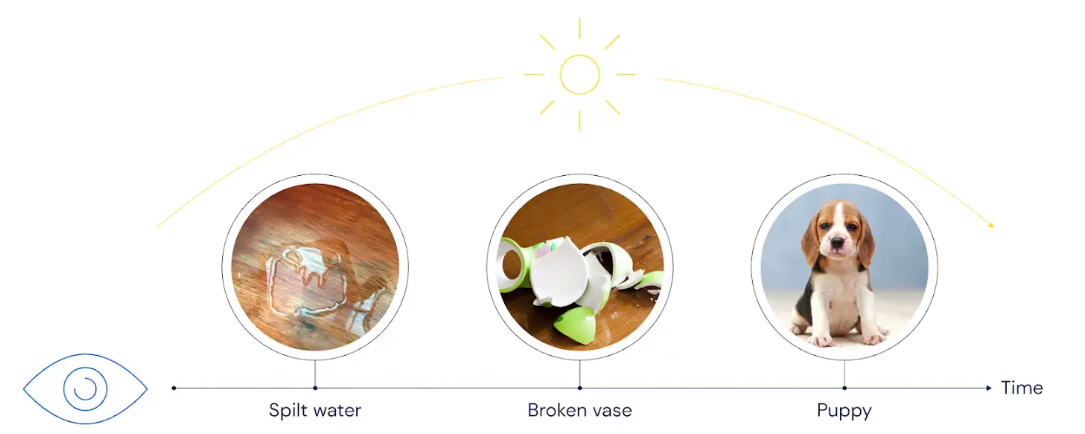 via DeepMind
To take this replay experiment to the next level, DeepMind in collaboration with Oxford and UCL have made few experiments. In these experiments, the subjects are shown a few scenes and then shown the scrambled sequence and then given five minutes to rest, while sitting in an MEG (magnetoencephalography) brain scanner.
To find how the brain builds sequences, the researchers played a new sequence for participants. In this sequence, they walk into your factory and see spilt oil on the floor. They then see a knocked over an oil barrel. Finally, they turn to see a guilty robot.
Common sense implies that the robot has spilt the oil in spite of not witnessing the act itself. This inference might come from the experiences such as those of having a kid or a dog at the house who spills water and then stands in a corner.
The researchers found the use of some abstract codes between the two narratives. These abstract codes, which incorporate the conceptual knowledge that lets people unscramble the sequences, may help the brain to retrieve the correct item for the next slot in the replay sequence.
This paints an interesting picture of a system where the brain slots new information into an abstract framework built from past experiences, keeping it organised using precise relative timings within very fast replay sequences.
Can Machines Benefit From Replaying Experience?
 Research into experience replay has unfolded along parallel tracks in artificial intelligence and neuroscience, with each field providing ideas and inspiration for the other.
Incorporating replay on computers has been beneficial to advancing AI. Deep learning often depends upon a ready supply of large datasets. In reinforcement learning, these data come through direct interaction with the environment, which takes time.
The technique of experience replay allows the agent to repeatedly rehearse previous interactions, making the most of each interaction.
Experience Replay is originally proposed in Reinforcement Learning for Robots Using Neural Networks in 1993. Experience Replay stores experiences including state transitions, rewards and actions, which are necessary data to perform Q learning.
Q-learning is a model-free reinforcement learning algorithm. The goal of Q-learning is to learn a policy, which tells an agent what action to take under what circumstances.
This method proved crucial for combining deep neural networks with reinforcement learning in the DQN agent that first mastered multiple Atari games.
Deep Q-Network(DQN) is introduced in 2 papers, Playing Atari with Deep Reinforcement Learning on NIPS in 2013 and Human-level control through deep reinforcement learning in 2015.
Since the introduction of DQN, the efficiency of replay has been improved by preferentially replaying the most salient experiences from memory, rather than simply choosing experiences at random for replay.
Further improvements in agent performance have come from combining experiences across multiple agents, learning about a variety of different behaviours from the same set of experiences.
Experiments such as the above show that a carefully constructed AI algorithm can reach superhuman performance and the potential of AI to enter the coveted arena of AGI looks higher than ever before.
Read the original paper here.

Read nextCoding Dopamine: How DeepMind Brought AI To The Footsteps Of NeuroscienceContinue reading →
- Top Twitter Accounts To Satiate Your AI Curiosity In 2020
- Reinforcement Learning With Augmented Data Is So Superior It Beats Google & DeepMind Hands-down
- 11 Ways AI Is Fighting Coronavirus Outbreak
- DeepMind Releases Algorithm To Create Mind-Blowing Paintings Just From Text
- DeepMind Compares How Children And AI Explore The World