
There has been an exponential increase in R&D related to virtual reality, photorealistic computer animations and augmented reality. Researchers from around the globe are working in these domains and have been creating machines which have the abilities of a human — or humanoid robots.
This is an emerging research domain which is now playing a crucial role in robotics research. However, according to the uncanny valley theory, the humanoid objects which imperfectly resemble actual human beings provoke uncanny or strangely familiar feelings of revulsion in observers.
The IEEE spectrum ranks robots into three categories, — top-rated, creepiest and most wanted. In this article, we list down the top 10 creepiest robots ranked by the IEEE spectrum.
(These creepy robots are listed according to their rankings)
1| Telenoid

Country: Japan
Creator: ATR
Year: 2010
Telenoid is developed by the researchers from Osaka University and Advanced Telecommunications Research Institute International (ATR). This robot secures the first position as the creepiest robots by the IEEE spectrum and is a portable teleoperated android robot which is created for effectively transfer peoples’ presence.
2| Diego-San

Country: United States
Creator: UC San Diego, Kokoro, and Hanson Robotics
Year: 2010
Diego-San is a humanoid which comprises of a Hanson Robotics-created head and a body by Japan’s Kokoro. It is a learning robot which is modelled after a 1-year-old baby. The head accommodates all the hardware which powers its expressive face.
3| Kaspar
Country: United Kingdom
Creator: University of Hertfordshire
Year: 2005

Kaspar is a child-sized humanoid robot which is capable of showing different expressions. The face of this robot is a mask which is used in training mannequins designed for teaching CPR. The robot can be controlled by the external PC via USB or wirelessly using an onboard mini PC.
4| CB2

Country: Japan
Creator: Osaka University
Year: 2006
CB2 is a child-robot with a biomimetic body which can record emotional expressions using eye-cameras, then memorise and match them with physical sensations, and cluster them on its circuit boards. This robot performs motions like dangles its legs from a chair as its shoulders rise and fall with rhythmic breathing and its black eyes follow movements across the room.
5| Flobi

Country: Germany
Creator: Bielefeld University
Year: 2009
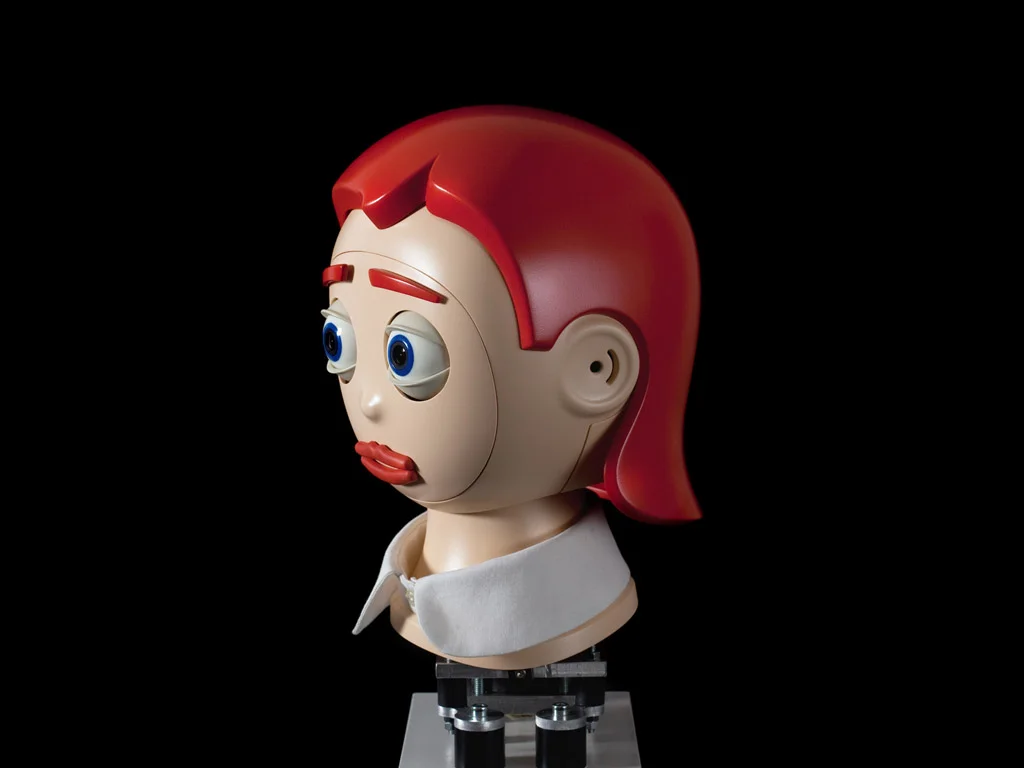
Flobi is a robotic head that can express human-like emotions like shame, sadness, happiness, etc.. The robot head of Flobi appears as a cartoon-like character and has a ‘hole-free’ design without any visible conjunctions.
6| Pneuborn

Country: Japan
Creator: Osaka University
Year: 2009
Pneuborn is a robotic infant simulator that focuses on the development of musculoskeletal systems. It can teach itself to crawl, sit, and stand using pattern generators and learning algorithms. The researchers developed this robot to demonstrate that the musculoskeletal infant robot can be a good platform to investigate motion development.
7| ECCE

Country: France
Creator: The Robot Studio and ECCEROBOT Project
Year: 2009
ECCE (Embodied Cognition in a Compliantly Engineered Robot) is a humanoid robot that uses artificial bones, muscles, and tendons to move as a normal human being does. The feature of this robot includes holding a conversation over Skype with head direction and gestures controlled by the remote operator.
8| Kobian

Country: Japan
Creator: Waseda University
Year: 2007
Kobian is a humanoid which is capable of displaying expressions of emotion and was developed to realise culture-specific greetings. The robot can also simulate human speech including the movement of the lips and the oscillations of the head.
9| Geminoid Hl

Country: Japan
Creator: Osaka University, ATR, and Kokoro
Year: 2006
This robot is an android twin of its creator, Hiroshi Ishiguro which also reproduces the voice and head movements of another operator including Ishiguro. The bot can be remotely controlled via a motion capture system which tracks Ishiguro's mouth movements and allows the bot to speak his voice.
10| Kismet

Country: United States
Creator: MIT
Year: 1998
Kismet is a robot head created at MIT. To facilitate a natural infant-caretaker interaction, the robot is equipped with visual, auditory, and proprioceptive sensory inputs. Kismet's social intelligence software system or synthetic nervous system (SNS) was designed with human models of intelligent behaviour in mind.

Your reaction