


Key takeaways
- Facebook is committed to advancing AI, demonstrated by its open-sourcing of the LASER NLP toolkit.
- Machine learning at Facebook enhances developer productivity through tools like code search, recommendations, and bug fixing.
- AI tools are being used to tackle various challenges across Facebook's product range, as highlighted by the CTO during the conference.
- The company has a long history in computer vision, particularly with its auto-tagging photo feature using advanced neural networks.

Computer Vision
Facebook started out very early in the domain of face recognition with machine vision. Its auto-tagging photo feature uses convolutional neural networks(CNNs). And these neural networks got better as people shared billions of photos over more than half a decade.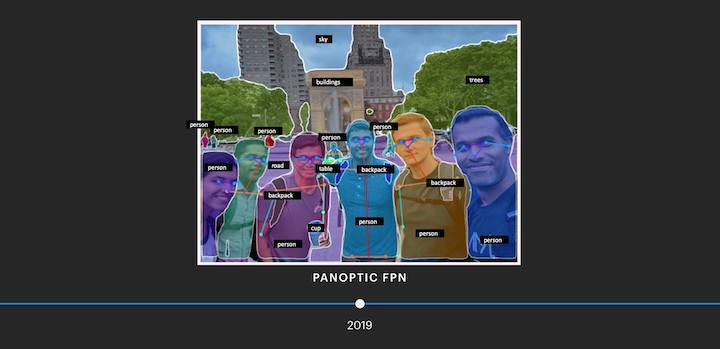 Now these CV systems have recognised progressively more image components over the years and can now perform detection of objects in both the foreground and the background with a single network. This results in better understanding of a photo’s overall context, as well as more computationally efficient image recognition.
This was achieved using a new approach to object recognition, called a panoptic feature pyramid network (Panoptic FPN), which enables instance segmentation tasks (for the foreground) and semantic segmentation tasks (for the background) at the same time, on a single, unified neural architecture.
Content Curation
Finding policy violations within video is orders of magnitude harder than in photos. In many videos, however, only a few clips have information that’s salient to a specific task, such as detecting bullying, and the rest are either redundant or irrelevant. So a new approach where hashtagged videos functioned as weakly supervised data, meaning training examples whose labels had been applied by people, but without the precision of full supervision. This led to a 5.1 percent improvement over the previous state of the art’s 77.7 percent accuracy. The majority of the systems today rely on supervised training and the lack of enough training data makes these models not so reliable. With these new approaches Facebook pushes for self-supervision with support from AI pioneers like Yann LeCun who also is the Chief AI Scientist at Facebook.PyTorch 1.1
PyTorch is one of the hottest products to come out of Facebook. Facebook uses PyTorch 1.0 end-to-end workflow for building and deploying translation and natural language processing (NLP) services at scale. These systems provide nearly 6 billion translations a day for applications such as real time translation in Messenger and, as the foundation of PyText, power complex models that rely on multitask learning in NLP. Companies like Airbnb and Microsoft also leverage PyTorch to build conversational AI applications and other cognitive services. The ongoing evolution of PyTorch serves as an example of the power of open, community-led development in AI. Key Features:- Improved performance for common models such as CNNs
- Added support for multi device modules including the ability to split models across GPUs while still using Distributed Data Parallel (DDP)
- PyTorch-BigGraph: PBG is a distributed system for creating embeddings of very large graphs with billions of entities and trillions of edges.
Open Source Tools
- BoTorch: BoTorch is a research framework built on top of PyTorch to provide Bayesian optimization, a sample-efficient technique for sequential optimization of costly-to-evaluate black-box functions.
- Ax: Ax is an ML platform for managing adaptive experiments. It enables researchers and engineers to systematically explore large configuration spaces in order to optimize machine learning models, infrastructure, and products.
- BigGAN-PyTorch: This is a full PyTorch reimplementation that uses gradient accumulation to provide the benefits of big batches on as few as four GPUs.
- Curve-GCN: A real-time, interactive image annotation approach that uses an end-to-end-trained graph convolutional network (GCN)

