
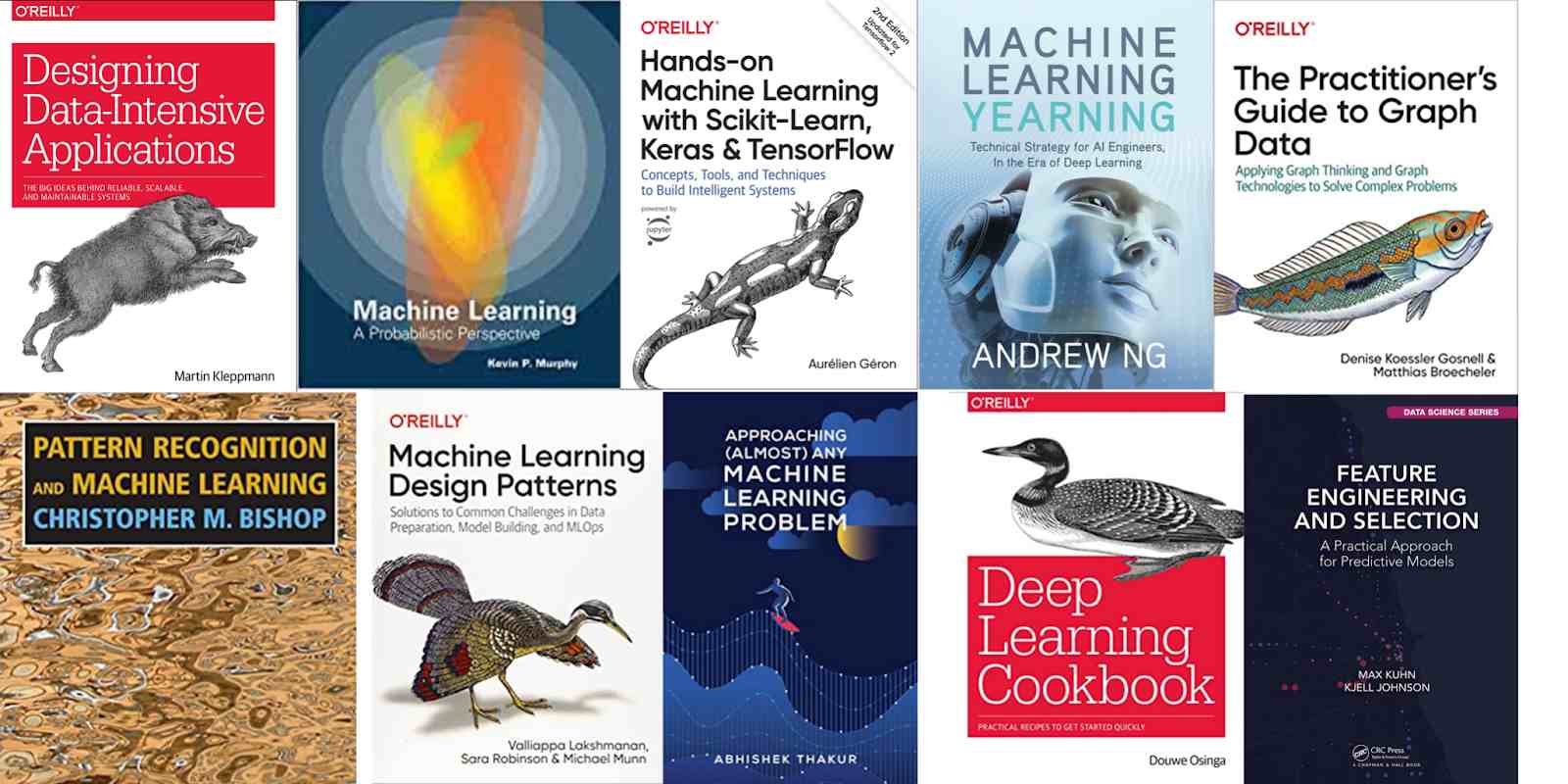
There is no dearth of sources when it comes to mastering machine learning. Now this is a problem too. Be it a book or a blog, beginners and those looking for a career transition might find it challenging to pick the right resource. So, we have asked machine learning practitioners for the right books to begin with to gain a comprehensive understanding of all things machine learning.
Here’s the list (In no particular order):
Designing Data-Intensive Applications
by Martin Kleppmann

Designing data intensive applications is one of the most widely read books by data engineers across the world. In this book, author Martin Kleppmann offers a diverse landscape as he examines the pros and cons of various technologies for processing and storing data. This book covers the following:
- Strengths and weaknesses of different tools
- A treatise on consistency, scalability, fault tolerance, and complexity of applications
- Distributed systems and how modern databases are built
- Behind the scenes of major online services
Find it here.
Machine Learning Yearning
by Andrew Ng

In this book, well-known ML researcher and tutor, Andrew Ng walks readers through the nitty gritties of an ML project and its diagnostics. This book focuses on how to make ML algorithms work. Through Machine Learning Yearning, readers get a decent understanding of how to prioritise the directions for an AI project and diagnose errors while building complex ML systems.
(Recommended by Sahar Mor)
Find it here.
Feature Engineering and Selection: A Practical Approach for Predictive Models
By Max Kuhn and Kjell Johnson

While most books talk about how to develop predictive models, they miss out on a key aspect of modeling. In this book, authors Max Kuhn and Kjell Johnson describe techniques for finding the best representations of predictors for modeling and for finding the best subset of predictors for improving model performance. A variety of example data sets are used to illustrate the techniques along with R programs for reproducing the results.
(Recommended by Martin Henze)
Find it here.
Machine Learning Design Patterns
by Valliappa Lakshmanan, Sara Robinson, Michael Munn

This book captures best practices and solutions to recurring problems in machine learning. According to the authors, these design patterns codify the experience of hundreds of experts into straightforward, approachable advice. The authors have included detailed explanations of 30 patterns for data and problem representation, operationalisation, repeatability, reproducibility, flexibility, explainability, and fairness. Each pattern comes with a description of the problem, potential solutions, and recommendations for choosing the best technique for your situation.
(Recommended by Ram Seshadri)
Find it here.
Deep Learning Cookbook
by Douwe Osinga

In this book, readers will learn how to solve deep-learning problems for classifying and generating text, images, and music. The author has framed each chapter in such a way so that the readers get to complete the project through multiple techniques. Author Osinga also provides a chapter with half a dozen techniques to help the readers who are stuck. Examples are written in Python with code available on GitHub as a set of Python notebooks.
(Recommended by Ram Seshadri)
Find it here.
Hands on Machine Learning
by Aurelien Geron

One of the popular books in the ML community, this practical guide by Aurelien Geron uses concrete examples and minimal theory via Scikit-Learn and TensorFlow frameworks. This book helps the readers gain an intuitive understanding of the concepts and tools for building intelligent systems. Readers will learn a range of techniques, starting with simple linear regression to deep neural networks.
(Recommended by Ram Seshadri)
Find it here.
Approaching Almost Any Machine Learning problem
by Abhishek Thakur

In this book, 4x Kaggle Grandmaster, Abhishek Thakur dives deep into the concept of ML techniques. This book assumes some theoretical knowledge of deep learning (and well on track to applied ML level) on the part of the reader. The book jumps straight into the hands-on aspect of working with ML.
(Recommended by Ram Seshadri)
Pattern Recognition and Machine Learning
by Christopher M. Bishop

No ML book list is complete without this seminal work by Christopher Bishop. At a time when machine learning was still restricted to labs, Bishop played a key role in making ML palatable to masses. Even after many years of publishing, this book still stands out and is highly recommended by top ML practitioners. The book expects the readers to be familiar with multivariate calculus and basic linear algebra.
(Recommended by Sanjeev Sharma, Founder, Swaayatt Robots)
Find it here.
Machine Learning A Probabilistic Perspective
By Kevin Murphy

In this book, Kevin P. Murphy, a Senior Staff Research Scientist at Google Research, offers a treatise of topics such as probability, optimization, and linear algebra as well as conditional random fields, L1 regularization, and deep learning. Written in an informal, accessible style, this book is complete with pseudo-code for the most important algorithms. Rather than providing a cookbook of different heuristic methods, the author tries a principled model-based approach, often using the language of graphical models to specify models in a concise and intuitive way.
(Recommended by Sanjeev Sharma)
Find it here.
The Practitioner's Guide To Graph Data
by Gosnell & Broecheler

In this book, authors Denise Koessler Gosnell and Matthias Broecheler show data engineers, data scientists, and data analysts how to solve complex problems using graph databases. Readers get to explore templates for building with graph technology, along with examples that demonstrate how teams think about graph data to build a Customer 360 application.
(Recommended by Sandip Bhattacharjee, Chief Data Scientist at Tabsqaure.ai)
Find it here.

Your reaction
Discussion
What's your take on this story?
No comments yet — be the first to share your view.