
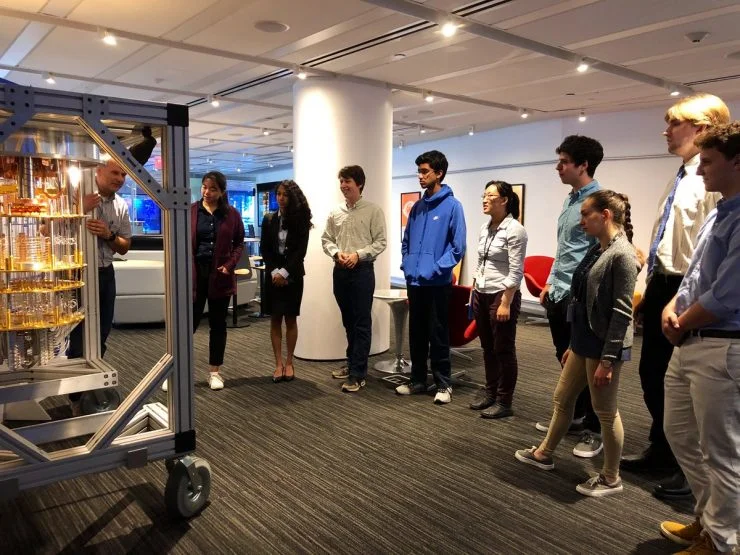
A quantum computer offers exorbitant processing power compared to classical computers. This is achieved by manipulating qubits.
Generating and managing Qubits is a huge challenge. “While the classical computer is very good at calculus, the quantum computer is even better at sorting, finding prime numbers, simulating molecules, and optimization, and thus could open the door to a new computing era,” according to a Morgan Stanley report. In other words, Quantum computing is the future.
We have curated a list of quantum computing project ideas.
(The list is no particular order)
Q-score
Introduced last year by Atos, Q-score is a free and open-source quantum metrics that apply to all programmable quantum processors. Q-score measures a quantum system’s effectiveness at handling real-life problems which traditional computers cannot solve, rather than simply measuring its theoretical performance. It is the only metrics system based on near-term available quantum algorithms and measures a quantum system’s capacity to solve practical operational problems.
Know more here.
Open Catalyst Project
Open Catalyst Project is an open-source project to solve renewable energy storage problems using quantum mechanics. The project is a collaborative research effort between Facebook AI Research (FAIR) and Carnegie Mellon University’s (CMU) Department of Chemical Engineering. The main goal of this project is to use AI and quantum computing to model and discover new catalysts for use in renewable energy storage to help address climate change. The developers have released the Open Catalyst Dataset for training ML models to enable the research community to participate in this project. The dataset contains 1.2 million molecular relaxations with results from over 250 million DFT calculations.
Know more here.
Quantum computing to a particle process
A team of researchers at Berkeley Lab used a quantum computer to simulate an aspect of particle collisions typically neglected in high-energy physics experiments, such as those that occur at CERN’s Large Hadron Collider. The developed quantum algorithm accounts for the complexity of parton showers, which are complicated bursts of particles produced in the collisions that involve particle production and decay processes. The researchers constructed a “toy model,” a simplified theory that can be run on an actual quantum computer while still containing enough complexity that prevents it from being simulated using classical methods.
Know more here.
COVID-19 detection on IBM quantum computer
Researchers Erdi Acar and İhsan Yilmaz used quantum transfer learning method in different quantum real processors (IBMQx2, IBMQ-London and IBMQ-Rome) and simulators (Pennylane, Qiskit-Aer and Cirq) for COVID-19 detection. By using a small number of data sets such as 126 COVID-19 and 100 Normal CT images, the duo obtained a positive or negative classification of COVID-19 with 90% success in classical computers and a high success rate of 94-100% in quantum computers.
Know more here.
Qiskit
Qiskit is an open-source SDK for working with quantum computers at the level of pulses, circuits and application modules. The framework accelerates the development of quantum applications by providing the complete set of tools needed for interacting with quantum systems and simulators. Using this framework, you can study and reduce the impact of noise using built-in modules for noise characterization and circuit optimization. You can also execute code on multiple quantum hardware architectures, from superconducting qubits to trapped-ions and access a rich set of well-studied circuits, which can be used as benchmarks, building blocks in more complex circuits, or as a tool to explore quantum computational advantage.
Know more here.
Tequila
Tequila is an Extensible Quantum Information and Learning Architecture where the main goal is to simplify and accelerate the implementation of new ideas for quantum algorithms. It operates on abstract data structures allowing the formulation, combination, automatic differentiation and optimization of generalized objectives. Tequila can execute the underlying quantum expectation values on the state of the art simulators and real quantum devices.
Know more here.

Your reaction
Discussion
What's your take on this story?
No comments yet — be the first to share your view.