
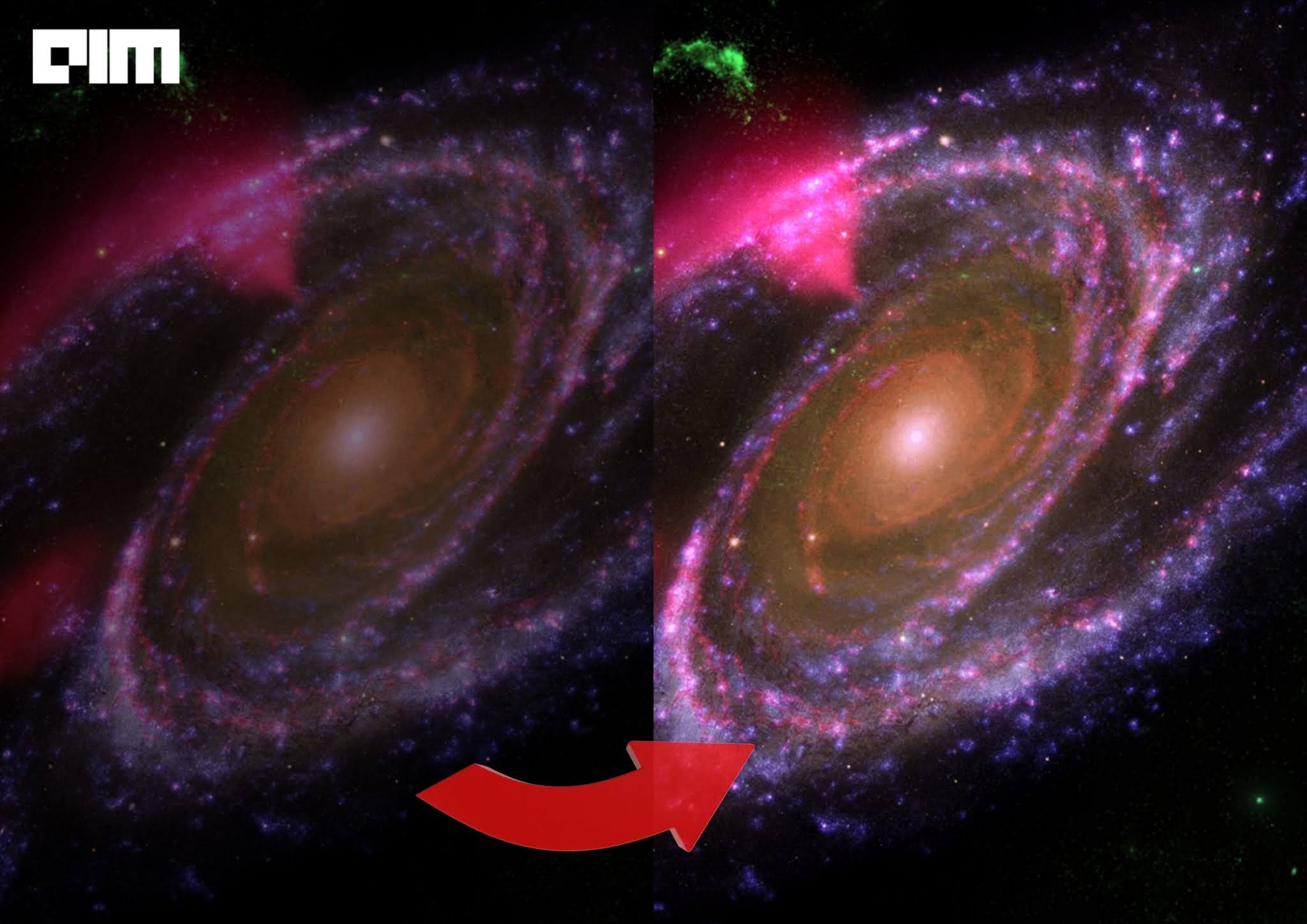
The Big Bang theory posits our Universe is ever-expanding. Edward Hubble has confirmed the Expanding Universe hypothesis through analysis of galactic redshifts. Currently, our Universe is about 93 billion light-years in diameter.
Recently, researchers from Carnegie Mellon University and the University of California have developed a way to create a complex simulated universe in under 24 hours combining supercomputing, machine learning and astrophysics. The team of researchers included Tiziana Di Matteo, Rupert Croft, Flatiron, Yin Li, Yueying Ni and Yu Feng.
Methodology
Cosmological simulations help extrapolate the mysteries of the Universe, including dark matter and dark energy. Up until now, the researchers had two options: simulations focused on a small area at high resolution or a big chunk of the Universe at low res.
Cosmological simulations are expected to cover a large volume for cosmological studies and calls for high res to resolve the small-scale galaxy formation physics, which would meet daunting computational challenges. The technique we have developed can be used as a powerful and promising tool to match the two requirements at the same time by modelling the small-scale galaxy formation physics in large cosmological volumes, said Yuyeing Ni.
The researchers trained a machine learning algorithm based on neural networks to upgrade the fidelity of simulations.
The trained code takes full-scale, low-res models to create super-resolution simulations with up to 512 times as many particles. It will take 560 hours to make high-res simulation of a region 500 million light-years across with 134 million particles using a single processing core. The researchers can carry out the same task in 36 minutes using the same app approach.

The researchers used a generative adversarial network, pitting two neural networks against each other. One network intake low-resolution simulations of the Universe and utilises them to generate high-res models. The other network tries to tell those simulations apart from ones made by conventional methods. Over time, both neural networks get incrementally better and the simulation generator creates faster simulations than conventional ones.
With our previous simulations, we showed that we could simulate the Universe to discover new and interesting physics, but only at small or low-res scales. By incorporating machine learning, the technology can catch up with our ideas, said Croft.
Wrapping up
Some free simulation codes are also available including the latest GADGET-4, a parallel cosmological N-body and hydrodynamical code for simulations of cosmic structure formation as well as calculations related to galaxy evolution and galactic dynamics.
While constructing new models and simulations, it is crucial to keep in mind that the primary goal of simulations is not primarily to fit observed data but rather to gain insights into galaxy formation physics. Advances in this direction benefit often more from failures of certain ideas or models.
It's clear that AI is having a big effect on many areas of science, including physics and astronomy. Our AI Planning Institute program is working to push AI to accelerate discovery. This new result is a good example of how AI is transforming cosmology, said James Shank, one of the program director in the US National Science Foundation's Division of Physics.
The research was funded and supported by the NSF, the NSF AI Institute. The research was powered by the fastest academic supercomputer in the world, the Frontera supercomputer at the Texas Advanced Computing Center (TACC).

Your reaction
Discussion
What's your take on this story?
No comments yet — be the first to share your view.