
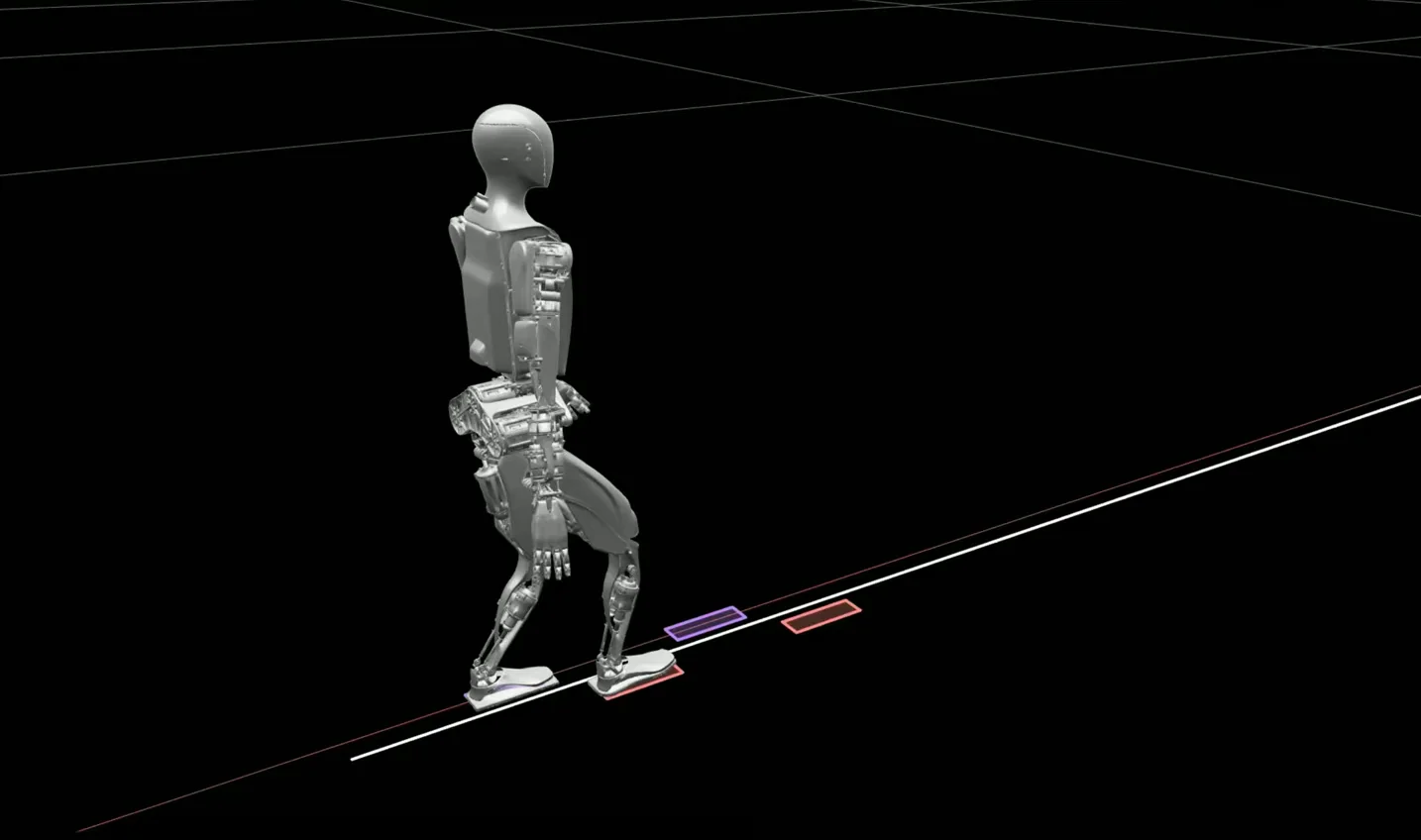
On Tesla AI Day 2022, Elon Musk revealed a working prototype of the Optimus Robot. Still in early stages of development, Optimus works on the mechanism of Tesla’s self-driving cars and also showcases capabilities of practical tasks.
Though Optimus is trained with techniques like locomotion planning and using sensors to predict the walking surface, Christian Hubicki, robotics professor and Director of Optimal Robotics Lab, pointed out that Optimus seems to be working on the method called Zero-Moment Point (ZMP) to balance its weight during each next step by bending knees and tilting backwards or forward.
ZMP is the dynamic model for the control of legged locomotion (biped locomotion) in robots and humanoids. Essentially, the algorithm or technique specifies the point where the sum of gravity forces and horizontal inertia is zero during the contact of each foot to the ground. This ensures that there is no moment of inertia in the horizontal direction while walking—meaning, the robot won’t tip over while taking each step due to uneven weight distribution by ensuring all the weight is on the centre of gravity of the robot.
Optimus uses electrical actuators for locomotion while the much-compared Boston Dynamics’ ATLAS uses a high powered hydraulic actuator which heavily drains the battery. ‘Cassie’, the prototype bipedal robot developed by Agility Robotics, balances itself dynamically at every step based on the gait library method and is a closer comparison to the locomotion technique of Tesla’s robot’s Zero-Moment Point (ZMP).
Biped locomotion has been researched for decades now. Miomir Vukobratović introduced the concept of ZMP in the legged locomotion community in 1968 at the Third All-Union Congress of Theoretical and Applied Mechanics in Moscow.
Biped Locomotion Mechanism
Biped robots are designed to mimic human-like locomotion and have an advantage over other multi-legged robots because they are highly adaptable. Irrespective of the structure and design of a robot, the basic characteristics of a biped locomotion robot are:
- Passive Degrees of Freedom (DOF): DOF can be simply referred to as the number of movable joints of a robot. A passive DOF is the possibility of occurrence of a new “joint” because of disturbances from outside during movement of one foot, causing changes in the overall system.
- Gait repeatability or gait symmetry.
- Regular interchangeability between double support phase (DSP) and single support phase (SSP).
The development and improvement of biped robots and establishing these characteristics for stability has been challenged by few problems:
- Passive joints that are not in contact with the ground make the structures unstable.
- The gait cycle has varying configurations during locomotion, changing with every step—DSP is when both feet are on the ground and SSP is when one foot is on the ground and the other is in the process of being transferred from back to front, also known as the ‘unstable’ stage.
- Robots interact with different surfaces and environments which affects the algorithm.
ZMP in Optimus
In DSP, it is easy to determine the zero-moment point by calculating the position of the centre of gravity (COG) or the hip trajectory. To maintain the stability of robots during SSP, which comprises 80% of the gait cycle of a biped robot, DSP is incorporated and all the joints are actuated and rigidly controlled to track the hip trajectory, which simplifies the control task. Both of these processes depend on linear pendulum mode (LPM) for prediction of the centre of gravity.
Since, the point of contact between the foot and the ground cannot be controlled directly like the other mechanism joints, it is indirectly controlled by enabling and ensuring appropriate dynamics of mechanism present above the foot, like the COG of the hip trajectory. Therefore, ZMP is the point where all the forces acting on the mechanism can be replaced by a single force and should be inside the support polygon.

The support polygon is the area on a horizontal plane where the applied and reactionary force coincide, or simply, the sole of the foot. In a balanced gait, ZMP and COG coincide, therefore it is easy to find out and maintain equilibrium in the mechanism. In the above figure, ‘P’ is the zero-moment point.
In the case of a disturbance that can cause rotation of the foot, the ZMP might shift to the edge of the foot and result in a disbalance of the mechanism. Though it still remains in the support polygon, the area on the edge reduces, and thus causes imbalance. In this case, by tracking the hip trajectory, the robot can balance itself by shifting its weight across the system.
Therefore, assumably, by training, locomotion planning, and scanning the walking path and surface in front of it, the steps that Optimus takes by calculating the hip trajectory and bending its knees to ensure all the force is on its centre of gravity, seems to be working on a method based on Zero-Moment Point calculation.

Your reaction
Discussion
What's your take on this story?
No comments yet — be the first to share your view.