
Anthropic today released the Claude 3 model family which comprises Claude 3 Haiku, Claude 3 Sonnet, and Claude 3 Opus.
Opus is the flagship model of the Claude 3 family. Meanwhile, Claude 3 Sonnet is designed for enterprise workloads, and Claude 3 Haiku stands out as the fastest and most compact model, ensuring near-instant responsiveness. It excels at answering simple queries and requests with unmatched speed
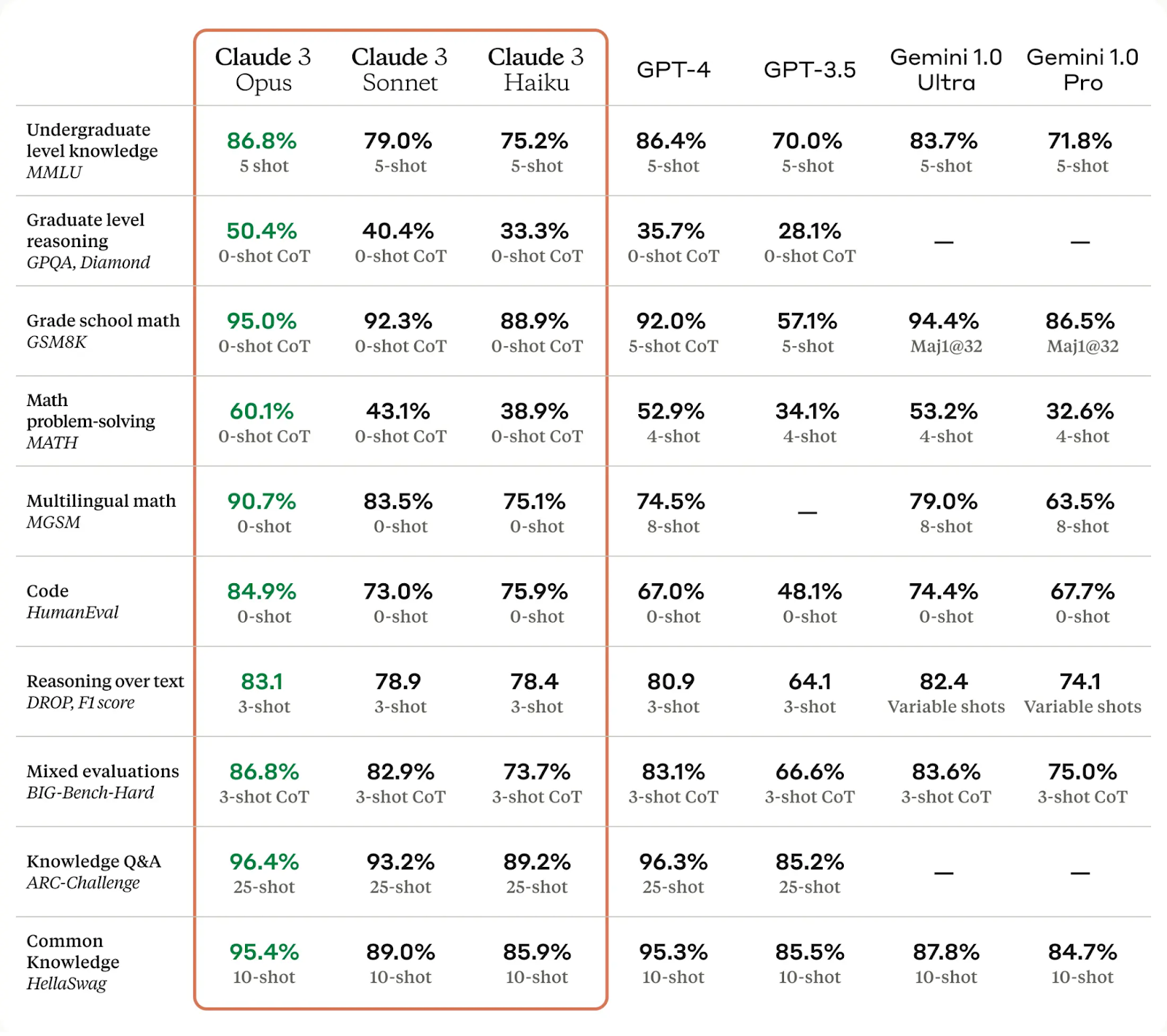
Claude 3 Opus (the strongest model) outperforms GPT-4 on common benchmarks like MMLU and HumanEval. Claude 3 capabilities include analysis, forecasting, content creation, code generation, and conversing in non-English languages like Spanish, Japanese, and French.
The Claude 3 family initially offers a 200K context window, but all models are capable of processing inputs exceeding 1 million tokens. Opus, in particular, showcases near-perfect recall, surpassing 99% accuracy in the 'Needle In A Haystack' evaluation. In contrast Gemini 1.5 has a context window of 1 million tokens.
The Claude 3 models prove their mettle by enabling near-instantaneous results, fueling live customer chats, auto-completions, and real-time data extraction tasks. Haiku stands out as the fastest and most cost-effective in its category, delivering remarkable performance, reading through information-dense research papers in less than three seconds.
The models also have strong vision capabilities for processing formats like photos, charts, and graphs. Anthropic claims these models have a more nuanced understanding of requests and make fewer refusals.
The input cost for Opus is $15 per million tokens, with an output cost of $75 per million tokens. For Sonnet, the input cost is $3 per million tokens, and the output cost is $15 per million tokens. As for Haiku, the input cost is $0.25 per million tokens, and the output cost is $1.25 per million tokens.
Opus and Sonnet are available to use today in API, which is now generally available, enabling developers to sign up and start using these models immediately. Haiku will be available soon. Sonnet is powering the free experience on claude.ai, with Opus available for Claude Pro subscribers.
Sonnet is also available today through Amazon Bedrock and in private preview on Google Cloud’s Vertex AI Model Garden—with Opus and Haiku coming soon to both.
It's time OpenAI released GPT-5. In conversation with Bill Gates, OpenAI Chief Sam Altman spoke at length about GPT-5, emphasising on customisation and personalisation.
“The ability to know about you, your email, your calendar, how you like appointments booked, connected to other outside data sources—all of that. Those will be some of the most important areas of improvement,” said Altman. Furthermore, he claimed that GPT-5 would have much better reasoning capabilities than GPT-4.
- Tech Mahindra Partners With SpaceXSI to Bring AI Into Software Engineering
- Infosys AI Revenue Rises 29% in Q2, FY27 Growth Guidance Cut
- LTM Launches BlueVerse Industrial AI Lab in Chennai
- Chariot Launches Speech Recognition Model for 10 Indian Languages
- Meta Expects Up To $145 Billion In Capex As AI Investments Expand
- Cyient's Technology Order Intake Rises 39.7% as It Expands AI Capabilities