

5 min
 Since the discovery and emergence of computers, we know that they lack thought capacities. That is something where human mind surpasses computing technologies. However, the present times narrate a different story. Computers might not possess cognitive abilities, but they are capable of executing operations which completely rely on human perceptions.
Whether it is business security, critical processes or customer experiences, it is possible to utilize the power of automation. From handwriting recognition, face identification and behavioral pattern determination to any task requiring cognitive skills, computers are capable of delivering the right solutions.
Defining cognitive technology
With that brief introduction, we arrive at describing cognitive technologies. What we aim at enumerating in the article is the amalgamation of human cognitive intelligence and computing power, yielding a brand new tech innovation. Well, the name of this innovation is cognitive technology, and it is creating wonders for numerous industrial sectors across the globe. Let us get down to deriving a working definition of cognitive technology. The term ‘cognitive technology’ refers to the ability of a machine (precisely computers), to facilitate interactions with humans, by utilizing unstructured or structured data. The process also involves the application of self-learning or machine learning models for predicting outcomes beforehand.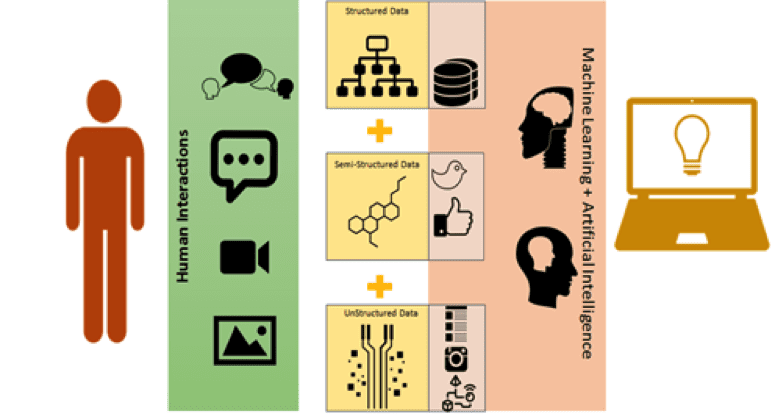 Breaking it further into three segments as the definition progresses:
-
Interaction with Humans
-
Utilizing structured and unstructured data
- Between people and people (Which has been happening since ever through various mediums)
- Between things and people (Which we have mastered to quite an extent but still has a brilliant future)
- Between things and things (Which is the next big thing which is going to happen)
-
Self-Learning and Machine learning
Cognitive technology: The why’s and how’s
Cognitive technology has successfully met the demands of each of these sectors. And it is here that we need to find out how. Business analysts and thought leaders classify cognitive technology applications into three broad categories, namely process, product, and insight.- Process cognitive: As the term suggests, process applications aim to integrate themselves into the organizational workflow. In this case, cognitive technologies get embedded within existing business operations, thus automating or improving operations.
- Product cognitive: Product cognitive refers to the integration of the technology into a specific product or service, thus ensuring unparalleled end benefits for customers.
- Insight applications: Other than processes and products, businesses also have insights. Cognitive technology finds application in the identification, assessment and evaluation of these technologies resulting in strategic and decisive business moves.
Why is it important?
Technical innovations prepared the grounds for rapid innovations in this sector. The emergence of natural language processing, ML or machine learning as well as speech recognition systems, takes computational operations to unsurpassed heights. To be precise, cognitive technology empowers the IT infrastructure of an enterprise. As the result, business organizations are better equipped to make cost cut-downs by ensuring increased productivity and enhanced operational speed. According to the prevailing market trends, the power of cognitive and artificial intelligence will take-off towards unsurpassed excellence in the next 5 years, only if users know the art of incorporating it. In-depth knowledge and acquired expertise will create a win-win situation whereas half-hearted efforts and incomplete knowledge will bring about doomsday. Take a look at the following points for a brief outline of the significance, use and implementation of cognitive technologies by some organizations:Netflix
A unique example of cognitive technology implementation into product offerings is Netflix. It is a movie rental service for movies and TV Series online. As any online platform, it suggests users more stuff to watch. Now if, the users’ interest can be predicted and the suggested content is in accordance with the interest, it hits the bull’s eye. What is done: Machine learning is used to understand what kind of content a user would like based upon his/her past experiences. Accordingly, more content could be predicted and is suggested to users. This movie rental service on the virtual platform features a recommendation option that utilizes machine learning to predict customer preference What is achieved: Since there is a synch between what user is expecting and what is being suggested, the users end up watching the recommended or suggested content. The impact of this particular feature is undeniable, as it accounts for almost 75% of Netflix’s usage now.IBM
Another brilliant example is of IBM Healthcare where they are using huge amount of data which is spread across large populations and are deducing conclusions and results which can be further utilized to improvize the working efficiency and counter-strike the issues faced by the organizations.. They are working with various global medical institutes and hospitals and the results are indeed impeccable. One of them is a busy hospital which is delivering around 5000 babies, hosting 23,000 surgical operations, more than 588 open heart surgeries and around 70 kidney transplant per year. What is done: At such busy hospital, readmission of patients creates a crunch of resources and the patients who might be needing more attention are not attended or are attended but late because of readmissions. The idea was to about reduce the number of readmissions in the hospital for chronic disorders. Started with COPD, IBM healthcare made a predictive model for the risk of readmissions so that intervention could be done at the right time What is achieved: The accuracy of prediction is 85 percent and the readmissions are reduced significantly. Owing to reduced readmissions, the limited resources of the hospital are best utilized for the patients who needed them most. These examples are only a glimpse of what cognitive technology has in store for us and in our successive blogs, we would explore the possibilities that the cognitive world promises!- Why Buying Specialist Engineering Firms Won't Fix Indian IT’s Growth Problem
- The Anthropic-Indian IT Partnership Is a Two-Way Bet
- Coforge Is Outgrowing Its Larger Rivals. Is AI the Reason?
- Are Boutique AI Firms India’s Next Big Thing?
- Indian IT’s New Workforces Come with a Margin Challenge
- ‘Owning of the IP Itself is Meaningless,’ Says Mphasis’ Ravi Vasantraj