Key takeaways
- The workshop focused on advanced SYCL concepts for heterogeneous computing, emphasising simplified code implementation.
- Participants gained insights into memory models, including buffers/accessors and unified shared memory.
- Live hands-on sessions featured sample codes on Intel® DevCloud to enhance practical understanding.
- The session highlighted real-world applications, such as the Easy Wave Simulation developed for Nvidia GPUs.
- Intel representatives led the workshop, sharing expertise and use cases related to oneAPI.
Intel®, in collaboration with Analytics India Magazine, recently concluded its Intel® oneAPI workshop on advanced SYCL concepts for heterogeneous computing, on June 24, 2022, at IST 5:00 PM. The session witnessed close to 200+ participants.
The workshop covered advanced concepts and features of the latest SYCL specifications, including simplified code implementation for heterogeneous computing, an overview of memory models involving buffers/accessors and unified shared memory (USM), and an understanding of simplified reduction with live hands-on sample codes on Intel® DevCloud.
The session was led by Jyotsna Khemka, software engineering manager at Intel Corporation – Asia Pacific & Japan – South, alongside Subarnarekha Ghosal, a software technology consulting engineer at Intel Corporation.
Key highlights
Opening the workshop, Khemka threw light on the oneAPI use cases, showcasing one of the case studies done by the University in Berlin, where they developed a Tsunami application called the Easy Wave Simulation, which was developed for the Nvidia GPU. The team used oneAPI as a programming model, converted that code into SYCL, and was able to use it on different kinds of hardware architecture.
Further, she spoke about various oneAPI toolkits. She said that some of these tools allow users to convert their CUDA code to SYCL and use this programming language to run on multiple hardware and instances.
Following this, Ghosal introduced SYCL 2020 language specification. Highlighting the latest features, she said that it enhances productivity, and more than anything, it reduces the verbosity of writing code and runs the code faster across laptops. She also spoke about SYCL Standard, an open collaboration platform. “SYCL is growing every day, and it is growing taking the feedback,” she added.
Simply put, Intel®’s SYCL* standard helps in enhancing productivity, performance, and fast-tracking open collaboration.
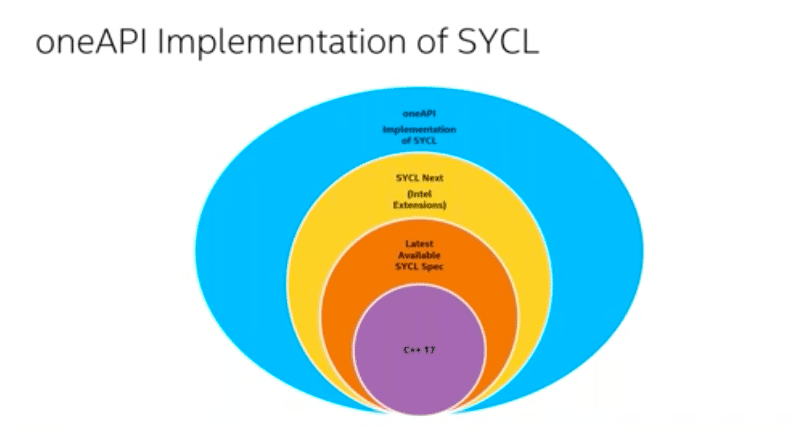
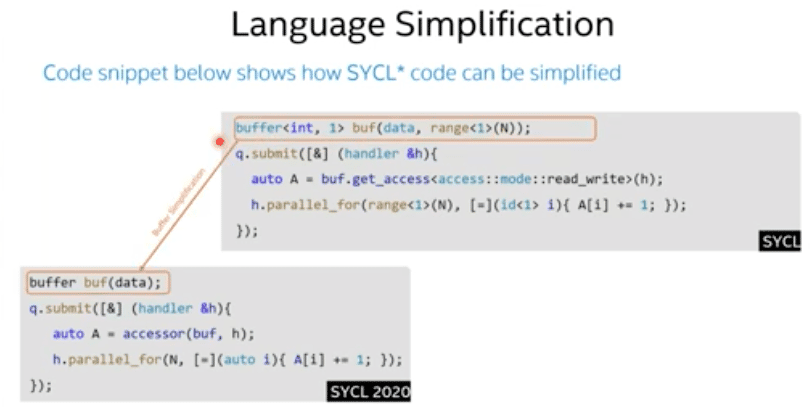
Comparing the latest version of SYCL with traditional coding, she gave an overview of various parameters that go into writing the code, including the SYCL buffers method, explaining host code, accelerator device code and host code. In addition, she also showcased how it simplifies language simplification and more.
This was followed by a hands-on guide to learning pointer-based memory management for heterogeneous computing using unified shared memory, alongside understanding the implicit and explicit ways of moving memory using unified shared memory and handling data dependency between kernel executions.
In addition, Ghosal showcased the advantages of using Subgroups in SYCL programming, deciphering various concepts, and explained how Subgroup Shuffle operations could help avoid explicit memory operations. She also showcased a hands-on explanation of using SYCL reduction to simplify reduction with parallel kernels and urged the users to take advantage and reduce functions to reduce sub_group and work-group levels.
Click here to download Intel® oneAPI Toolkits to get started.
Click here to create an Intel® DevCloud account.
At the end of the work, Analytics India Magazine ran a lucky draw, wherein lucky participants won an Amazon Voucher worth INR 2000/- each. The winners were shortlisted based on their engagement with Discord throughout the workshop.
- Nikhitha Avula
- Prasanta Kundu
- Anirban Malla
- Anirban Dasgupta
- Aswin Vijayakumar
- Vidyasagar M
- Rakesh Roy
- Karthik Koundinya S R
- Rahul Raj
- Shobana LakshmiNarsimhan
Here’s a Github link to explore the lab session. Sign up for Intel DevCloud.
Spotted an error? Tell our editors. Read our editorial standards and corrections.