Key takeaways
- Computer vision is instrumental in monitoring social distancing and public safety during the COVID-19 pandemic.
- Technologies are assessing how well people adhere to social distancing and identify surfaces needing sanitation.
- Numina.co's tool tracks movement patterns in urban spaces, aiding city planners in improving public infrastructure.
- Voxel51 has introduced a Physical Distancing Index to quantify adherence to social distancing measures.
From predicting protein structures to accelerated drug discovery, AI has been at the forefront in the fight against COVID-19. Now, as the world embraces radical measures to flatten the curve, lockdowns and social distancing have been given more emphasis. Computer vision is also helping answer questions such as:
- Are people maintaining safe social distances?
- What surfaces are people touching that may need cleaning?
- How many people are wearing masks?
Computer vision systems have been deployed in many places to ensure safety. Let us take a look at how they are currently being used, and how they can promote public safety:
Monitoring Urban Spaces
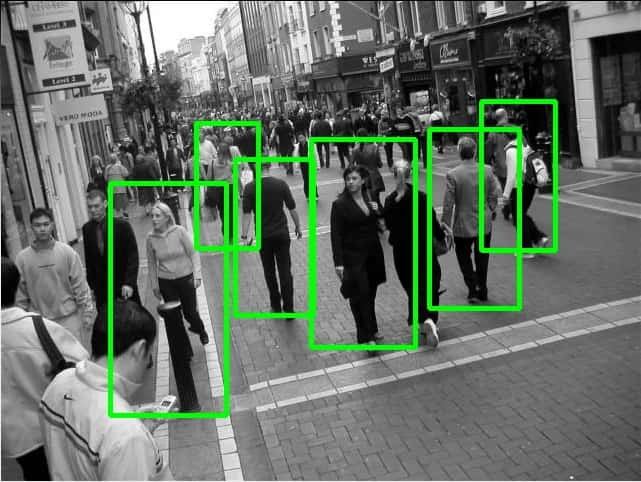
Numina.co have developed a tool that measures what, where, when, and how things move in streets and open spaces. Multi-object tracking in video enables objects and their pathways as they move through a space, to be monitored and focused on, while depth measurements enable measurements to be made.
This data helps city planners, mobility companies, and other stakeholders design better systems for people, bicycles, wheelchairs, strollers, and more. Last month, as COVID-19 spread began to peak in New York, they have shown how effectively social distancing is being followed.
Voxel51 Formulates A Physical Distancing Index(PDI) Using CV
Voxel51, a computer vision startup is using its cutting-edge computer vision models and live video streams from some of the most visited streets in the world to calculate the PDI. This index captures the average amount of human activity and social distancing behaviors in major cities over time. The developers believe that their PDI metric also gives insights about how the coronavirus is changing human activity in real-time around the world.
Megvii’s Contactless Screening
China’s Megvii technology limited, a startup that excels in AI, was one of the first companies to offer CV-based solutions. Megvii’s solutions were even installed at many public places in Beijing back in February.
Megvii’s AI-enabled temperature detection solution integrates body detection, face detection and dual sensing via infrared cameras and visible light, and can accurately detect elevated body temperature at distances greater than 3 meters and amid considerable passenger traffic.
People no longer have to remove their masks and other protective devices or queue up for temperature checks. Once someone with a high body temperature has been identified, a pre-set warning system is triggered, allowing a staff member to approach the person in question for manual secondary screening.
Carnegie Mellon’s Zensors Tracks Activity Levels
Zensors, a two-year-old spinoff of Carnegie Mellon University's Human-Computer Interaction Institute, is responding to the COVID-19 crisis by making its computer vision platform available for free and is further inviting machine learning researchers to collaborate.
Zensors’ algorithms analyse feeds from existing CCTV cameras to provide real-time data on the number of people in an area, and whether safe distances are maintained between them.
By using Zensors, organizations can automatically analyze millions of images of a city or facility each day, enabling a limited usage of human resources.
Indian Students Use CV To Measure Social Distancing
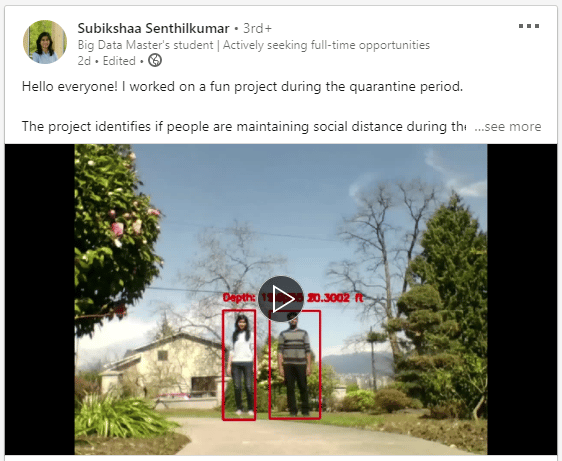
A couple of students have used Single Shot object Detection (SSD) using MobileNet and OpenCV to calculate the distance between people, bounding box coordinates and depth of the person. Any trace of violation of social distancing will be indicated by a bounding box glowing red. This can be used in public places to alert the people to observe social distancing more stringently.
Not only this, but many developers and students from the ML community are putting their skills and lockdown time to use by building tools that can be deployed at the local level to monitor social distancing.
Unpopular Argument
While it is heartening to see that AI is being readily used for real-world crises, there is also an argument of putting public privacy at stake. If one has to choose between public health and privacy, the answer is almost obvious now. While these companies, which are developing AI tools, claim that they are doubling down on privacy by installing security protocols of the most reliable standards, there is a notion of misusing this voluntarily uploaded data in a post-COVID setting. Though we will manage to eliminate the viral strains of COVID-19, it will however, leave its mark forever in societal norms.
Spotted an error? Tell our editors. Read our editorial standards and corrections.