Key takeaways
- The rise in cryptocurrency scams has led to increased public awareness efforts by regulatory bodies.
- Many cash markets for virtual currencies lack government oversight and essential consumer protections.
- Research has identified how machine learning can help prevent cryptocurrency pump-and-dump schemes.
- Volatility in cryptocurrency prices poses significant risks for investors in the cash market.
 In February 2018, with increased complaints of virtual currency exchange scams, the US Commodity Futures Trading Commission issued an advisory note for the public to create awareness. This was crucial because the incentives were so alluring that it is almost impossible to keep people away from this gold rush of the 21st century.
Risks Involved With Virtual Currency
- Most cash markets are not regulated or supervised by a government agency;
- Platforms in the cash market may lack critical system safeguards, including customer protections;
- Volatile cash market price swings or flash crashes;
How Pump-And-Dump Happens In 4 Steps
- The organiser opens a channel accessible to a potential pumping group. They invite members by advertising and posting invitations on popular forums like Reddit. Once the group exceeds 1,000 members, they are ready to pump.
- The organiser broadcasts the time and date of a future pump event. As the time nears, the admin tips the members on how to buy fast and how long to hold the coin to lure more users.
- The admin announces the coin on predetermined time and date. They use an OCR proof pattern to evade and hamper the machine from detecting. During the first minute of the pump, the coin price typically surges, increasing manifold.
- As the coin price approaches peak value, it starts dropping and the participants dump it or sell it to walk out with full pockets. This trend continues until the price falls even below the original price.
Predictive Modeling: An ML Approach
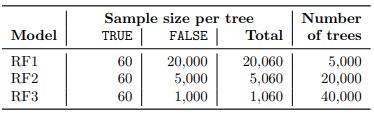 Due to the heavily imbalanced nature of the sample, when using RF, the model always includes TRUE cases when bootstrapping the sample to build a decision tree.
Model RF1 stays loyal to the sample’s original TRUE/FALSE ratio, with 0.3% of TRUE’s contained in each tree-sample. RF2 and RF3 raise the TRUE/FALSE ratio to 1.2% and 6%, respectively.
Whereas, LASSO (least absolute shrinkage and selection operator) regularisation is applied to the GLM models to avoid the problems arising due to skewed distribution.
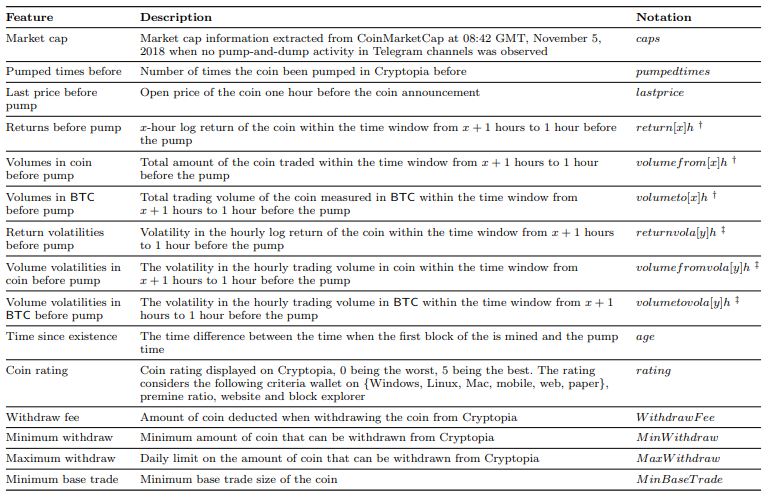
Both the random forest model and GML are able to predict whether a given coin will be pumped as a likelihood ranging between 0 and 1. In terms of F1 measure, RF models, in general, appear superior to GLM models both with the training sample and the validation sample.
At each pumping event, the researchers checked the coin’s normalised vote that has breached the predetermined threshold limit. They then purchased the coin one hour before the announcement based on the model’s prediction. With all the coins purchased, the investment, measured in BTC, on each coin is proportionate to its vote supplied by the random forest model.
The results show that the model suggests purchasing 6 coins of which 5 are actually pumped.
This Study
- Is the first of its kind of pump-and-dump schemes in the world
- Shows that pump-and-dump activities are a lot more prevalent that previously believed Specifically, around 100 organised Telegram pump-and-dump channels coordinate on average 2 pumps day which generates an aggregate artificial trading volume of $7 million a month.
- Helped in developing a predictor that, given a pre-pump announcement can predict the likelihood of each coin being pumped with an AUC (Area Under Curve) of over 0.9 both in-sample and out-of-sample.
- Formulates a simple trading strategy that, based on historical data, gives a return of 80% over a period of three weeks, even under strict assumptions.