

Data Science and Python are two of the most common technical terms which we hear all everywhere. Combination of these two will give an advantage for the aspirants in the New Tech area. As showcased year after year, the usage and importance of Python is growing daily, especially with the data analytics and the data science community.
Here we will give you a general guide to get started:


Why Python
- Popularity:
- General Purpose Programming:
Step 1: Establishing A Python Environment For Data Analysis
- Download the ANACONDA Python Data Science Platform
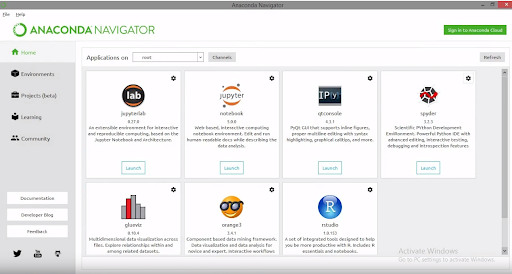
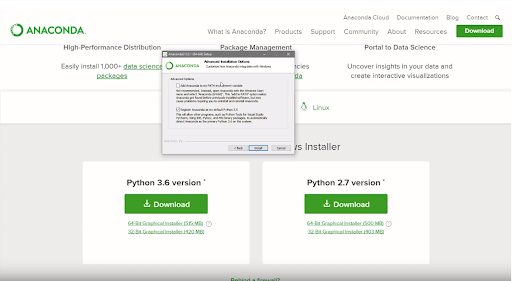
Step 2: Acquiring The Basics And Fundamentals
There are numerous ways to learn the basics of Python. A number of online courses which offer free tutorials on Python for data science. These free courses consist of video tutorials and documentation with practice exercises is a comprehensive way to learn by active participation, as opposed to the traditional method of reading concepts and looking at examples. One of the popular course is offered by DataCamp.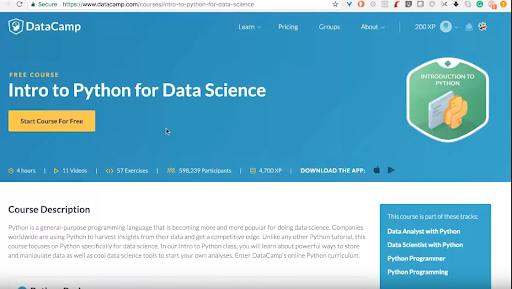
Step 3: Knowing About Essential Python Packages For Data Analysis
Being a general purpose language Python is often used beyond data analysis and data science. Abundant availability of libraries makes Python remarkably useful for working with data functionalities. The significant Python libraries that are used for working with data.- Numpy – this library provides fundamental scientific computing.
- Matplotlib – used for plotting and visualization.
- Pandas – applied for data manipulation and analysis.
- Scikit-learn – library designed for machine learning and data mining.
- StatsModels – packed with statistical modelling, testing, and analysis.
- Scipy-SciPy is a bunch of mathematical algorithms and convenience functions built on the Numpy extension of Python.
- Seaborn-Seaborn is mostly used for the visualisation of statistical models.
- Plotly-a web-based toolbox for constructing visualisations.
- Theano-package that defines multi-dimensional arrays.
Step 4: Loading DataTo Learn With
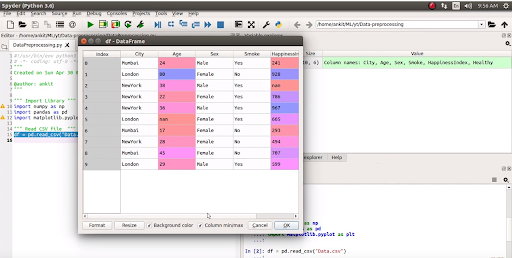
The best way to learn any programming language is to take a sample dataset and start working with it. By practising on these sample datasets will help aspirants to apply new techniques and experiment with learned methods and get to know about one's strengths and areas that need improvement. The StatsModels library of Python includes some preloaded datasets that can be used. Once being familiar with working users can load a dataset from the web or a CSV file.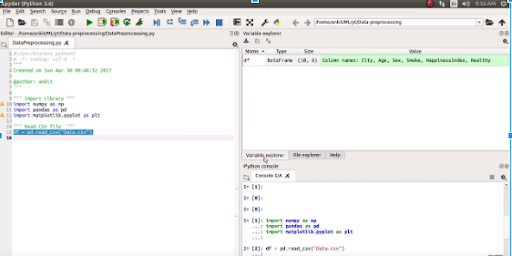
Step 5: Operations On Data
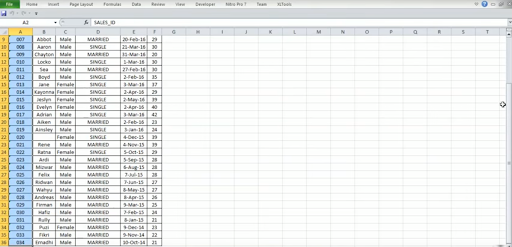
The most important skills required to extract information from abundant data is data administration. In most of the occasions, we get crude data which is not applicable for analysis. To make the data available for analysis we need to manipulate it. Python provides tools and applications for transforming, formatting, cleaning and moulds it for examining. Learning the operations of various libraries of python which were mentioned above in this article would really help aspirants to expertise data manipulation.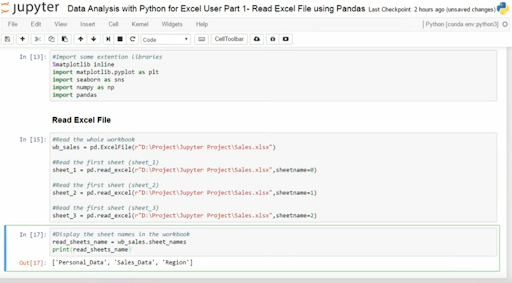
Step 6: Effective Data Visualisation
Visuals are remarkably relevant for both exploratory data analysis and to communicate results. Matplotlib is the regular Python library used for visualisation.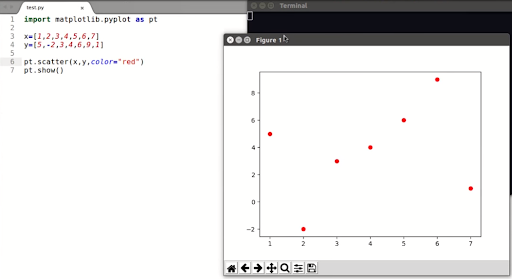
Step 7: Data Analytics
Analysing data is not just formatting and creating plots and graphs. The core aspects of analytics are statistical modelling, machine learning algorithms, data mining techniques, inferences. The Python programming language is an excellent tool for analysing data because it has effective libraries such as Scikit-learn and StatsModels which contain the tools of the models and algorithms that are essential for analysis.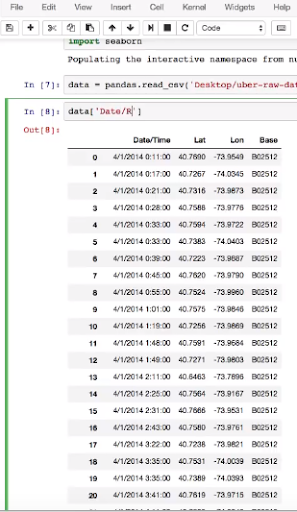
Practice
As we discussed what essential technical skills are required in python to start with data science. The focus should be on practice. Start importing data sets from various resources and begin manipulating them. It is highly recommended to use as many operations as possible as it makes one familiar with techniques.
Read nextTutorial For DataPrep - A Python Library to Prepare Your Data Before TrainingContinue reading →
- A Beginner’s Guide to Deep Regression Forest
- Hands-On Guide To Pillow - Python Library for Image Processing
- HCL To Help Tamil Nadu Govt To Set Up Data Analytics Center To Fight COVID-19 Pandemic
- Beginners Guide To Logistic Regression In Python
- A hands-on guide to anomaly detection in time series using ADTK