
Key takeaways
- Poker requires a balance of statistics and gut feeling, making it a complex game.
- Previous AI attempts to master poker had limited success until Pluribus emerged.
- Pluribus, developed by Facebook AI and Carnegie Mellon University, defeated elite players in six-player no-limit Texas Hold'em.
- This achievement builds on the success of Libratus, which previously defeated top players in two-player poker.
 Bluffing and tricking opponent with little to no interaction is what makes poker such an intense and lucrative game to play and to watch as well. Bluffing occasionally can be effective, but it might become predictable over time, resulting in losing a lot of money. It is, therefore, an art to balance the probability with which one can win, making it a tricky game.
Not only statistics but a lot of gut feeling goes into the game. So, can AI, a data-driven, pattern matching machine, trump the best minds of the game?
Efforts have been made for the past few years to teach AI to beat humans at almost every game that involves strategy. Poker so far has been immune to the relentless efforts of AI even though there were some decent achievements in the form of Libratus back in 2017.
But the tables turned overnight as an algorithm trained by the might of Facebook AI and Carnegie Mellon University beat the poker professionals at the latest showdown in Texas.
Pluribus, a new AI bot has defeated elite players in the most popular and widely played poker format in the world: six-player no-limit Texas Hold'em poker.
Pluribus is innovated on Libratus, the AI that decisively beat four leading human professionals in the two-player variant of poker called heads-up no-limit Texas hold'em last year.
Pluribus runs on two CPUs. For comparison, AlphaGo used 1,920 CPUs and 280 GPUs for real-time search in its 2016 matches against top Go professional Lee Sedol. Pluribus also uses less than 128 GB of memory.
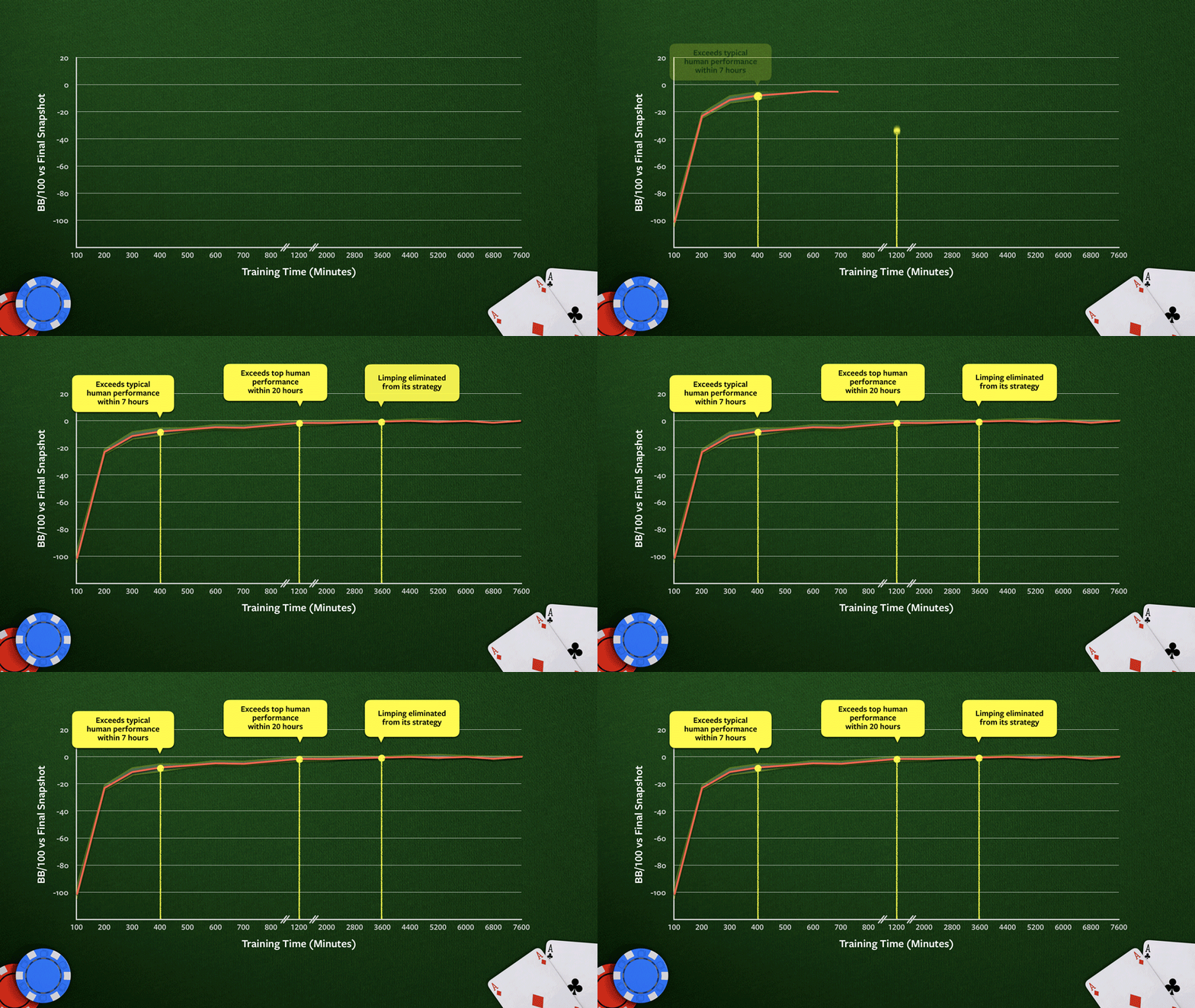
The amount of time Pluribus takes to search on a single subgame varies between one second and 33 seconds depending on the particular situation. On average, Pluribus plays twice as fast as typical human pros: 20 seconds per hand when playing against copies of itself in six-player poker.
The Bluff Of Pluribus
All AI breakthroughs in previous benchmark games, be it checkers, chess, Go, two-player poker, StarCraft 2, and Dota 2, have been limited to those with only two players or two teams facing off in a zero-sum competition. In each of those cases, the AI was successful because it attempted to estimate widely popular strategy- Nash equilibrium. It is not generally possible to efficiently compute a Nash equilibrium in a game with three or more players.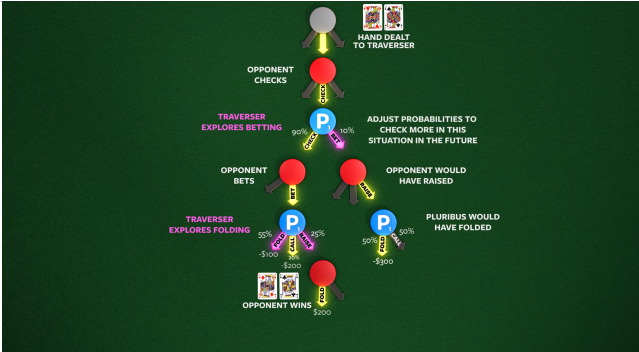
Key Takeaways
- This is the first time an AI bot has beaten top human players in a complex game with more than two players or two teams.
- Pluribus succeeds because it can very efficiently handle the challenges of a game with both hidden information and more than two players. It uses self-play to teach itself how to win, with no examples or guidance on strategy.
- Pluribus training cost is the equivalent of less than $150 worth of cloud computing resources compared to other recent AI milestone projects, which required the equivalent of millions of dollars’ worth of computing resources to train.