
Key takeaways
- Machine learning can enhance business insights by improving speed and accuracy.
- A well-organised pipeline allows for better control and flexibility in model implementation.
- Machine learning models are created through training algorithms that identify patterns in data.
- Pipelines consist of multiple components that process data iteratively to refine model performance.
- A typical machine learning pipeline includes data collection, cleaning, and feature extraction.
To a business, machine learning can deliver much-needed insights in a faster and more accurate way.
The main objective of having a proper pipeline for any ML model is to exercise control over it. A well-organised pipeline makes the implementation more flexible. It is like having an exploded view of a car engine where you can pick the faulty pieces and replace it- in our case, replacing a chunk of code.
The term ML model refers to the model artefact that is created by the training process.
The learning algorithm finds patterns in the training data that map the input data attributes to the target (the answer to be predicted), and it outputs an ML model that captures these patterns.
A model can have many dependencies and to store all the components to make sure all features available both offline and online for deployment, all the information is stored in a central repository.
A pipeline consists of a sequence of components; components which are a compilation of computations. Data is sent through these components and is manipulated with the help of computation.
Pipelines, unlike the name, would suggest, are not one-way flows. They are cyclic in nature and enable iteration to improve the scores of the machine learning algorithms. And, make the model scalable.
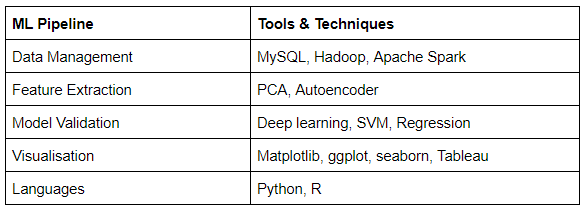
A typical machine learning pipeline would consist of the following processes:
 Data collection and cleaning are the primary tasks of any machine learning engineer who wants to make meaning out of data. But getting data and especially getting the right data is an uphill task in itself.
Data quality and its accessibility are two main challenges one will come across in the initial stages of building a pipeline.
The captured data should be pulled and put together and the benefits of collection should outweigh the costs of collection and analysis.
For this purpose, a data lake is recommended for every organisation. A data lake is a centralised repository that allows the user to store both structured and unstructured data at any scale. It also enables ad-hoc analysis by applying schemas to read, not write. In this way, the user can apply multiple analytics and processing frameworks to the same data.
Since every case has its own bargain for the amount of data, usually in an unsupervised setting, things can go out of hand if the quantity of data available for training is less.
- Data collection
- Data cleaning
- Feature extraction (labelling and dimensionality reduction)
- Model validation
- Visualisation
 Data collection and cleaning are the primary tasks of any machine learning engineer who wants to make meaning out of data. But getting data and especially getting the right data is an uphill task in itself.
Data quality and its accessibility are two main challenges one will come across in the initial stages of building a pipeline.
The captured data should be pulled and put together and the benefits of collection should outweigh the costs of collection and analysis.
For this purpose, a data lake is recommended for every organisation. A data lake is a centralised repository that allows the user to store both structured and unstructured data at any scale. It also enables ad-hoc analysis by applying schemas to read, not write. In this way, the user can apply multiple analytics and processing frameworks to the same data.
Since every case has its own bargain for the amount of data, usually in an unsupervised setting, things can go out of hand if the quantity of data available for training is less.