

5 min
 Reading some recent blogs, I sense a level of angst among Data Science practitioners about the nature of their field. What exactly IS Data Science - a question that seems to lurk just below the surface . . .
As a young field of study and work, it will naturally take time for a definition of Data Science to crystallize. In the meantime, see if this works for you . . .
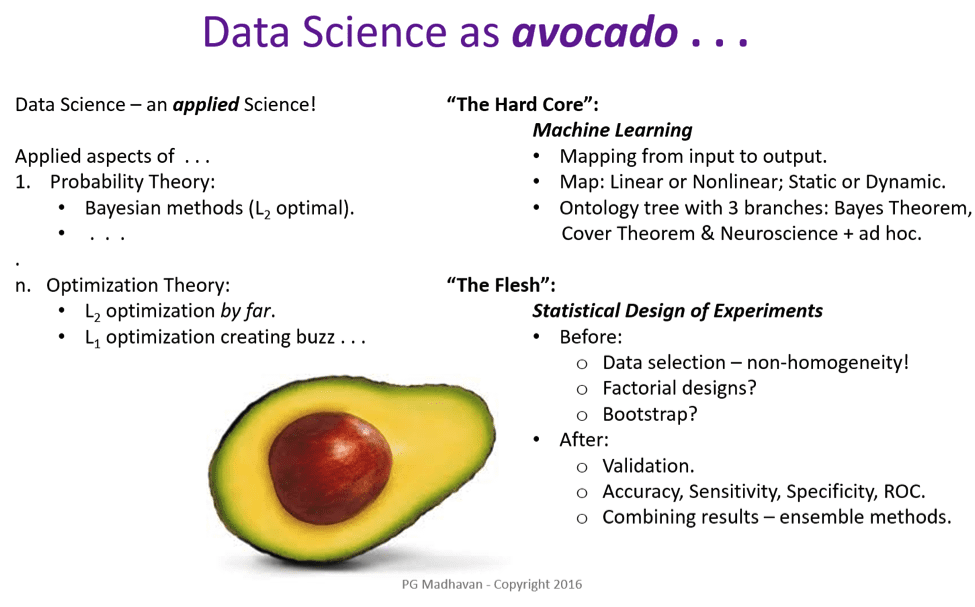 Data Science is the applied aspect of many theories. My orientation is Bayesian; so I have Probability theory at the top. Many other sciences also play a part – Physics & Statistical Mechanics for one play a significant role. We have been comfortable with L2 optimization (Euclidian distance metric) for a long time but there is a ground-swell of activity in L1 optimization (taxi-cab distance metric). L1 optimization pushes us out of our comfort zone of mean-squared error optimality and associated 2nd-order thinking!
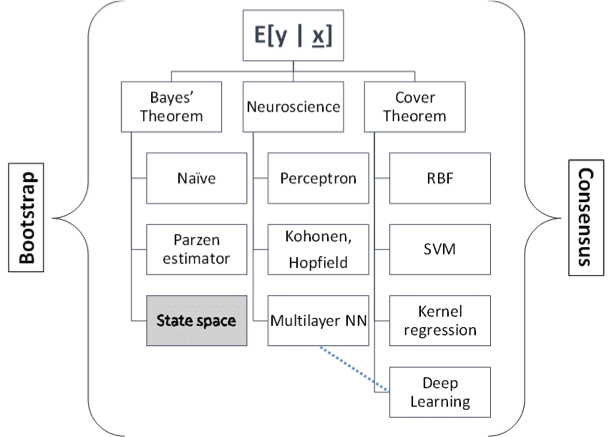
No doubt that the HARD CORE of Data Science is Machine Learning (ML) – and the topic is “hard-core”! ML is fundamentally concerned with finding the all-important “mapping” between input and output vector spaces (for a complete development of this topic, see “SYSTEMS Analytics: Adaptive Machine Learning workbook”). These are so many tools and tricks that developing a comprehensive understanding of ML can be frustrating; so I have put together an ontology below that organizes all we know about ML. The highlight is the collection of the vast material under 3 topics: Bayes Theorem, Cover Theorem and Neuroscience & ad hoc methods. In ML practice, these ML methods are “wrapped” around by “bootstrap” and “consensus” methods.
The “hard core of the avocado” is within the large brackets.
- Cover Theorem states (from Haykin, 2006): “A complex pattern classification problem, cast in a high-dimensional space nonlinearly, is more likely to be linearly separable than in a low-dimensional space, provided that the space is not densely populated”.
- Estimating the Conditional Expectation, E[ y | x], where ‘y’ is the output and ‘x’ is the input, from the conditional probability density function of the output is the stuff of hard core probabilistic approach. My own personal favorite is the use of State Space data models and Kalman Filter is estimate the parameters.
- The middle branch is a “catch all” dominated by Neuroscience starting with Perceptrons. Deep Learning is the newest incarnation of this approach (combined with high-dimensionality) in this ontology.
 Statistical Design of Experiments provides the surrounding “meat”!
Input side: Bootstrap methods
The objective is to maximize Training Set information use.
- There are many approaches:
- Bootstrap training set; sample Training Set with replacement.
- Monte Carlo methods; for probability density estimation.
- Feature subspace.
- Design of Experiments principles from Statistics; “blocking”, factorial design, etc.
- And many more.
- Combine “weak learners”.
- Random Forest.
- And many more.
- ‘Nobody Wants a Proprietary Platform,’ Says Coforge’s Anup Nair
- Why Buying Specialist Engineering Firms Won't Fix Indian IT’s Growth Problem
- The Anthropic-Indian IT Partnership Is a Two-Way Bet
- Coforge Is Outgrowing Its Larger Rivals. Is AI the Reason?
- Are Boutique AI Firms India’s Next Big Thing?
- Indian IT’s New Workforces Come with a Margin Challenge