Key takeaways
- Recognize that India's AI regulations may hinder the growth of Global Capability Centres (GCCs).
- Understand that GCCs rely on agility and cost-efficiency, which could be challenged by new government proposals.
- Acknowledge the Competition Commission of India's role in managing fairness in AI and tech markets.
- Be aware of concerns regarding the concentration of AI power and data infrastructure among a few entities.
- Observe that innovation is driven by challenges like GPU shortages, leading to the development of new AI models.
Global Capability Centres (GCCs) in India have emerged as innovation hubs, focusing on building advanced skills and capabilities to accelerate their time-to-market. However, the Indian government’s recent regulatory proposals could pose roadblocks to GCCs, which thrive on agility and cost efficiency.
On November 9, 2023, the IT ministry constituted a sub-committee to identify the gaps and recommend a framework for AI governance. Last year, the government proposed AI guidelines based on the AI Governance Guidelines Development report. If enforced, these guidelines could potentially hinder GCC growth in India.
Report vs Concerns
However, such issues are not new to the competition laws in India or globally. The Competition Commission of India oversees cases of abuse of dominance, vertical integration, and similar concerns.
According to the report, one of the major concerns about unfair trade practices stemming from the abuse of dominance by a few entities controlling large AI systems is relevant. This is particularly due to the concentration of computational power and data infrastructure in a few hands.
However, as technology evolves, challenges like the shortage of GPUs drive further innovation, encouraging the development of AI models that are less dependent on GPUs. The ongoing development of AI is likely to create new scenarios that test regulatory frameworks.
For instance, it could lead to algorithmic collusion, in which algorithms enable coordinated behaviour between entities without explicit communication.
Assessing "market dominance" and "abuse of dominance" in the AI ecosystem will require regulators to continuously monitor and analyse its shifting dynamics.
Techno-legal measures can play a crucial role in helping regulators model the broader impact of AI systems and applications, ensuring a balanced and fair ecosystem.
How Will it Play Out for GCCs?
Arijit Mitra, managing director at BEAT, Acuity Knowledge Partners, told AIM, “Instead of rushing into premature regulations, the government should focus on providing opportunities for innovation by making infrastructure and GPUs widely accessible.”
He further mentioned that initiatives like mandatory reporting, liability management across the AI lifecycle, and tools such as watermarking add unnecessary overheads, especially at a time when India should be promoting growth in this emerging field.
Mitra explained that these proposed measures could prematurely burden GCCs with compliance requirements like data protection, accountability, and bias mitigation. “Currently, India lags behind the USA and China in the AI race,” he noted. Such regulations would only stifle innovation and deter experimentation, which is essential for GCCs to remain agile and efficient.
Mitra suggested a “wait and watch” approach for India to avoid introducing further complexities that could slow down AI adoption. This would allow us to learn from global best practices, observe how AI evolves, and design regulations that are both effective and non-restrictive, he added.
Conversely, experts like Tushar Bisht, senior principal software architect at Sabre, view the AI governance guidelines as a commendable step towards promoting safe and responsible AI integration.
“These guidelines are a critical step in addressing the challenges posed by AI, such as the risks of deepfakes, AI-generated content, and unchecked use in areas like optimisation, forecasting, classification, and autonomous decision-making,” Bisht said.
He also spoke about the government’s efforts to encourage ethical AI adoption while safeguarding societal interests. Bisht stressed that corporations and educational institutions must complement these efforts by ensuring transparency, bias detection, and privacy protection in AI and ML models.
However, he added that ethical AI starts with model development, where preventing biases in datasets is as crucial as detecting them post-deployment. Balancing personalisation with privacy concerns is also essential to ensure innovation does not compromise ethical principles.
Ram Rastogi, chairman of the Governance Council for the Fintech Association for Consumer Empowerment (FACE), stated in a LinkedIn post, “In my opinion, this initiative demonstrates a nuanced understanding of India's AI landscape.”
He further stated that it would enable “the government to develop robust governance aligned with national priorities, ensuring that sector-specific frameworks are complemented by overarching governance principles”.
According to a Nasscom Community report called ‘Compliance Challenges for GCCs’, “Compliance is both a challenge and an opportunity for GCCs to build trust and resilience.”
The report highlights that “GCCs must adopt proactive strategies such as staying abreast of evolving global tech regulations, embedding ethical guidelines into technology development, and fostering collaboration with regulatory bodies to shape and influence compliance standards.”
What GCCs Mean to India
GCCs deliver tangible outcomes by aligning capability-building initiatives with parent organisations’ goals. They are shaping the future by driving innovation through AI-based solutions.
Lowe’s Bengaluru team, for instance, has been a key driver of the company’s AI journey. The team has developed critical systems such as omnichannel order management and self-checkout terminals, providing unmatched scalability and flexibility.
Similarly, Kimberly-Clark’s global AI centre of excellence in Bengaluru supports innovative projects like KC-GPT, a customised version of ChatGPT enriched with the company’s proprietary data, alongside leveraging platforms like Microsoft Azure and OpenAI.
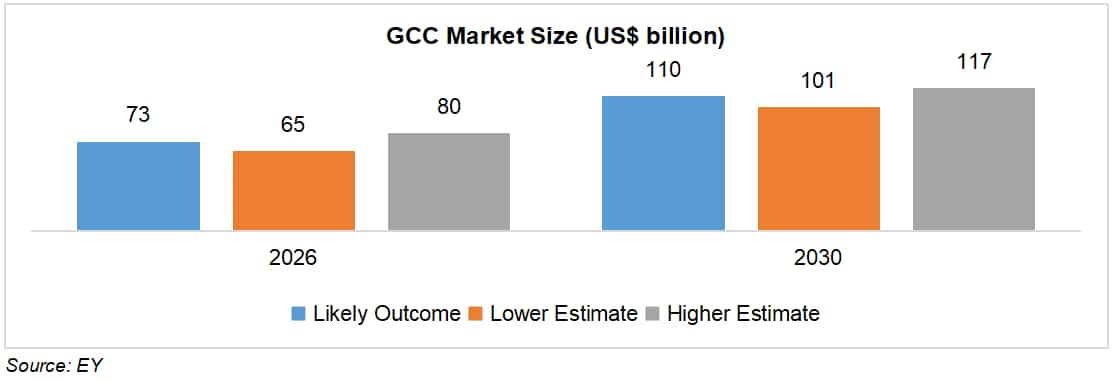
Meanwhile, with over 1.6 million professionals currently employed, the GCC sector is on an upward trajectory. This momentum is expected to continue, with EY projecting the sector to grow from 1,580 GCCs in 2023 to 2,400 by 2030, creating over 4.5 million jobs in India.