
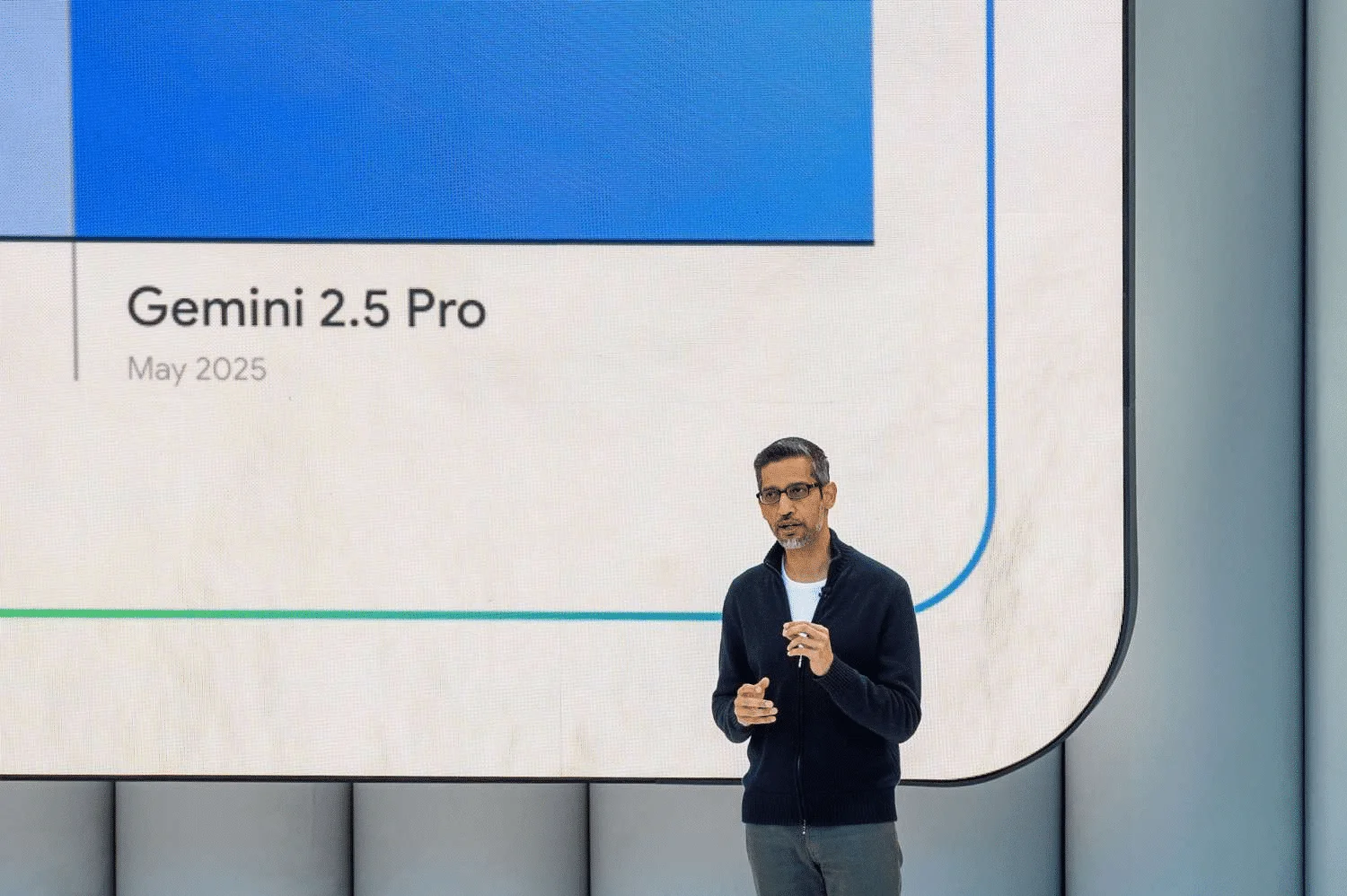
At its annual Google I/O developer conference in California, Google made it clear that AI is now central to everything it builds. Gemini 2.5 lies at the heart of new product features, developer tools, and infrastructure improvements. From real-time 3D video calls using Google Beam to smarter coding assistants and AI-powered search, Google is advancing AI integration across its ecosystem, prioritising speed, efficiency, and support for developers.
Gemini Replaces Google Assistant, Powers Real-Time Interactions
The tech giant officially replaced the Google Assistant with Gemini 2.5, which now acts as the intelligence layer across productivity tools, cameras, and more.
Gemini 2.5 Flash and Gemini 2.5 Pro introduce advanced text-to-speech capabilities via native audio out, offering control over voice style, accent, and pace. It supports single and multi-speaker output across 24 languages.
A standout feature, Gemini Live, combines the camera, voice, and web access to deliver real-time, contextual answers—an evolution of last year’s Project Astra.
Gmail also sees deeper integration, with Personalised Smart Replies allowing users to generate more natural responses. CEO Sundar Pichai said the feature even helps him respond to friends he might otherwise ignore, calling it “a way to be a better friend.”
New AI Plans and Developer Tools
Google rebranded its AI subscriptions. The $20/month AI Premium plan is now AI Pro, while a new top-tier AI Ultra plan launches at $250/month, exceeding OpenAI’s $200 ChatGPT Pro offering.
Under the hood, Gemini 2.5 Pro now leads in benchmarks like WebDev Arena and LMArena. The model has been enhanced with LearnLM for education-focused use cases and a new Deep Think experimental mode that enables advanced reasoning on complex tasks such as USAMO and MMMU.
For developers, Google added thought summaries for easier debugging, thinking budgets to balance latency and cost, and new SDK support for open-source agent frameworks via MCP.
Google introduced Gemma 3n, a mobile-first model optimised for phones, tablets, and laptops, developed in collaboration with Qualcomm and Samsung. Available now in early preview, it will soon integrate with Gemini Nano across Android and Chrome.
AI Tools That Code, Design, and Animate
Google introduced Jules, a new AI coding assistant, now in public beta worldwide. Using Gemini’s advanced reasoning, Jules helps developers write and fix code faster and easier, expanding Google’s AI-for-coding capabilities beyond what OpenAI’s Codex or Cognition’s Devin currently offer.
Google also announced Stitch, an AI tool designed to streamline the creation of user interfaces and front-end code. Stitch uses natural language and image inputs to generate UI designs and corresponding code rapidly. Users can describe their desired app or website in plain English, specifying layout, colour schemes, or other preferences, or upload sketches and wireframes. Stitch then produces multiple design variants for exploration.
In creative tools, Google launched Imagen 4, which enables photorealistic image generation, while Flow lets users type scenes and characters to create AI-generated video clips. Meanwhile, Veo 3 adds realism and physics-aware animation to AI videos.
AI Search and AR Wearables
Search now features an AI Mode —essentially a chatbot embedded in search—to assist with complex queries. Adding on to this, the tech giant also introduced a new shopping experience integrated into Search’s AI Mode, combining Gemini AI capabilities with Google’s Shopping Graph, which contains over 50 billion product listings refreshed hourly. Google expanded its virtual try-on technology to allow shoppers to see how clothes look on themselves by uploading a full-length photo.
Google is also working on mixed-reality glasses under the Android XR umbrella, showing off floating text, AR maps, and translations during I/O. It has partnered with Gentle Monster and Warby Parker, while Samsung’s Project Moohan headset is slated for release later this year.
Rebranded as Google Beam, the updated version of Project Starline turns 2D video calls into real-time 3D experiences using six cameras and AI. Beam tracks head movements very accurately at 60 frames per second. It is made for business use and runs on Google Cloud. Beam will be available to selected customers later this year, with HP and Zoom as partners.
AI for the Real World
Pichai closed the event with two real-world AI initiatives. Fire Sat, an upcoming satellite network, will help detect wildfires early. Wing, Google’s drone delivery service, was used to deliver supplies during Hurricane Helen and continues to expand its capabilities.

Your reaction