
Key takeaways
- Language translation involves complex historical and cultural nuances that can confuse machine learning models.
- Open-domain question answering is a crucial task in advancing natural language understanding.
- AI researchers are working to create a flexible and universal structure to support the pursuit of General AI.
- The introduction of the Natural Questions dataset aims to enhance research in question answering systems.
 The black cat has crossed the road — this sentence might sound simple but when you try to translate it to native languages, all the historical inferences and semantic sophistications come into play. For some feline lover, that sentence might remind them of fluffy cat pictures and crossing the road is unimportant to them. For some, it could be an ominous warning, and for others a sign of prosperity. A harmless statement like this can throw amateur linguists into disarray.
Questions such as these regarding the structure of language have been persistent for quite some time. With the advent of machine learning, NLP tasks are hotter than ever.
Our understanding, or the lack of it, plays a very trivial role in task-specific machine translations. But at a more generalised level, it gets tricky if machines are tasked to respond to a French query in Hindi or to a question which has a pun backed up by a localised cultural inference.
Open-domain question answering (QA) is a benchmark task in natural language understanding (NLU).
AI researchers and linguists have been collaborating to figure out a way to supplement the pursuit of General AI with a structure, universal at its core and flexible in its deployment.
This paper introduces Natural Questions (NQ), a new dataset for QA research, along with methods for QA system evaluation.
In contrast to tasks where it is relatively easy to gather naturally occurring examples, the definition of a suitable QA task, and the development of a methodology for annotation and evaluation is challenging.
Modelling An Annotator
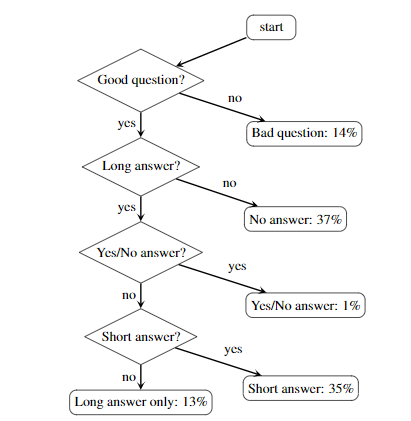
The Rationale Behind This Model
The researchers tried multiple annotation approaches to make the model more robust. One such example is when the annotator(25-way) was asked- ‘where is blood pumped after it leaves the right ventricle’. Of 25, there were 11 correct answers and 14 responses with sub-strings linking to ‘lungs’. The idea here is to identify popular answers for the longer version with the assumption that it is highly rare for a question to have more than 3 distinct long answers annotated. If at least 2 out of 5 annotators have given a non-null long answer on the example, then the system is required to output a non-null answer that is seen at least once in the 5 annotations; conversely if fewer than 2 annotators give a non-null long answer, the system is required to return NULL as its output.Key Takeaways
The goal of this research was to:- provide large-scale end-to-end training data for the QA problem.
- provide a dataset that drives research in natural language understanding.
- study human performance in providing. QA annotations for naturally occurring questions.
Spotted an error? Tell our editors. Read our editorial standards and corrections.