

A few years ago, a meme went viral during the AI boom, comparing NVIDIA to a company selling shovels during a gold rush. As AI companies rushed to build models and data centres, NVIDIA supplied the chips that made it all possible.
But every shovel maker needs its own suppliers. For NVIDIA, one of the most important is SK Hynix.
SK Hynix has emerged as one of the biggest beneficiaries of the AI boom, driven by soaring demand for advanced memory chips. In May, the South Korean chipmaker crossed the $1 trillion market capitalisation mark, becoming the third Asian company to reach the milestone, following Samsung Electronics and TSMC.
Just 16 months earlier, SK Hynix was worth less than $100 billion, meaning it added nearly $900 billion in market value in under a year and a half.
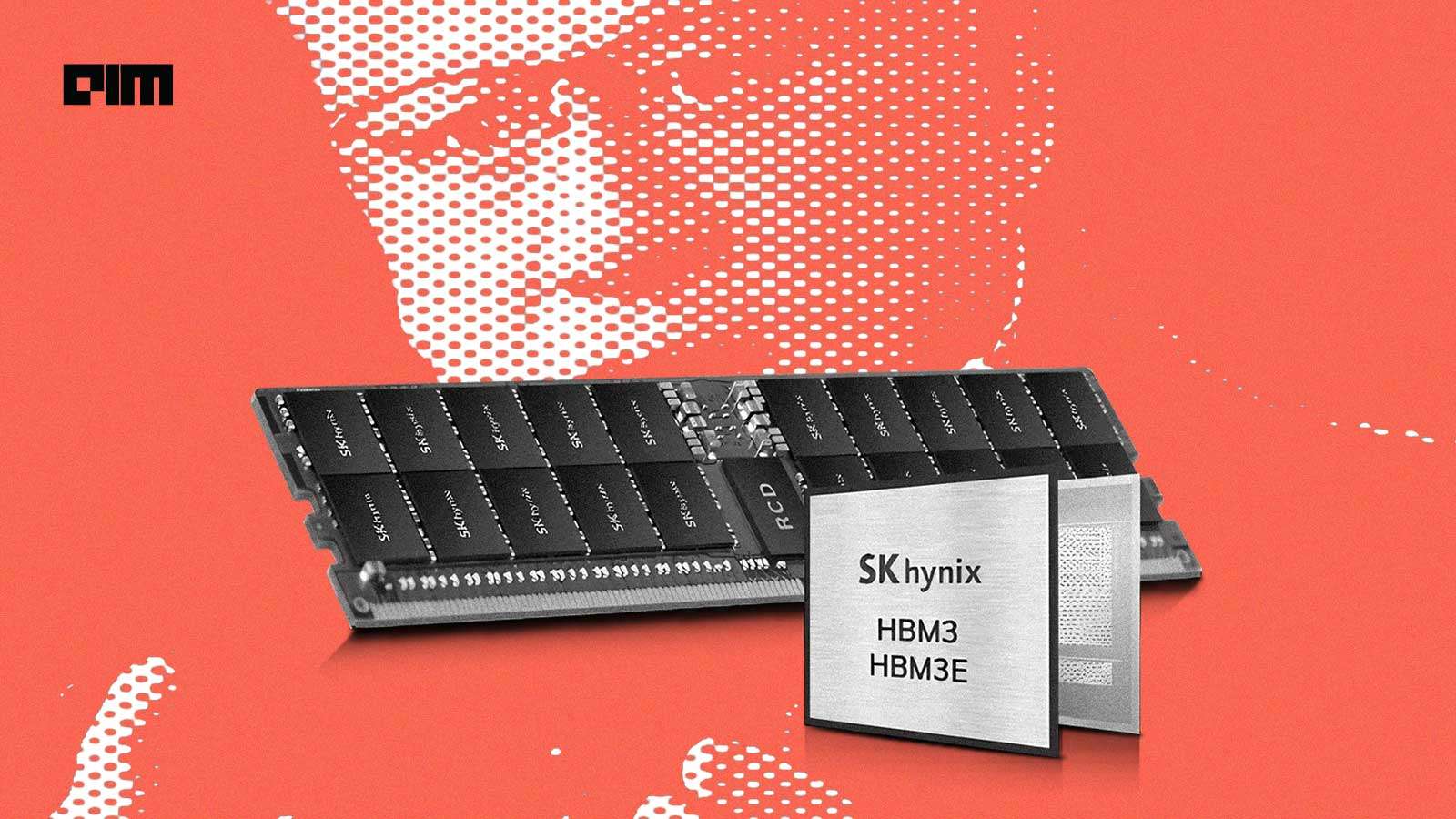
Much of that growth has been driven by the company’s early bet on High Bandwidth Memory (HBM), a specialised type of memory that has become essential for training and running large AI models.
The HBM Advantage
SK Hynix’s early and sustained investment in HBM packaging technology gave it a meaningful lead when AI demand arrived in force.
The company was the first memory maker to mass-produce HBM3 chips in 2022 and later strengthened its lead with HBM3E, including the world’s first 12-layer HBM3E product with 36GB capacity.
The company is now preparing for the next phase of AI infrastructure with HBM4. SK Hynix completed the development of HBM4 in 2025, shipped samples to customers, including NVIDIA, and has been expanding its mass-production capacity.
The results have shown up clearly in market share figures. SK Hynix led the HBM market with a 57% share in Q4 2025, with Micron following at 21% and Samsung trailing at 22%, according to Counterpoint Research.
MS Hwang, Research Analyst at Counterpoint Research, tells AIM that SK Hynix’s market capitalisation and subsequent re-rating are the result of its dominance in HBM, a sharp rally in commodity memory prices, and a series of market-friendly reforms in South Korea’s stock market.
Shrish Pant, Director Analyst at Gartner, attributes SK Hynix’s valuation re-rating over the past five to six quarters to cautious capacity additions after the 2023 memory market downturn and a sharp rise in AI data centre demand for server DRAM and HBM.
“HBM consumes up to four times more input wafers for a similar output, which has contributed to a sharp improvement in SK Hynix’s profitability. As a result, operating margins have risen from around 30% to nearly 80%, and we expect them to remain strong at least through the end of 2027, given the ongoing undersupply,” he says.
If there is a single relationship that best explains SK Hynix’s rise, it is the one with NVIDIA.
SK Hynix had locked in approximately 70% of HBM supply agreements for NVIDIA’s Vera Rubin architecture, closely tying its trajectory to the industry’s dominant player.
On June 7, the two companies announced a new multi-year partnership to develop next-generation memory technologies for AI infrastructure and apply AI to semiconductor design and manufacturing.
Under the agreement, they will co-develop memory for NVIDIA’s upcoming Vera Rubin AI supercomputers, Vera CPUs, RTX Spark-powered PCs and Jetson Thor robotic computing platforms.
“Without SK Hynix’s partnership, today’s AI industry would not have developed as wonderfully as it has,” said NVIDIA CEO Jensen Huang during the media briefing.
Moreover, the two companies will also apply AI to semiconductor chip design and manufacturing, using NVIDIA CUDA-X libraries and NVIDIA PhysicsNeMo to accelerate semiconductor simulations, TCAD workflows, and in-house engineering codes.
“Together, we are codeveloping the next generation of memory for AI factories and applying AI to how we design and manufacture semiconductors — work that will shape the future of AI infrastructure,” says Chey Tae-won, Chairman of SK Group.
Three Musketeers of AI
SK Hynix’s main competitors are Samsung Electronics and Micron. Together, the three companies dominate the global memory chip market.
Despite falling to third place in the HBM market in 2025, Samsung remains a major competitor. The company has resumed construction of its Pyeongtaek P5 chip plant and is using its latest sixth-generation DRAM technology to prepare for large-scale production of HBM4 memory chips.
Samsung is expected to begin shipping HBM4 chips in early 2026, with the memory set to be used in NVIDIA’s next-generation Rubin AI platform.
“Although SK Hynix currently holds the top position in the overall HBM market, Samsung has secured the number one market share in HBM4 this year. Maintaining a leadership position in the tech market is inherently highly challenging,” Hwang says.
He adds that Samsung’s strengths in both memory and logic semiconductor technologies position it as one of the strongest competitors to SK Hynix in the long term.
Similarly, Pant says the HBM market opportunity remains strong, with most capacity already sold out through 2027. He adds that long lead times and AI accelerator roadmaps that use more HBM per card are expected to keep demand strong until mid-2028. “This presents an opportunity for both Samsung and Micron to increase their share and not significantly impact opportunities for SK hynix,” he opines.
Meanwhile, Micron, the lone American memory chipmaker, is pursuing a different strategy.
In December last year, Micron announced plans to exit the consumer memory and storage market and focus on AI data centre customers, sharpening its push into the high-margin HBM segment where SK hynix has established a strong lead.
The strategy is already paying off. Micron’s Cloud Memory Business Unit generated $5.28 billion in revenue in fiscal Q1 2026 with a gross margin of 66%, nearly double the level recorded a year earlier, driven by strong demand for AI memory and long-term HBM commitments.
The company has also begun shipping HBM4 samples and outlined plans for HBM4E, which is expected to enter production in 2027.
Hwang notes that memory chipmakers are continuously advancing semiconductor technology to improve performance and speed. As memory manufacturing increasingly adopts technologies that have traditionally been used in logic chips, companies with expertise in both areas could gain an advantage.
“The transition in memory manufacturing is moving beyond traditional gate structures and advanced materials toward technologies that have been widely used in logic chips, such as FinFET,” Hwang adds.
- OpenAI Says AGI is Here. But Not Everyone is Buying It
- Why Oracle is Bringing Post-Quantum Security to Java
- What Really Happens When You Turn Your Selfie Into a 1980s AI Pic?
- AI Agents Are Making Data Security A Bigger Enterprise Problem
- OpenAI is Getting Nervous About Reinforcement Learning
- Meta’s Bold Open-Weight Bet is Meant to Muse Developers