
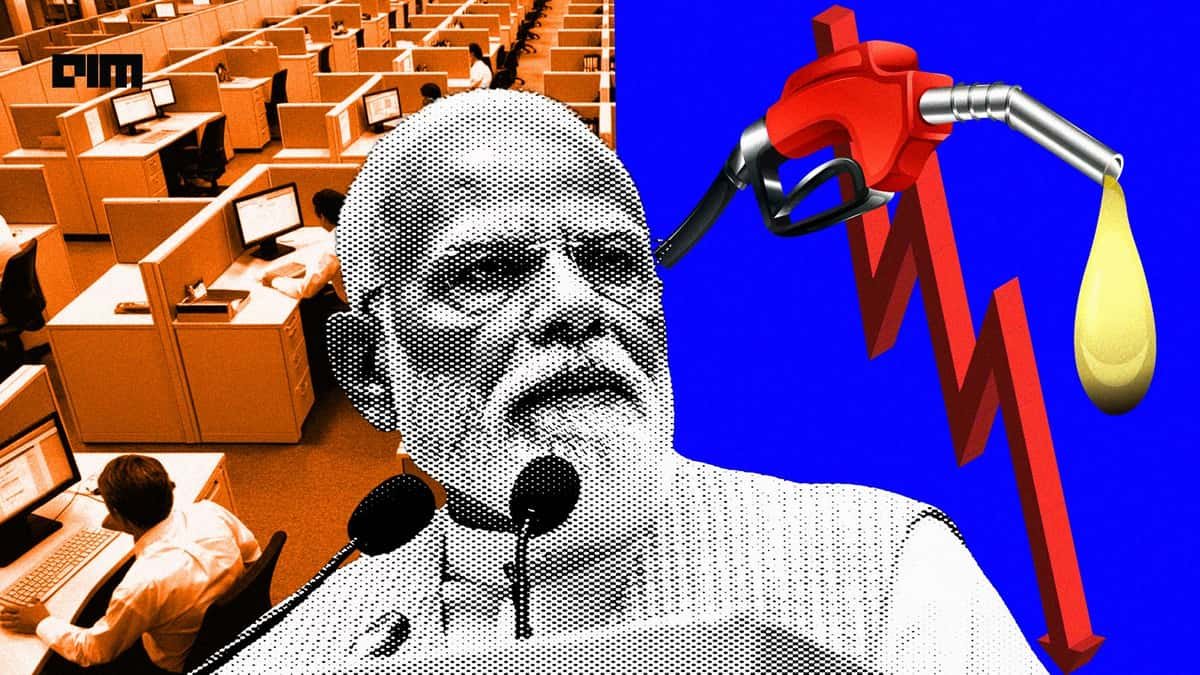
Prime Minister Narendra Modi’s appeal to revive work-from-home arrangements to conserve fuel has placed India’s technology industry in a difficult position at a time when firms are already grappling with AI-led disruption, weak global demand, and an aggressive return-to-office push.
For India’s Information Technology (IT) services industry, which successfully operated remotely during the pandemic, the shift is operationally feasible. However, industry observers say many IT companies remain wary of returning to prolonged remote work, especially as they restructure teams, retrain employees and adapt to AI-led changes in business models.
Speaking in Hyderabad on May 10, PM Narendra Modi urged organisations to revive COVID-19-era practices like remote work, virtual meetings, and curtailed travel to ease pressure on India’s imported fuel bill, as the US-Iran conflict drives Brent crude above $120 a barrel. India imports nearly 85% of its fuel needs, with a massive portion of this transiting through the now-disrupted Strait of Hormuz.
PM Modi’s remarks have created a policy dilemma for companies that spent the past few years tightening return-to-office mandates, but now face growing public pressure to support fuel conservation efforts, despite no formal government directive requiring them to do so.
“Companies recognise that a work-from-home structure can disconnect collaboration between employees, which poses a risk to productivity. During a slowdown like the one the IT sector is currently facing, it becomes even more important for teams to come together and work in sync. Work-from-home is certainly feasible, but it carries a risk to productivity,” Gaurav Vasu, CEO and Founder of market intelligence firm UnearthInsights, tells AIM.
Industry Bodies Write to Labour Ministry
The Nascent Information Technology Employees Senate (NITES) wrote to Union Labour and Employment Minister Mansukh Mandaviya on May 11, demanding a formal advisory directing IT and IT-enabled services companies to implement WFH wherever operationally feasible.
“The objective of such an advisory is not confrontation with employers, but collective national cooperation,” NITES wrote in the letter.
Harpreet Singh Saluja, Managing Partner of NITES Legal, in a LinkedIn post, wrote, “Reducing unnecessary daily commuting by lakhs of IT employees can contribute towards fuel conservation, reduced traffic congestion, environmental protection, and employee well-being.”
The Forum for IT Employees (FITE) also called for a clearer government directive, arguing that employees themselves do not have the authority to determine remote-work policies.
Nasscom adopted a more measured tone, saying the technology industry already operates on established hybrid work models, with companies calibrating work-from-home and in-office arrangements based on role requirements and customer needs. At the same time, the industry body said it is closely monitoring developments and remains engaged with industry stakeholders and government authorities to ensure a coordinated response.
Collision With Return-to-Office Policies
PM Modi’s appeal comes at a time when corporate India has been steadily pushing employees back to office campuses after years of pandemic-era flexibility. Since 2024, several IT firms have tightened attendance requirements, arguing that physical presence improves collaboration, training, innovation and organisational culture.
Tata Consultancy Services, India’s largest IT services employer, had scrapped its earlier hybrid framework and moved to a full five-day office workweek.
Companies undergoing AI-led transitions increasingly prefer employees to work from offices because teams are being retrained, reorganised and integrated into new workflows that managers believe are easier to supervise in person.
Broader Casualties of Policy Ping-Pong
The debate also extends beyond IT employees and corporate offices. India’s technology industry supports a vast urban services ecosystem that includes cab drivers, food vendors, housekeeping staff, security personnel and nearby small businesses that depend heavily on daily office commutes.
“The only challenge is that large-scale work from home affects several connected parts of the economy,” says Srinivas Padmanabhuni, an AI expert and technologist who previously worked as Principal Research Scientist and Associate Vice President at Infosys Labs.
“There are people managing infrastructure, security personnel, cab companies and nearby businesses that all get impacted. That is one of the reasons local governments have also supported return-to-office models. But from a technology standpoint, remote work today is even more viable than it was during the COVID-19 period,” he notes.
- The Anthropic-Indian IT Partnership Is a Two-Way Bet
- Coforge Is Outgrowing Its Larger Rivals. Is AI the Reason?
- Are Boutique AI Firms India’s Next Big Thing?
- Indian IT’s New Workforces Come with a Margin Challenge
- ‘Owning of the IP Itself is Meaningless,’ Says Mphasis’ Ravi Vasantraj
- Infosys’s $5.2 Billion Deal Wins Fail to Lift FY27 Outlook