
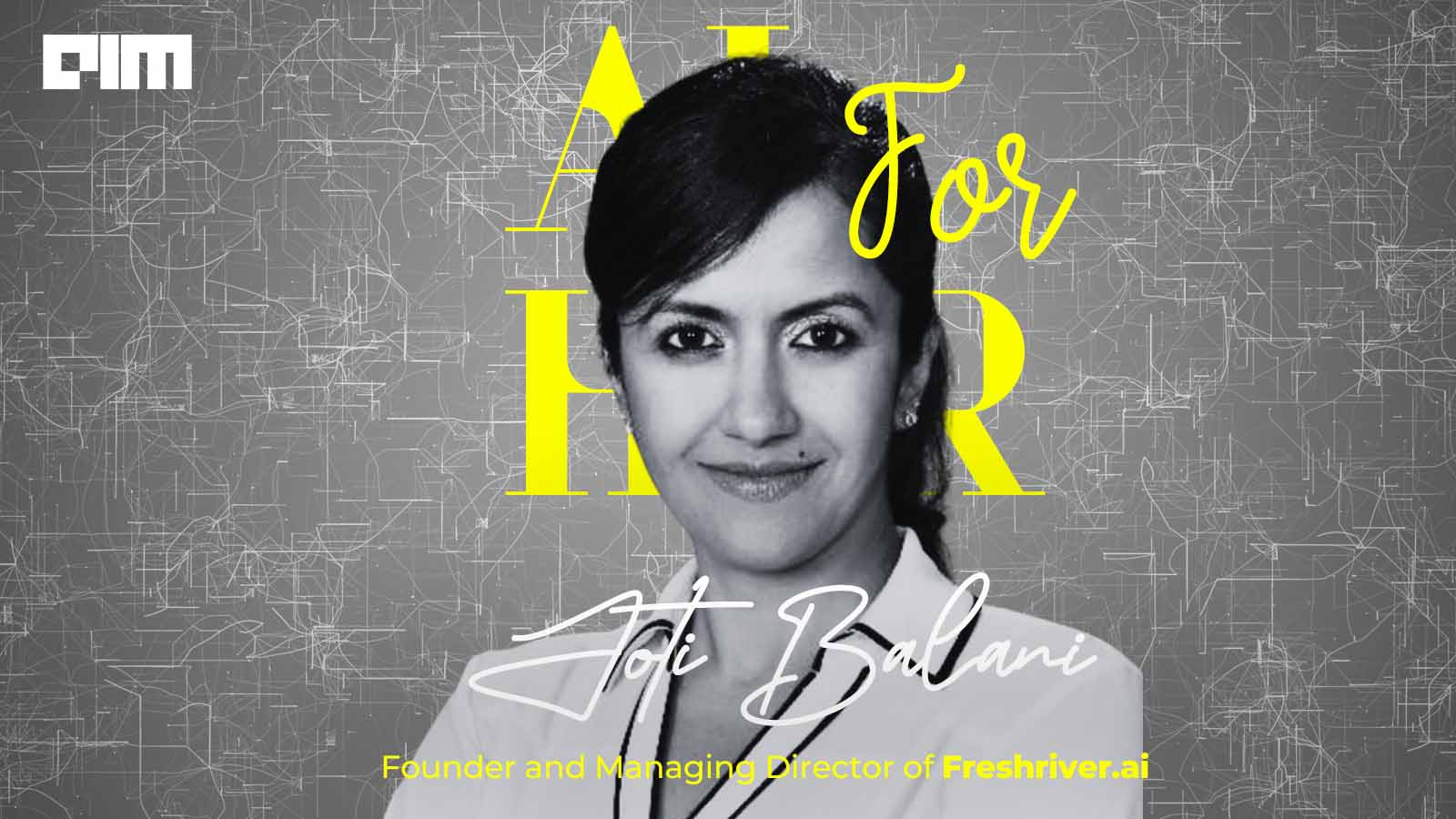
AI is no longer stuck in a cycle of hype. According to Joti, it has finally made its leap into the growth phase and is now establishing new benchmarks within the tech space.
In an exclusive interaction, Analytics India Magazine spoke to Joti Balani, Founder and Managing Director of Freshriver.ai, to better understand her vision for the future of Conversational AI.
Joti Balani is a creative architect who has designed a Multidimensional Transformation framework blending AI, data science, and social sciences. She has successfully led transformative innovations at several Fortune 100 enterprises to help create emotional and brand value.
Balani leads the AI Impact at Innovation of Large Organizations (ILO). She is also an AI Advisor to Web3-focused startups solving critical problems. Joti is also the co-founder of Women in Voice (WiV), New Jersey, US chapter.
AIM: How did Freshriver.ai come into existence?
Joti: My first view was looking at the emerging spaces, such as AI and blockchain. I was starting from scratch and had no network in these new spaces. Coming from a telecom background, I executed a framework of my own on how to solve problems with tech. AI is a massive field and it’s emerging in many ways. With the intention of delving further into this field, I began working on independent consulting projects—particularly into the branch of conversational AI. I grew up 22 years being product manager, senior product manager, director of products, vice president and then just like that—you exit and you get nothing. You're starting from scratch and that was a little scary. That was a lot scary.
AIM: Could you give more details on how Freshriver.ai functions?
Joti: We have come from an era of web application and mobile application interfaces. This is the era of natural language interfaces. Humans had to learn how to use these interfaces. I had to learn how to swipe and scroll on my phone, the same goes with the web. It’s unprecedented with a natural language interface because the machine has to understand human speech, chats, facial recognition—bringing an expansive view. Conversational AI just happens to be that final frontier, where the human and the machine will interact. This becomes different than the mobile and web, not only because the machine has to understand what humans are saying, but the way it is processing it is also very different. It must have the ability to process and then respond as well.
Freshriver.ai is completely technology agnostic. We do not have any favourite tech as the capabilities are just evolving rapidly. With over 2000 vendors in the conversational AI space, it's past the hype cycle and is now entering its growth phase. We have strategic relationships with top global leaders in the technological space, advising the product and R&D teams to deliver solutions.
AIM: Could you narrate a typical day in your life as the founder of Freshriver.ai?
Joti: I spend 80% of my time executing, interacting with my peers in the industry, and obviously, with my own team. But believe it or not, I am also talking to a lot of people in the non-tech space. As a technologist, my belief is that technology is leading everything. But, I think the world is out of balance because we don't have humanities and arts to inform technology. Companies are going to need to rethink how they're going to deploy AI, as we step more into emerging technology. The future is here. I also interviewed a lot of leaders in my own show called ‘AI Transformers Thought Leadership’. The aim was to enable leaders from the Fortune 500 to have a safe space to discuss ideas with their peers.
AIM: What inspired you to begin your journey with artificial intelligence?
Joti: My journey with AI started around four or five years ago. Belonging to a corporate career, I served in the telecommunications field for 22 years and worked with very large organisations, mid-size and small organisations or startups. I went from being a software engineer for the first couple of years to developing products and then rising through the ranks into executive positions. I really wanted to move into spaces that were shaping the world next.
So when I exited, I made a conscious decision to build something that was culturally deemed as a company but also took care of humans holistically. Since I believe philosophically that we're born into this world with a lot of superpowers and we have a lifetime to discover and use them to solve problems for the world and leave it a better place than we found it. I'm also writing a book on this. In fact, I'm currently working on a series around the rise of ‘digital slavery’. This cannot be sustainable—the way people work. I learned to create a company whose culture was very inclusive, very caring towards employees’ physical, psychological, and emotional health because I think, to a certain extent, we've lost that in today’s corporate life.
AIM: How can organisations make sure that Responsible AI is being used in their products?
Joti: What I've realised about AI is that we actually do not have any other choice but to have the human race well represented. Large organisations may sprinkle a few brown and black people on top and call it “diversity”. For example, how do you expect a young white man sitting in Silicon Valley to design a conversational AI experience for a 55-year old African American woman going through menopause? How will you design and engineer a conversation, if you have no clue what it's like to be there?
Any big tech that works with AI says that AI is for good, but trains their models with tainted biosystems. My question to them is: Where are your data cleaners? That's an emerging profile and there should be a team to look at the data before it's fed to the algorithm. Just like you would never put unrefined fuel in a car! The AI algorithm systems today inevitably have biases in them and I believe that now, more than ever, companies need to hire responsible AI systems.
AIM: What is your advice for AI/ML solving?
Joti: No matter what role they have, I have trained my entire team to understand a problem deeply. It's called the use case extraction part of the framework. This may involve design, conversation, frontend development, backend development, and AI training among others. The entire team needs to be involved, whether they are technical or non-technical. Are they even testing if they don't understand the problem? Until they have a clear understanding, they don't know what they're going to solve. Finding technical solutions is about looking for the right tools in the toolbox. The person solving it should have a community to dip into and brainstorm. The answer always lies in a team. I like to call them pods. When stuck with a problem, they have a safe place to go to and work it out. Interestingly, my team consists of brilliant engineers from Apple and Amazon, and I tell them that I believe you have the answer. But that answer will only come out when you have a conversation with somebody—you're then part of a larger discourse and helping find solutions.

Your reaction