

5 min
 ISVs are commonplace in software and technology business. Per Wikipedia, an independent software vendor (ISV) is an organization specializing in making software, designed for mass or niche markets. This is in contrast to software developed for in-house use only within an organization or software designed or adapted for a single, specific customer. Companies that make the platforms, such as Microsoft, SAP and Salesforce.com, encourage and lend support to ISVs, often with special "business partner" programs.
With the proliferation of Analytics - or Machine Learning (ML) or Data Science (DS) - offerings in the last five years, I see many business models: consulting, horizontal, vertical, in-house at major corporations, out-sourced to specialist firms and all the rest. As the shakeout continues, I believe there is room to replicate the ISV model in the Analytics context with some variations.
ISVs or App vendors have specialized software to sell to the end user. In the B2C case, we will call them “App vendors”; in the B2B case, “ISVs”. ISVs reach the customer through OEMs or platform providers. This symbiotic relationship has been very lucrative for both the ISV and the OEM in the software business domain, not to mention end users who get new differentiated technologies in a rapid fashion. In general, ISVs create price competition and also increase the pace of technology innovation in their markets.
Major OEMs initially tried to provide all the software necessary to meet end user needs. However, OEM business practices and priorities limit their responsiveness – hence the rise of ISVs. They find niches, either in applications or in innovative technologies, and quickly fill user needs thus enhancing the value of the OEM platform.
Analytics (or ML or DS) is similar - and even more highly specialized. Developing and deploying Analytics business solutions have to go through many demanding steps. Here is a rough guide:
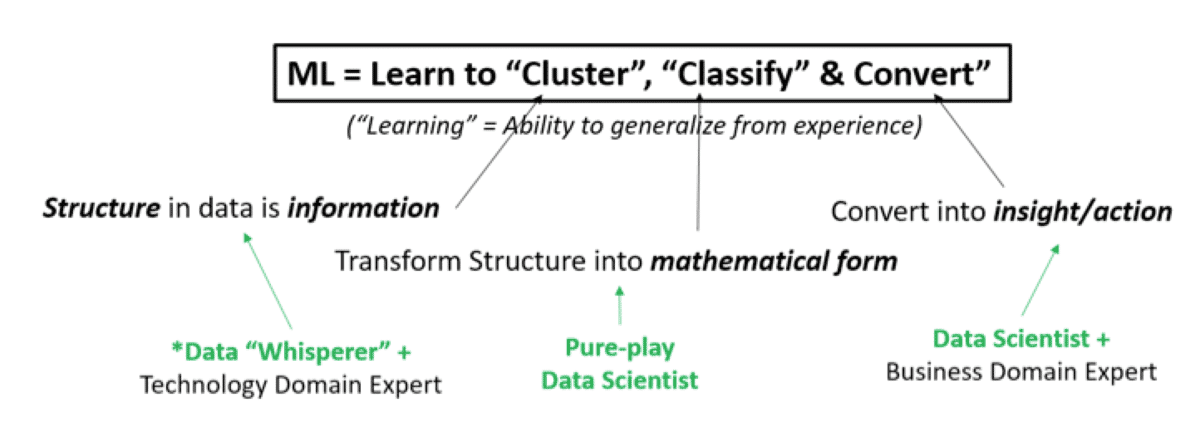 Having been in the Data Science trenches, I am convinced that full coverage of the three Data Scientist roles will be a challenge for most organizations. The reason is that this combination of Data Science expertise under one roof is hard to assemble because there are so few of them. Rarely can one person embody these three roles since temperament and skills for each role have deep differences!
In particular, the first “Cluster” stage is hard – data do not tell you where the information structure is hidden. Finding patterns is an “art” where inspiration, skill, experience, knowledge of inter-related theories, etc. play a major part – hence the Data “Whisperer” role.
Unlike previous solution attempts such as “expert systems”, ML can work to some extent if you dump data and crank through many ML tools taught in typical Data Science courses. However, if you are able to get at the most descriptive and discriminatory features at the “Cluster” stage, the rest of the steps will just fall into place (almost) and provide the best robust solution. On the other hand, if you just throw Big Data at ML, you may succeed but you will work many times harder during the Classify and Combine steps and end up with non-optimal answers. That is the difference between an outstanding robust business solution and a mediocre one.
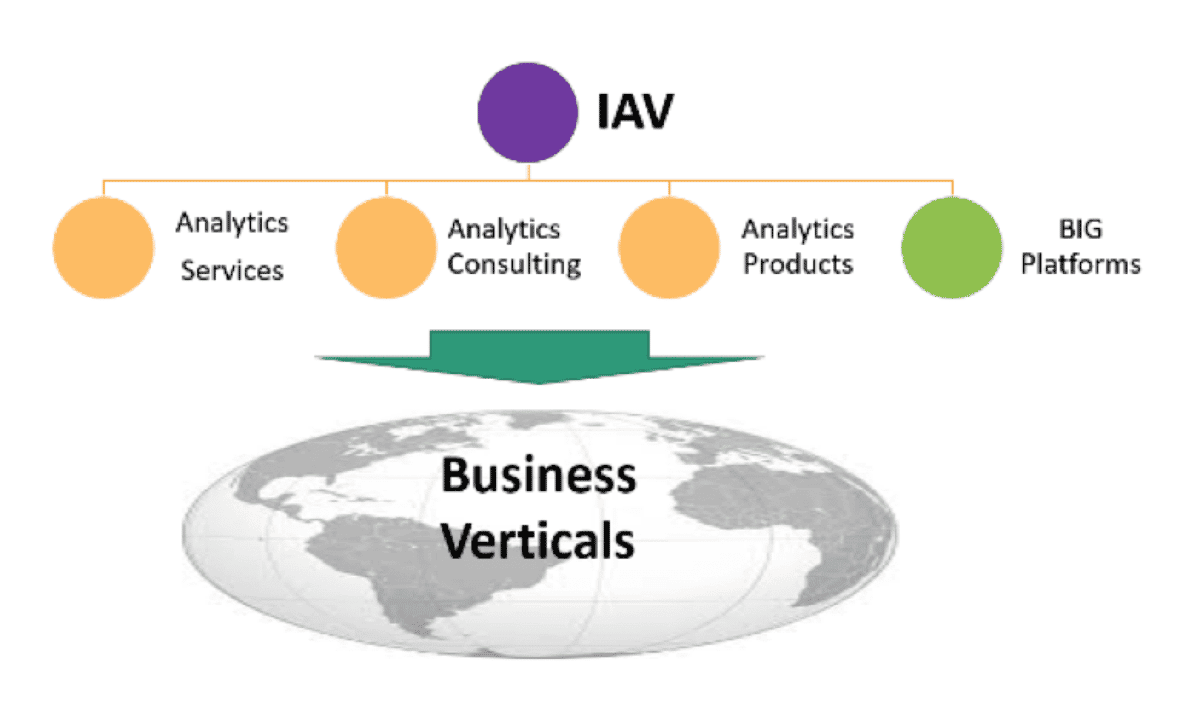
This is where Independent Analytics Vendors (IAVs) come in. With one set of the three Data Science roles under one roof, they can address multiple verticals – scaling of limited human resource! IAV specialists can then interact with business domain experts and rapidly produce vertical ML solutions that are “kick ass”. IAVs will thus drive the pace of technology adoption in many verticals - this is a good thing for the Analytics ecosystem.
In this resource-poor environment for data “whisperers” and experienced data scientists, OEMs such as Microsoft and SAP may be best positioned to corral the available human deep-skills and create AB Apps for their platforms. However, I see a replay of what happened in software in the past; OEM business practices and priorities limit their responsiveness – hence the inevitable rise of IAVs. The model will be slightly different this time . . .
A few IAVs will leverage their Data Science deep-skills to provide “Analytics Business Apps” (“AB Apps”) on OEM platforms. Major platforms will have certification programs to qualify AB Apps, provide business user access via their Analytics “store” (or in-built into their platforms in addition to their own AB Apps) and manage updates. Salesforce is an early example of this trend.
Not all “Apps” are created equal – here are some differences!
| App Type | Features | Pricing Model |
| Consumer Apps | Download and go. | Fixed price; Freemium |
| Business software | Deployment on servers or private/hybrid cloud. Employee usage training (a day or more) | Annual contract; Subscription |
| Analytics Business Apps | Descriptive analytics (slice & dice, visualize data) NOT included here (belongs in the row above). o For each deployment, “messy” data; needs some level of wrangling. o Predictive/prescriptive analytics actions have business impact. Ø Need a PoC (proof-of-concept) or “burn-in” period of weeks to few months. | Access fees during PoC; then, same pricing as business software (above row). |
- The same scarce-resource team can address multiple verticals
- High-quality ML *business* solutions with Scale & Agility.
- Why Buying Specialist Engineering Firms Won't Fix Indian IT’s Growth Problem
- The Anthropic-Indian IT Partnership Is a Two-Way Bet
- Coforge Is Outgrowing Its Larger Rivals. Is AI the Reason?
- Are Boutique AI Firms India’s Next Big Thing?
- Indian IT’s New Workforces Come with a Margin Challenge
- ‘Owning of the IP Itself is Meaningless,’ Says Mphasis’ Ravi Vasantraj