


The world is upskilling itself with generative AI in the quest for higher-paying jobs. The Indian IT, however, is upskilling its employees in a rather weird fashion, by simply ‘clicking next’ on the training module to be part of the so-called ‘generative AI ready’ workforce. This could unravel the mystery behind the phenomenal speed at which legions of employees are being trained in generative AI.
Check: NIRF Ranking of Engineering Colleges
The skyrocketing salaries at Silicon Valley startups such as OpenAI and Anthropic, coupled with the confidence of having ‘upskilled’ in GenAI is pushing Indian software engineers to expect exorbitant salaries. But the truth is that many of them are actually not technically skilled enough to demand such high salaries.
In a post, Ratnakar Sadasyula narrated the story of candidates demanding extremely high salaries. “Now that would not be an issue, if these people were extraordinarily brilliant, or IIT, NIT passout,” said Sadasyula. “Most of them are from ordinary engineering colleges, and forget about being extraordinary, they are not even of decent ability (sic),” he said, adding that most did not even possess proper communication skills.
Where does this stem from?
The truth is, though the qualification from a premier institute is not exactly an ideal criteria, technical knowledge is definitely necessary. That is a mistake that several Indian companies make. “A couple of freshers were recruited from CS streams of Tier 3 colleges… 9/10 didn't know how to code at all,” said a user.
Much of this demand for higher salaries among the new generation stems from the startup boom in 2020 when people were recruited for lofty salaries, at times even without the required skill set or ability. “And now we have an entire generation that acts so entitled, demanding high pay, for just about decent skills,” said Sadasyula.
This, coupled with the fact that most of the students during the pandemic were actually marked leniently, giving them less credibility in the market.
According to several reports, there are only around 2000 senior software engineers in India and the salary of a senior AI engineer ranges between INR 9-21 lakh ($11,000 – $25,000), whereas in the USA, they can easily bag an offer for an average of $121,000. AI is booming like never before, which means big tech companies are looking for experienced engineers to improve their products.
Meanwhile, the problem has been accepted by many. A user on X pointed out that many Indian IT tech graduates are unemployable for any real time projects and responsibilities. “India IT talent is going down and Vietnam, Indonesia, Malaysia, and Philippines are taking up jobs as they have the hunger to succeed with hard work which India's NCGs don’t,” the user added.
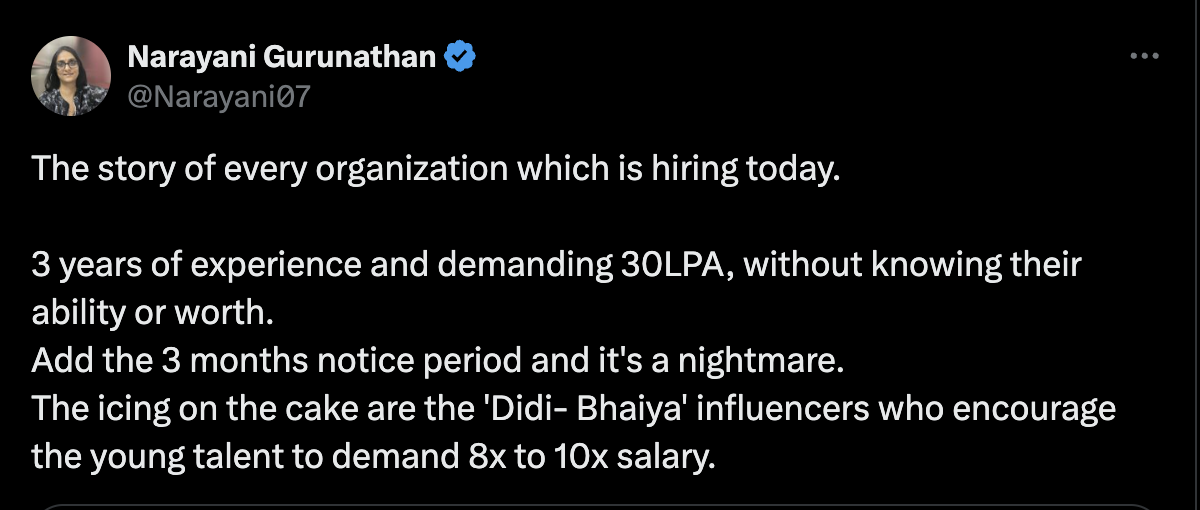
“Three years of experience and demanding 30 LPA, without knowing their ability or worth (sic),” noted Narayani Gurunathan, adding that the icing on the cake is the influencers who encourage the young talent to demand higher salaries.
The fact that the youth are demanding such salaries also indicates that there is actually someone out there hiring for such salaries.
You get what you pay for
The demand for generative AI jobs in India is definitely on the rise. A recent report revealed that senior developers working in generative AI draw over INR 1 crore per annum, while an entrant’s salary could easily be around INR 18 lakh. Another report indicates that mid-career software professionals in the GCC segment, with about three to eight years of experience, typically earned salaries ranging from INR 15 lakh to INR 35 lakh per annum.
To be fair, salaries go hand-in-hand with the cost of living at the place. A user on X explains that Gen Z standing up and asking for money is actually a good thing. But that discussion is not about the youth asking for money, but about mediocre people demanding higher salaries.
One solution is to move businesses to Tier-3 cities, where the cost of living is less, hence the youth might be more accepting of the lower salaries. Moreover, putting a cap and a budget on the salary while posting jobs or interviewing can help in setting realistic expectations for the candidates.
Deedy Das puts it out very simply, giving two options to the employers: “Hire them cause you can’t find cheaper” or “Don’t hire them and find cheaper and better talent,” adding that the candidates cannot be blamed for asking. Moreover, 30 LPA after three years of experience does sound reasonable.
This points to the basic supply and demand issue, which the market would eventually correct on its own. Some say that more awareness of the global salaries have made Indians realise that they were being exploited all this while.
- The Anthropic-Indian IT Partnership Is a Two-Way Bet
- Coforge Is Outgrowing Its Larger Rivals. Is AI the Reason?
- Are Boutique AI Firms India’s Next Big Thing?
- Indian IT’s New Workforces Come with a Margin Challenge
- ‘Owning of the IP Itself is Meaningless,’ Says Mphasis’ Ravi Vasantraj
- Infosys’s $5.2 Billion Deal Wins Fail to Lift FY27 Outlook