
5 min
 The 49th Sveriges Riksbank prize in economic sciences – commonly referred to as the Nobel Prize for economics – has been awarded to Richard H Thaler for his contributions to behavioural economics. He was a key proponent of the idea that humans do not act entirely rationally and is primarily known for his often misunderstood concept of Nudge Theory.
Attributed to Richard Thaler and Cass Sunstein in their book “Nudge: Improving Decisions about Health, Wealth, and Happiness,” a “Nudge” can change the behaviour or decision that a human will make. The basis of Nudge theory is to apply an understanding of predicted behaviours to shape and influence that automated process.
 Leveraging a variety of different strategies, such as default settings, information as an incentive and right context, companies have proven the ability to change someone’s behaviour through a successful Nudge.
The Nudge in analytics
It has been widely accepted that behavioural science and an understanding of human behaviour are essential tools for any analytics professional, and vice versa. The original test of Thaler’s Nudge theory was at a Chicago school district where just by changing the layout of the food served showed 35% increase in the consumption of healthy food among students. Let us look at other sectors where Thaler’s Nudge theory has aided analytics for better data collection. Nudge in Telecom Analytics: By leveraging data-driven technologies such as image recognition, predictive analytics, behavioural clustering and pattern recognition, among other things, telecom operators are using data science and machine learning, to expand the application of the Nudge theory. By clustering people based on their usage behaviour, telecom companies can apply nudge to those specific clusters in a manner that is most attuned to those cluster’s composition. For example, a mobile operator can use automated behavioural analysis to determine patterns of how a user uses his/her pre-paid balance, inbound, outbound on- and off-network activity distribution, etc. and also the highest propensity of being influenced by a specific Nudge. Nudge in wearable tech analytics: Using biometrics gathered from a user's mobile phone and/or wearable device, wearable companies can combine the best of data and behavioural science to deliver a personalised experience. By analysing the collected data points and using a "nudge, it can encourage users on their own unique wellness journey while enabling rich longitudinal data streams for researchers. Nudge in banking: The banking sector can also use the Nudge theory to benefit its customers. Last year, HSBC bank rolled out a new mobile app that used real-time analytics and the nudge theory to assist customers to manage their finances better.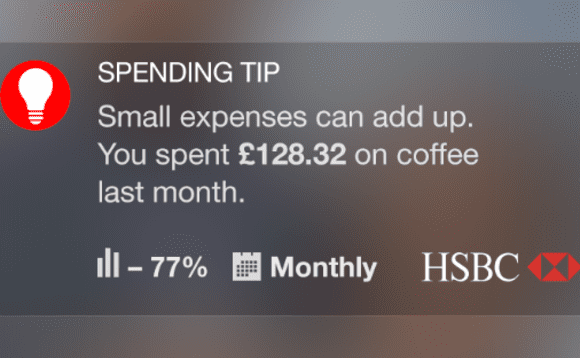 The app analysed real-time customer analytics to identify trends in users' spending habits. Using the same data, the bank could apply nudges in the form of alerts to inform people about their spending pattern. According to HSBC, it is "designed to encourage customers to act to support their financial intentions and longer-term goal".
As the bank worked upon the Nudge theory’s idea of indirect suggestions and alerts, that could encourage individuals to make desired decisions, the development of the app followed an HSBC commissioned report by the London School of Economics that suggested that using technology like automated messages to ‘nudge' people could encourage better spending habits.
Predictive analytics and behavioural science
Just as data analytics brings scientific rigour to the process of estimating an unknown quantity or making a prediction, employing behavioural nudge tactics can bring scientific rigour to the (largely judgment-driven) process of deciding how to prompt behaviour change in the individual identified by a model. When the ultimate goal is behaviour change, predictive analytics and the science of behavioural nudges can serve as two parts of a greater, more effective whole. Predictive analytics alone can be a powerful tool; and an understanding of behavioural science is also impactful, even if adopted in isolation. But when predictive analytics and behavioural nudges work together, they accomplish more than they could by themselves. Predictive analytics helps predict an outcome, while behavioural science helps influence the outcome. Predictive analytics can produce some valuable insights, but it is often unclear what to do about these insights. Thaler’s Nudge theory suggests that if companies have more information about why a customer defers a purchase, they could use their nudges even more effectively:- If the deferral is mainly the result of simple procrastination or inertia, use scarcity appeals, such as limited time offers.
- If there exists a fear of making the wrong choice (regret aversion), offer a guarantee.
- If the deferral is due to confusion or choice overload, help customers by simplifying their decision making.
Thaler, the Nobel favourite
Thaler was on many people’s list of Nobel favourites. But since Daniel Kahneman already won the award for behavioural economics in 2002 and then Eugene Fama, Lars Peter Hansen and Robert Shiller won it in 2013 for financial markets, Thaler’s chances seemed relatively slim. But the Great Recession – caused by financial markets seeming to behave “irrationally” – brought a lot of attention to research that extensively cites Thaler’s 40-year-long academic career.

Your reaction
Discussion
What's your take on this story?
No comments yet — be the first to share your view.