
Last year, in a landmark decision, the Indian government launched the production-linked incentive (PLI) and sanctioned Rs 76,000 crore to encourage semiconductor goods manufacturing in India. The scheme was announced in light of inadequate semiconductor chip supply globally, which also affected the sale of goods like cars, phones, and laptops.
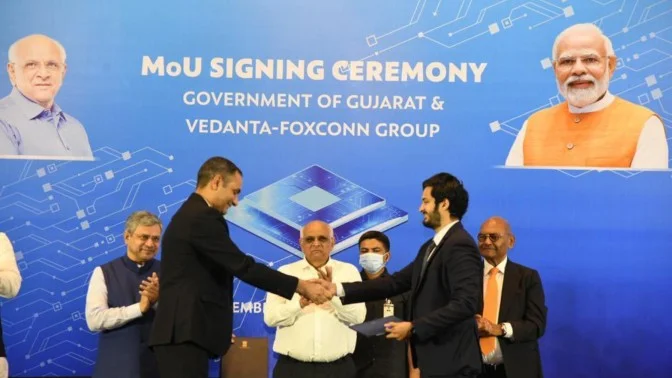
This scheme has already started to pay rich dividends as Taiwanese firm Foxconn ties up with Vedanta to build a chip manufacturing plant in Dholera, Gujarat, on 400 acres of land. While Vedanta is financing the project, Foxconn would assume the role of the technical partner.
Massive opportunity
Vedanta and Foxconn will invest USD 19.5 billion to set up semiconductor and display production plants in Gujarat. The joint venture has obtained several subsidies, for example, on capital expenditure and electricity from Gujarat to set up the units, as first reported by Reuters. This Rs 15.4 trillion investment is the largest ever by any group in an Indian state.
As per media reports, Vedanta will have a 60% equity stake in the venture, while Foxconn will own the remaining 40%. With this deal, an oil-to-metals conglomerate at the core, Vedanta hopes to diversify into the chip-manufacturing domain.
This deal is expected to create 100,000 jobs in Gujarat. The project will attract companies across the electronics ecosystem value chain. This includes manufacturers of sophisticated equipment, materials like chemicals, high purity glass, photomasks, and equipment service providers. “The company will create a hub for manufacturing of iPhones and TV equipment at Maharashtra, which will be a kind of forward integration for the Gujarat JV plant,” Vedanta founder and chairman Anil Agarwal told media.
State of tussle
However, the deal has been embroiled in its own share of controversies. PM Modi’s home state Gujarat bested Maharashtra to win the plant location. In a statement, a Foxconn representative said that the state’s infrastructure and government support played an active role in increasing the confidence to set up a semiconductor factory there.
A massive political controversy erupted when Gujarat was announced the winner. Opposition parties in Maharashtra are crying foul over the allocation, and Maharashtra Navnirman Sena (MNS) chief Raj Thackeray has sought a probe into the process. Notably, Shiv Sena, along with Congress and NCP, was recently ousted from power, post which the current chief minister Eknath Shinde and his party came to power.
Through its mouthpiece publication Saamna, MNS alleged that the deal went from Maharashtra to Gujarat as the BJP sought favour from CM Shinde for instating him in his current role. However, Vedanta chairman Agarwal has said that Gujarat was chosen based purely on professional and independent advice.
Gujarat offered Rs 28,000 crore capital subsidy to Vedanta-Foxconn for the plant, against Maharashtra’s offer of Rs 40,000 crore. Further, Gujarat offered 200 acres of land to both companies at Dholera at 75% of the going rate, while Maharashtra offered 1,100 acres of land in Talegaon Phase IV in Pune district – 700 acres of this was offered at 75% of the current rate, and remaining 400 acres for free.
More subsidies & ‘freebies’
Recently, the Union cabinet approved a uniform incentive of 50% of the project cost. This is towards setting up the semiconductor display and compound semiconductor fabrication unit and against the earlier incentive range 30-50% for the three schemes. The incentives for setting up semiconductor fabrication were based on the chip size, but the incentives for display fabrication and compound semiconductor fabs were largely 30% of the total cost of the project.
This new announcement has drawn criticism from experts, comparing the subsidies with freebies. Many doubt if projects like Vedanta-Foxconn and ISMS would swallow a large chunk of the government’s subsidiary allocation. This may even lead to ensuring financial incentives for a select few.
Raghuram Rajan, former RBI governor, has questioned the validity of these subsidies, asking what would stop these manufacturers from moving over to other countries when the subsidies and incentive schemes end? He said, “Manufacturers could also continue production but also demand continued tariff and subsidy protection.”

Your reaction
Discussion
What's your take on this story?
No comments yet — be the first to share your view.