

5 min
 Ever since 2016, Artificial Intelligence has been something of a hot topic of conversation among entrepreneurs and the reputed business magnates of the world. In fact, in 2017, the term Artificial Intelligence (AI) was ranked No. 7 on Gartner.com, showing how popular and widespread it had become in just a year.
In simple words, AI refers to the branch of computer science that seeks to create and develop intelligent or ‘smart’ machines that imitate human behavior, that is, learn from experience and perform human-oriented tasks. The term Artificial Intelligence was coined 1956, and today, it combines both machine learning and deep learning under one umbrella.
 Source: Chatbots Magazine
How Is AI Transforming The Business World?
AI is the hottest trend now in the business world. Dan Walker, head of Emerging and Disruptive Technology at the British Petroleum’s (BP) Technology Group, thinks: “AI is enabling the fourth industrial revolution, and it has the potential to help deliver the next level of performance.” Business magnates and entrepreneurs around the world are incorporating AI within their structure. This is mainly because AI provides the opportunity to companies to improve their overall customer experience; to automate work processes; to boost their employee performance, and most importantly, to develop intelligent machines to aid them in their day-to-day functioning. A recently published Harvard Business Review (HBR) maintains that about 51% of AI leaders have predicted that by the year 2020, AI will create a massive internal impact on the back office functions of IT, HR, and finance/accounting. This will enable the employees to divert their attention to more important tasks while AI will take care of repetitive and automatable tasks (questions about company policy, reset passwords, etc.). The following image shows how AI is becoming increasingly popular in the business world.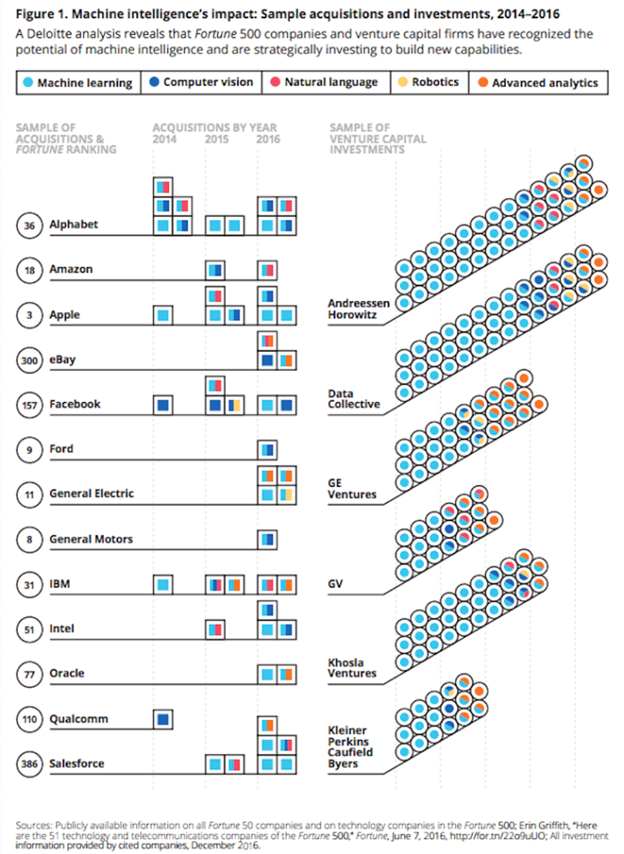 Source: Chatbots Magazine
According to Tata Consultancy Services’ Press Release on a study conducted on 835 executives across 13 global industry sectors in four regions of the world, many business executives are of the opinion that AI will facilitate a net reduction anywhere between 4-7% in company functions by 2020. K Ananth Krishnan, Chief Technology Officer of TCS, stated:
“As companies begin to gain a better understanding of AI’s application for business, they will realize the significant impact of this transformative force. This is reflected in our Global Trend Study, which shows that forward-thinking companies are beginning to make major AI investments.”
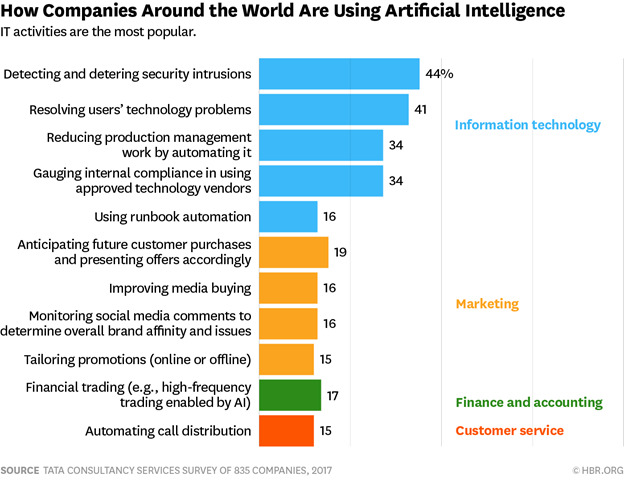 Source: Harvard Business Review
As you can see, all the major tech giants of the world are increasingly and heavily relying on AI.
What Is The Impact Of AI On The Energy Sector?
In 2017, Bill Gates wrote an online essay addressing college graduated all over the world. He made a very important point when he said: “If I were starting out today… I would consider three fields. One is artificial intelligence (AI). We have only begun to tap into all the ways it will make people’s lives more productive and creative. The second is energy because making it clean, affordable, and reliable will be essential for fighting poverty and climate change.” The third field, according to Gates is biosciences. AI holds great promises of revolutionizing the energy sector. In fact, the energy sector has already started utilizing the potential of technologies like AI, automation, and advanced analytics in most imaginative ways possible. According to a research study by Infosys, 48% of the respondents from energy, oil, gas, and utility industries consider AI to be a fundamental driving force behind their organization’s success, whereas 46% state that their organizations are incorporating AI into the “company ethos.” The primary drivers behind the incorporation of AI into the energy sector are the automation of IT and business processes, and of course, to boost innovation. Big data and advanced technologies are opening up new possibilities in the energy industry. AI can coordinate and optimize the use of energy resources as well as IoT. The Infosys research study further stresses that data leveraged by AI will be a primary “driver of a future sustainable energy ecosystem that includes an appropriate mix of fossil fuels and renewables.” The benefits of using AI in the energy sector are numerous. AI will bring about a vast improvement in common utility operations in the following ways:- Reliability - Powering self-healing grids and improving operations as well as ensuring the efficient use and storage of renewable resources
- Safety - Facilitate outage prediction and outage response
- Cybersecurity - Enhanced threat detection and response
- Optimization - Improved management of assets, maintenance, workflow, and portfolio
- Enhanced customer experience - Facilitate quicker and more intuitive interactive voice response, personalization, and product and service matching

Your reaction
Discussion
What's your take on this story?
No comments yet — be the first to share your view.