
If the last decade and a half of digital commerce was about using machine learning to make humans click faster, the next phase may be about humans stepping back entirely.
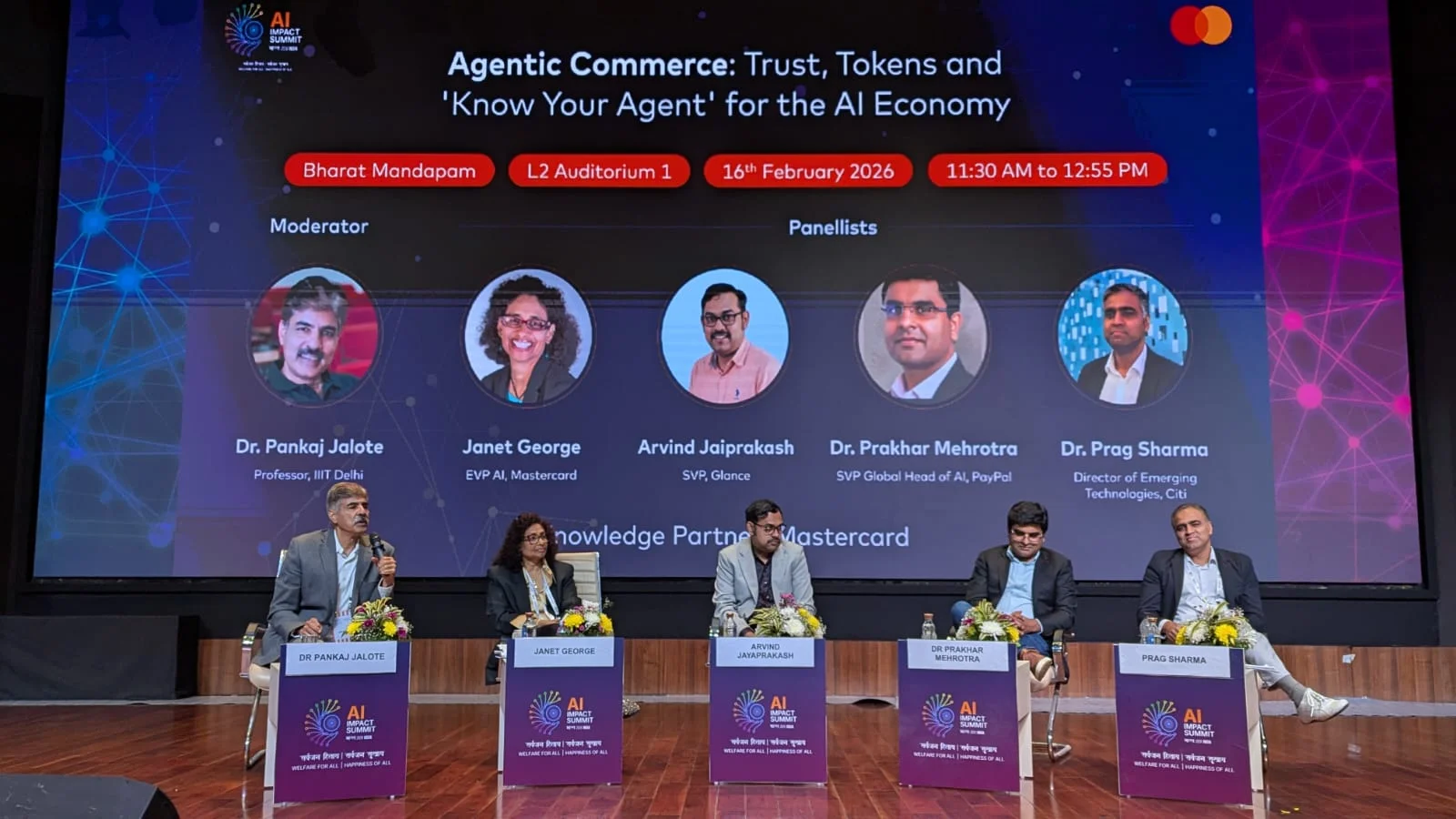
That was the underlying message at the ‘Agentic Commerce: Trust, Tokens and Know Your Agent’ session at the India AI Impact Summit, where leaders from payments networks, AI platforms, and commerce companies examined how autonomous digital agents could soon act as consumers’ proxies. The discussion was moderated by Dr Pankaj Jalote, Professor, IIIT Delhi.
The shift, the panel viewed, is subtle but profound. Instead of navigating product pages or comparing prices manually, users may simply define an objective—buy a kurta, plan a ₹50,000 vacation, book the most reliable early morning flight—and let an AI agent handle discovery, comparison, and execution.
For sellers, this redistribution of agency has immediate consequences. Visibility will no longer depend solely on search rankings or advertising spend; it will depend on whether a merchant is integrated into the ecosystems that AI agents rely on.
Complexity of Human Choice
Beyond the excitement lies a harder question: can machines truly replicate the layered way humans make decisions?
Arvind Jayaprakash, SVP, Glance, described how even a seemingly simple task such as choosing a flight can involve multiple invisible filters: price, on-time performance, cancellation history, and reliability under peak congestion. “Such trade-offs reflect upstream cognitive processes that are rarely captured in structured datasets. Commerce decisions, whether for apparel, electronics or travel, are shaped not just by measurable criteria but by instinct, context and risk tolerance,” he said.
This introduces the challenge of tacit knowledge—preferences that people cannot easily articulate. “A shopper might gravitate toward a particular table design without being able to explain why. Translating that intuitive pull into data that an agent can interpret remains one of the central technical hurdles of agentic commerce,” added Jayaprakash.
Payments leaders argued that while tacit knowledge is complex, consumers already generate vast behavioural signals. Browsing patterns, transaction histories, and loyalty memberships provide rich, if imperfect, insight into intent. The real task is building models capable of interpreting data meaningfully.
Trust as Infrastructure
If AI agents are to move money, make purchases and manage accounts, trust becomes foundational rather than optional.
Janet George, EVP AI, Mastercard, shared her experience of using an AI agent to transfer funds into a retirement account at Fidelity Investments under a tight deadline. “What made the interaction acceptable was not speed alone, but the architecture around it: explicit consent prompts, transaction-level clarity and the deactivation of the agent after the task was complete,” she shared.
Such examples underscore what many at the session described as the three pillars of agentic commerce: verifiable identity for every agent, granular and revocable authorisation, and clear provenance—a traceable record of every action taken. In effect, commerce is moving toward machine-grade trust frameworks where agents, not just users, must possess secure digital identities.
“Redress mechanisms are equally critical. Just as card networks build chargeback systems to protect consumers, agent-driven systems will require dispute resolution pathways if transactions go wrong. Without such safeguards, adoption will stall,” George added.
Interestingly, governance was framed not as eliminating friction but calibrating it. While seamlessness has long been the goal of digital commerce, panellists argued that intentional friction—such as confirmation steps for high-value transactions—may be necessary to prevent regret and build confidence. Human-in-the-loop systems, particularly for sensitive decisions, could remain an enduring feature rather than a transitional phase.
Why Merchants are Leaning In
Unlike many past technology cycles, demand for agentic systems appears to be coming directly from merchants. Prakhar Mehrotra, SVP Global Head of AI, Paypal noted an unusual dynamic: instead of technology providers pushing adoption, merchants are actively asking for agent capabilities.
“The reason lies in data. Traditional e-commerce relied heavily on structured signals—clicks, cart additions, checkouts. Agent-mediated commerce produces something far richer: unstructured conversational context. When consumers interact with AI agents, they articulate preferences, reject alternatives and refine constraints in natural language. That iterative dialogue can significantly increase purchase intent by the time a user reaches a merchant,” he said.
Early experiments suggest that agent-guided shoppers convert at multiples of traditional browsing rates, largely because indecision is resolved upstream. By the time the transaction point is reached, intent is clearer and stronger.
Beyond Checkout: The Future of Retail
The ripple effects extend beyond digital payments. “If transactions can be executed anywhere by autonomous systems, the purpose of a physical storefront may shift. Retail spaces could evolve from transactional hubs into community and experience centres—places where brand, belonging and shared identity matter more than the act of purchase itself,” explained Prag Sharma, Director of Emerging Technologies, Citi.
Underneath this transformation lies a complex AI architecture. Agentic systems are non-deterministic and adaptive, introducing risks around bias, toxicity, data leakage and uncontrolled memory retention. “Developers are now focusing on lifecycle management, monitoring agents from instantiation to deactivation, managing memory boundaries and ensuring auditability,” he added.
A Gradual Shift
The discussion stopped short of declaring a fully autonomous future. Instead, the consensus was pragmatic: AI agents will increasingly act as proxies, while humans move into supervisory and goal-setting roles.
Commerce, in this emerging model, becomes less about clicking and more about commanding. But the success of that shift will hinge not on algorithmic sophistication alone. It will depend on whether trust, identity and governance frameworks evolve quickly enough to support machines that buy on our behalf.

Your reaction
Discussion
What's your take on this story?
No comments yet — be the first to share your view.