
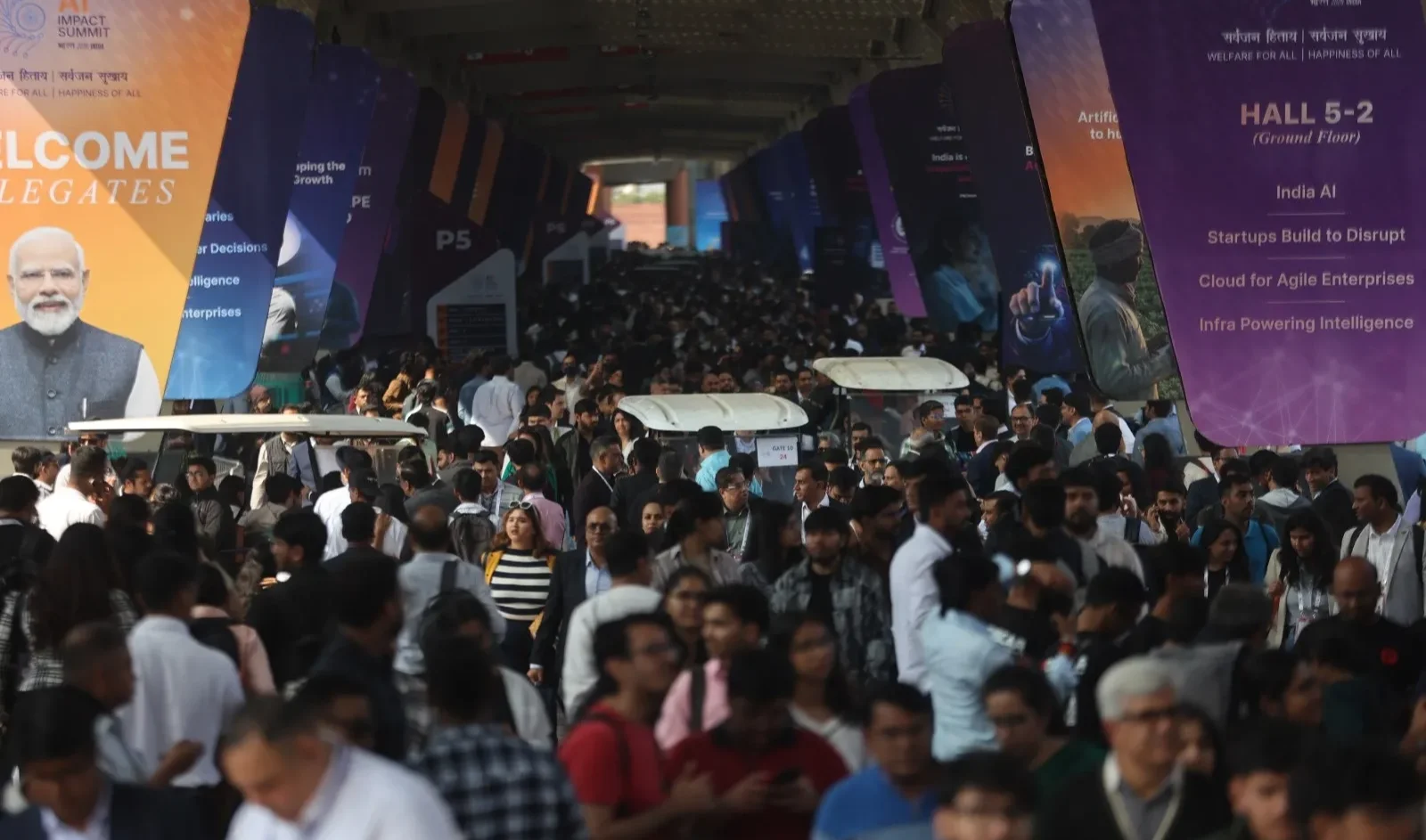
Thousands descended at Bharat Mandapam as the much-anticipated five-day-long IndiaAI Impact Summit kick-started today in New Delhi. The Summit is expected to witness participation from over 100 countries, including 15 to 20 heads of government, more than 50 ministers and over 40 CEOs from leading global and Indian companies.
While Day 1 did not feature major product launches or headline industry announcements, it left Delhi’s roads choked and auditoriums packed to capacity. The intensity is only expected to rise as the expo opens to the public in the coming days.
Prime Minister Narendra Modi, who will officially inaugurate the summit on February 19, welcomed delegates on X: “Bringing the world together to discuss AI! Starting today, India hosts the AI Impact Summit at Bharat Mandapam in Delhi. I warmly welcome world leaders, captains of industry, innovators, policymakers, researchers and tech enthusiasts from across the world for this Summit.”
If there was a dominant theme on the inaugural day was the impact of artificial intelligence on jobs, democracy, and governance.
Jobs, Jobs, No Jobs
Corporate leaders offered sharply differing views on AI and employment.
Microsoft India and South Asia President Puneet Chandok said the future belongs to AI-native enterprises. “The next generation of AI businesses will be built on AI, not just clouds,” he remarked, adding provocatively, “AI will not kill jobs, but will unbundle jobs… If you are not learning AI today, you are not learning anything.”
But Vineet Nayar, Founder-Chairman of Sampark Foundation and former CEO of HCL Technologies, offered a more hard-nosed view. “From an employment point of view… if you believe that [companies] are going to create employment, you must be dreaming,” he said, arguing that profit-driven firms will prioritise efficiency.
Striking a middle ground, Sanjeev Bikhchandani, Founder of Info Edge, recalled the widespread fears that came with the introduction of computers in banks. “Nobody lost their job, and instead productivity went up,” he observed. His advice to young people was pragmatic: “Don’t worry about policy. Just think what should you do so that AI does not make you lose your job and instead help you get a job.” Calling AI “both a threat and an opportunity,” he emphasised upskilling as the way forward.
AI and the State’s Role
S Krishnan, Secretary to the Ministry of Electronics and Information Technology (MeitY), announced that US-based Micron will commence production at its assembly, test, marking and packaging facility at Sanand, Gujarat. Micron is expected to eventually produce High Bandwidth memory, critical to AI systems.
Later, Ashwini Vaishnaw, Minister of Electronics and Information Technology, announced plans to launch a ‘Create in India Mission’. “Like the semiconductor mission, the Create in India mission will also be industry-oriented, employment-oriented, and future-oriented. It will look at strengthening what we already have and help in making us become the most preferred platform for the world for creating,” he said in a fireside chat organised by FICCI.
Meanwhile, India’s Principal Scientific Adviser Ajay Kumar Sood described AI as a “double-edged sword,” arguing that policymakers must “sharpen the edge of opportunity while blunting the edge of risk.” He raised concerns about children’s growing exposure to AI-driven platforms, saying, “We still do not fully know the long-term effects of growing up with AI companions, personalised learning apps, algorithm-driven feeds and synthetic media.”
Union Minister of State for Electronics and Information Technology Jitin Prasada struck a similar note of caution, especially when it comes to misinformation and deepfakes. “If you don’t get into digital literacy, then you have the vulnerability of falling to cyber threats. Cyber security is such a big issue, and AI deepfakes, misinformation,” he said, warning that in a democracy like India, where elections are frequent, AI-driven misinformation “has the power to derail democracies.”
“You could have voted on false information,” he added, underscoring the governance challenge.
Vaishnaw also said that India is in talks with ministers of more than 30 countries on technical and legal solutions for deepfakes.
International Focus
AI’s applications in disaster management also came into focus. United Nations Office for Disaster Risk Reduction official Sujit Mohanty highlighted India’s work in predictive analytics, noting that AI solutions are enabling disaster risk analysis in ways “not possible earlier,” while also stressing the need for legal frameworks to ensure accountability in decision-making.
International participation has reinforced the summit’s global ambitions. The United Kingdom delegation, led by Deputy Prime Minister David Lammy and AI Minister Kanishka Narayan, signalled a focus on growth and safeguards. “This summit is an important moment… to unlock the full benefits and potential of AI, while baking in robust and fair safety standards that protect us all,” Lammy said ahead of the event.
The summit is expected to witness participation from over 100 countries, including 15 to 20 heads of government, more than 50 ministers, and over 40 CEOs from leading global and Indian companies over the next four days.
The 2026 edition builds on previous AI gatherings in Paris, Seoul and Bletchley Park, but with a sharper emphasis on measurable impact. If Day 1 is any indication, the coming days will see not just technological showcases, but hard debates about jobs, democracy and the future social contract in an AI-driven world.

Your reaction
Discussion
What's your take on this story?
No comments yet — be the first to share your view.